Mannerheim's gazelle beetle
Nebria mannerheimii, commonly known as Mannerheim's gazelle beetle, is a ground beetle species in the family Carabidae. It occurs in the Pacific Northwest and Alaska, where it inhabits riparian environments along streams and rivers. Adults are nocturnal predators.
Metallic gazelle beetle
Nebria metallica is a ground beetle species in the subfamily Nebriinae, first described by Gotthelf Fischer von Waldheim in 1822. It is known by the common name Metallic gazelle beetle. The species has a predatory lifestyle, with both larvae and adults functioning as predators. It occupies a range extending from the Aleutian Islands through Alaska and western Canada to the northwestern contiguous United States.
oval gazelle beetle
Nebria ovipennis is a ground beetle endemic to California and Nevada, where it inhabits meadows and snowfield margins in upland and mountainous areas. Adults are brachypterous (short-winged), nocturnal, and carnivorous. The species belongs to the subfamily Nebriinae, a group often associated with cool, moist habitats at higher elevations.
Nebrioporus rotundatus is a species of diving beetle in the family Dytiscidae, occurring in North America. It belongs to a genus of small predaceous diving beetles commonly found in freshwater habitats. The species was described by LeConte in 1863 and is currently accepted as valid.
American Carrion Beetle
Necrophila americana is a North American carrion beetle in the family Silphidae. Adults and larvae feed on decomposing animal flesh and also prey on fly larvae that compete for the same resources. Unlike burying beetles in the genus Nicrophorus, this species does not bury carcasses. Adults have been observed at sap flows on oak trees and in fermenting bait traps. The species has been documented in forensic entomology contexts due to its predictable association with decomposing remains.
Nectoporus is a genus of diving beetles (family Dytiscidae) established by Guignot in 1950. It belongs to the subfamily Hydroporinae, a diverse group of small to medium-sized predatory aquatic beetles. Members of this genus are found in freshwater habitats, primarily in the Southern Hemisphere based on available distribution records. As with other dytiscids, they are aquatic predators with adaptations for underwater life including modified hind legs for swimming.
Neobidessus pullus is a small predaceous diving beetle in the family Dytiscidae. The species occurs across North America and extends into the Neotropics. Two subspecies are recognized: the nominate N. p. pullus and N. p. floridanus described from Florida. As a member of the tribe Bidessini, it inhabits aquatic environments where it functions as an active predator.
Neoclypeodytes amybethae is a species of predaceous diving beetle in the family Dytiscidae, described by K. B. Miller in 2001 as part of a comprehensive revision of the New World genus Neoclypeodytes. The genus contains 25 valid species distributed in western North America and northern Central America. Species in this genus are characterized by a distinctive pattern of two maculae on each elytron, which represents a possible synapomorphy supporting the monophyly of Neoclypeodytes.
Neoclypeodytes cinctellus is a small predaceous diving beetle in the family Dytiscidae. It is distributed across western North America and northern Central America. The species has been documented as a predator of the critically endangered Devils Hole pupfish (*Cyprinodon diabolis*), representing a notable conservation concern. It was formerly described under the name *N. centralis* before being synonymized.
V-marked Lady Beetle
Neoharmonia venusta venusta is a subspecies of lady beetle in the family Coccinellidae. The nominate subspecies is characterized by distinctive coloration including a metallic blue elytra with an orange or reddish pronotum, creating a striking V-shaped or contrasting pattern. It occurs in North America, with records spanning multiple regions. Like other lady beetles, it is a predator of soft-bodied insects. The species has been documented through citizen science platforms and appears to be encountered regularly enough to have accumulated several hundred observations.
Bentbristles
Neoitamus is a genus of robber flies (family Asilidae) comprising at least 60 described species. The genus has a worldwide distribution with notable presence in Europe, Asia, and North America. Species within this genus are predatory insects that hunt other insects. The common awl robberfly, Neoitamus cyanurus, has been subject to genome sequencing, revealing a 365.5 Mb chromosome-level assembly.
Yellow-thighed Bentbristle
Neoitamus flavofemoratus is a species of robber fly in the family Asilidae. The common name "Yellow-thighed Bentbristle" refers to the distinctive yellow coloration on the femora. As with other robber flies, it is a predatory species. It has been documented in over 1,100 observations on iNaturalist.
Neomochtherus is a large genus of robber flies (family Asilidae) comprising at least 140 described species. These predatory insects are associated with grassland habitats, where they play a role in suppressing other invertebrate populations. The genus includes species of conservation concern, such as the Critically Endangered Neomochtherus pallipes (Devon Red-legged Robberfly).
intertidal red velvet mite
Neomolgus littoralis is a species of snout mite in the family Bdellidae, commonly known as the intertidal red velvet mite. It inhabits shoreline environments across North America, Europe, and Japan. The species reaches approximately 2 mm in length and is characterized by its red coloration, ridged abdomen, and elongated snout. It is known to prey on small insects including kelp flies.
pygmy backswimmers
Neoplea is a genus of minute aquatic predatory true bugs in the family Pleidae, commonly known as pygmy backswimmers. The genus contains at least 25 described species distributed across North and South America, with numerous undescribed species. Members are small-bodied (approximately 1.5 mm), active predators in lentic freshwater habitats. The best-studied species, Neoplea striola, has been investigated for its potential role in trophic cascades in fishless subtropical ponds.
Neoporus vitiosus is a small predaceous diving beetle in the family Dytiscidae, subfamily Hydroporinae. The species was described by LeConte in 1855 and is documented from North America, with specific records from Ontario and Québec in Canada. As a member of the Hydroporinae, it likely inhabits freshwater environments, though detailed ecological studies are limited.
Western Spotted Orbweaver, Zig-zag Spider
Neoscona oaxacensis is a large orb-weaving spider distributed across the Americas from the United States to South America, including the Galápagos Islands. Females reach 9–18 mm in body length, males 6–13 mm. The species exhibits highly variable dorsal abdominal patterning, with a distinctive black-and-white pattern that aids identification. It constructs spiral orb webs to capture flying insects and is active primarily from late spring through autumn. The species was first described from Oaxaca, Mexico in 1863.
ornate lady beetle
Nephus ornatus is a small lady beetle species in the family Coccinellidae, commonly known as the ornate lady beetle. It is classified among the dusky lady beetles, a group characterized by generally subdued coloration compared to the brightly patterned lady beetles more familiar to the public. The species was described by John Lawrence LeConte in 1850 and is known to occur across North America.
net-winged insects, lacewings, antlions, mantidflies, owlflies
Neuroptera is an order of holometabolous insects comprising approximately 6,000 species, commonly known as net-winged insects or lacewings and their allies. The group includes lacewings (Chrysopidae, Hemerobiidae), antlions (Myrmeleontidae), mantidflies (Mantispidae), owlflies (Ascalaphidae), and several other families. Adults possess four membranous wings of similar size with dense, net-like venation that gives the order its name. The group first appeared in the Permian period and diversified through the Mesozoic, with some extinct lineages evolving remarkably large, patterned wings. Neuroptera is grouped with Megaloptera and Raphidioptera in the clade Neuropterida.
Serrate Dark Fishfly, Saw-combed Fishfly, Hellgrammite
Nigronia serricornis is a large aquatic insect in the family Corydalidae, commonly known as the serrate dark fishfly or saw-combed fishfly. The aquatic larvae, often called hellgrammites, are sit-and-wait ambush predators and frequently the largest insect predators in small woodland streams. Adults are short-lived, weak fliers that do not disperse far from their emergence sites. The species has a broad distribution across eastern North America with documented genetic structure shaped by the Appalachian Mountains.
San Francisco lacewing
Nothochrysa californica, commonly known as the San Francisco lacewing, is a species of green lacewing in the family Chrysopidae. It is native to North America and was first described by Nathan Banks in 1892. The species is part of a genus of large lacewings distinguished from typical green lacewings (Chrysoperla) by morphological features.
spotted big-eyed beetle, Common springtail stalker
Notiophilus biguttatus is a predatory ground beetle in the family Carabidae, native to the Palearctic and introduced to North America. It is a specialized predator of springtails (Collembola), particularly Orchesella cincta, and exhibits distinctive mass aerial migration behavior during July in some populations. The species has been extensively studied for its density-dependent predation, food-limited growth, and reproductive costs including accelerated ageing.
backswimmers, common backswimmer, Milky Backswimmers
Notonecta is a genus of aquatic predatory insects commonly known as backswimmers, comprising approximately 70 species. They are distinguished by their habit of swimming upside down, using long hind legs modified as oars. The genus exhibits distinct morphological and behavioral traits that separate it from superficially similar water boatmen (family Corixidae), including triangular cross-section body shape, bold color patterns, and diurnal activity patterns. Notonecta species occupy diverse freshwater habitats and function as active predators of small aquatic organisms.
backswimmer
Notonecta borealis is a species of backswimmer (family Notonectidae) found in North America. As a member of the genus Notonecta, it is an aquatic predatory insect that swims upside down. The species was described by Hussey in 1919. Very little specific biological information has been published for this particular species.
Notonecta hoffmani is an aquatic predatory bug in the family Notonectidae, commonly known as backswimmers. The species has been studied for its functional response to prey availability, showing measurable preferences among alternative prey types. Like other Notonecta species, it swims inverted using its keel-shaped dorsum and modified hind legs. Research indicates its predatory efficiency on mosquito larvae is influenced by the presence of competing prey sources.
backswimmer
Notonecta indica is a predatory aquatic true bug in the family Notonectidae, commonly known as backswimmers. The species has been documented in eastern Jamaica where it preys on mosquito larvae, particularly Aedes aegypti, with consumption rates increasing exponentially through nymphal development. Adults consume approximately 38 mosquito larvae daily under laboratory conditions. The species occurs across a broad geographic range including the Caribbean, Central America, North America, Oceania, and South America. Development from egg to adult takes approximately 36 days under warm conditions, with shorter development times than temperate backswimmer species attributed to higher temperatures and food availability.
backswimmer
Notonecta insulata is a species of backswimmer, an aquatic true bug in the family Notonectidae. It is found in North America, where it inhabits freshwater environments. Like other backswimmers, it swims upside down and is an active predator of small aquatic invertebrates. The species was described by Kirby in 1837.
backswimmer
Notonecta irrorata is a North American backswimmer species first described in 1879. It is a predatory aquatic insect known for its distinctive upside-down swimming posture. Research has demonstrated that its presence in ponds repels oviposition by Culex mosquitoes, and that its colonization patterns show a hump-shaped relationship with habitat isolation.
Backswimmer
Notonecta lunata is a species of backswimmer in the family Notonectidae. It is found in North America, with specific records from Vermont and other parts of the United States. Backswimmers in the genus Notonecta are aquatic insects known for swimming upside down and preying on small aquatic organisms.
Grousewinged Backswimmer
Notonecta undulata, commonly known as the grousewinged backswimmer, is an aquatic true bug (Hemiptera: Notonectidae) found across North America. Adults measure 10–12 mm in length and are distinguished from other backswimmers by their 4-segmented antennae and wing pattern featuring a large black spot on the wing membrane median line. The species inhabits small ponds and lakes with slow-moving water, swimming upside down beneath the water surface to capture prey. It is a generalist predator with documented preference for mosquito larvae, and has been studied as a potential biological control agent.
Notonecta unifasciata andersoni is a subspecies of backswimmer (family Notonectidae) described by Hungerford in 1933. It belongs to the genus Notonecta, a group of aquatic true bugs known for their upside-down swimming posture. The subspecies is part of the widespread N. unifasciata species complex, which occurs across the Americas. As with other notonectids, it is presumed to be an aquatic predator, though specific biological details for this subspecies remain poorly documented in available literature.
Devil's Coach-horse Beetle, Devil's Coach-horse, Devil's Footman, Devil's Steed
Ocypus olens, commonly known as the Devil's Coach-horse Beetle, is a large rove beetle in the family Staphylinidae. Originally described as Staphylinus olens in 1764, this species has a long history of association with folklore and superstition across Europe, particularly in Ireland where it was known as 'Dar Daol' (the Devil's beetle). The beetle is a formidable predator with an intimidating defensive posture—raising its curled abdomen like a scorpion when threatened. In North America, it has been introduced to California where field studies suggest it may serve as a biological control agent for the brown garden snail (Helix aspersa), an agricultural pest.
two-spined trapjaw ant
Odontomachus haematodus is a large, aggressive species of trap-jaw ant native to South America that has established introduced populations across the southeastern United States, particularly along the Gulf Coast. The species is notable for its powerful, spring-loaded mandibles capable of rapid snapping movements used in prey capture and defense. Workers are active both diurnally and nocturnally, foraging in and around rotting wood and occasionally nesting within plants such as Aechmea aquilega. Research has documented this species as a predator of Thoropa taophora tadpoles and has identified unique queen pheromones involving dialkyltetrahydrofurans, compounds previously unknown in eusocial insects.
A coastal fly in the family Dryomyzidae, Oedoparena glauca is notable as the only known dipteran predator of barnacles. Its life cycle is tightly linked to intertidal barnacle beds, with larvae developing inside and consuming multiple barnacle hosts before pupating in empty shells. Adults emerge during morning low tides, reflecting precise behavioral adaptation to tidal cycles.
Three-toothed harvestman
Oligolophus tridens is a harvestman (Opiliones) in the family Phalangiidae, native to central and western Europe. It has been introduced to North America. Adults mature in summer. The species is predatory and has been documented dispersing seeds of Melampyrum.
Oligota is a genus of small rove beetles in the family Staphylinidae. Multiple species have been documented as predators of mites, particularly spider mites (Tetranychus urticae), and are studied for their potential use in biological control. The genus has a cosmopolitan distribution with species recorded across North America, Europe, and Asia. Individual species show specialized predatory behaviors and habitat associations ranging from decaying organic matter to agricultural crop environments.
Lady beetle
Olla is a genus of lady beetles (Coccinellidae) in the subfamily Coccinellinae. Members of this genus are predatory beetles known for their role in biological control of pest insects. The genus includes species such as Olla v-nigrum, commonly known as the ash-gray lady beetle.
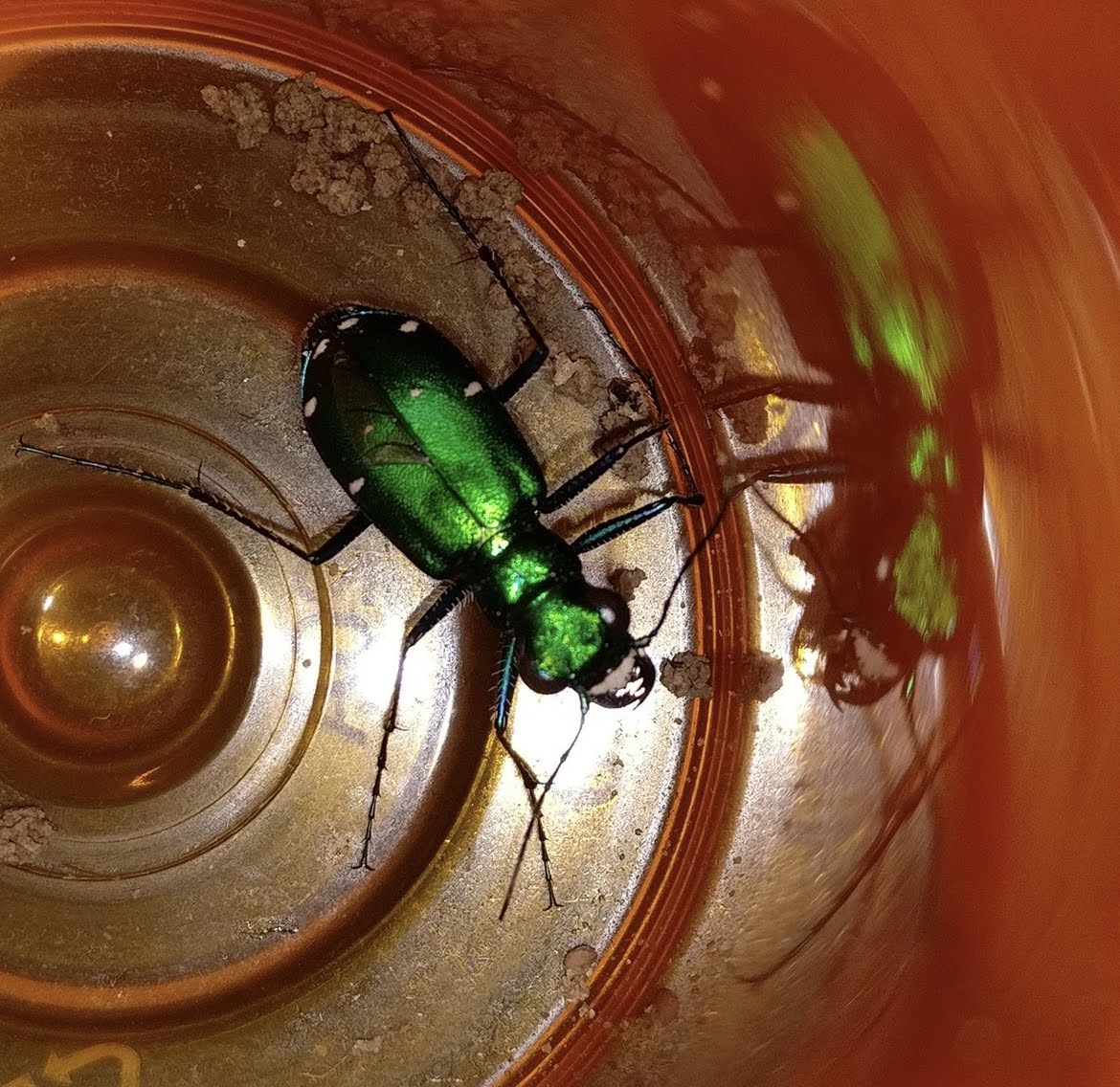
California Night-stalking Tiger Beetle
Omus californicus californicus is the nominate subspecies of the California night-stalking tiger beetle, a flightless, nocturnal carabid beetle endemic to California. Adults are active primarily in spring and early summer, with larvae occupying permanent burrows in soil. The species exhibits strong habitat fidelity to specific substrates and moisture conditions. Unlike diurnal tiger beetles in the genus Cicindela, Omus species are crepuscular to nocturnal hunters that do not rely on vision for prey capture.
Subcylindrical Night-stalking Tiger Beetle
Omus californicus subcylindricus is a subspecies of night-stalking tiger beetle in the family Carabidae. It is one of several subspecies within the Omus californicus complex, which exhibits considerable morphological and geographic variation across its range in western North America. The subspecies was described by Nunenmacher in 1940 and is distinguished by its subcylindrical body form compared to other members of the complex.
Oncerotrachelus pallidus is a species of assassin bug in the family Reduviidae, first described by Barber in 1922. It belongs to the subfamily Saicinae, a group of thread-legged assassin bugs characterized by their slender, elongated bodies and raptorial forelegs adapted for predation. The species is known from North America, though specific details regarding its biology, ecology, and distribution within this range remain poorly documented in available literature.
clown beetles
Onthophilus is a genus of clown beetles (family Histeridae) containing over 40 described species. The genus has a fossil record extending back approximately 100 million years, with specimens preserved in Burmese amber. A Cretaceous relative, Cretonthophilus tuberculatus, provides exceptional insight into early histerid morphology and potential ecological associations.
Operclipygus is a genus of hister beetles (family Histeridae) containing approximately 177 described species. The genus name refers to the clamshell-like appearance of the pygidium (rear end). A 2013 systematic revision by Caterino and Tishechkin described 138 new species from Central and South America, increasing the genus size more than sixfold. These beetles are small, round, and predominantly black, with ecological importance as predators of insect larvae.
mite harvestmen, opilioacarid mites
Opilioacaroidea is a small superfamily of arachnids comprising the single family Opilioacaridae, with approximately 25 described species. These organisms represent a phylogenetically significant group, often considered the most primitive living mites due to their retention of ancestral chelicerate characteristics. They occupy an intermediate position between mites and harvestmen (Opiliones), exhibiting morphological features of both groups. Their restricted distribution and specialized habitat requirements make them among the least studied arachnids.
meadow katydid
Orchelimum is a genus of meadow katydids in the family Tettigoniidae, comprising 21 described species. These insects are characterized by their exceptionally long, thread-like antennae and are among the most abundant orthopterans in eastern North America and adjacent Canada. Males produce species-specific songs through stridulation, rubbing a file on one forewing against a scraper on the other. Many species exhibit opportunistic predation on other insects, particularly when plant food sources are limited or when seeking additional protein.
Red-headed Meadow Katydid
Orchelimum erythrocephalum is a North American katydid species in the meadow katydid genus Orchelimum. The common name refers to its distinctive red head coloration. Like other Orchelimum species, it inhabits grasslands and wetland edges where it feeds on both plant material and small insects. The species was described by entomologist William T. Davis in 1905.
superb meadow katydid
Orchelimum superbum, the superb meadow katydid, is a species of meadow katydid in the family Tettigoniidae. It is native to North America, with confirmed records from Florida, Georgia, Louisiana, Maryland, Mississippi, and Oklahoma. As a member of the genus Orchelimum, it shares characteristics with other meadow katydids, including long antennae and association with grassy or marshy habitats. The species was described by Rehn and Hebard in 1915.
A genus of dwarf spiders (family Linyphiidae) established in 1894, comprising approximately 30 species distributed across cold-temperate and Arctic regions of the Northern Hemisphere. Most species inhabit high-latitude or high-altitude environments. The genus was revised extensively by Saaristo & Marusik in 2004, resulting in numerous new species descriptions.
insidious flower bug, minute pirate bug
Orius insidiosus, commonly known as the insidious flower bug or minute pirate bug, is a predatory true bug widely distributed across the Americas. Adults are approximately 2–3 mm in length, black with distinctive white wing markings. The species is an important biological control agent, mass-reared commercially for management of thrips, aphids, mites, and other agricultural pests in greenhouses and field crops. Both nymphs and adults are predatory, though they also feed on pollen and plant tissues, making them zoophytophagous. Despite their beneficial role, they occasionally bite humans, causing disproportionately painful but harmless irritation.
minute pirate bug, minute flower bug
Orius tristicolor is a minute pirate bug in the family Anthocoridae, known for its role as a generalist predator of small arthropod pests. The species exhibits behavioral plasticity in foraging, adjusting search effort based on leaf damage and prey type. It develops through five nymphal instars before reaching adulthood and has been documented in agricultural systems, particularly in association with thrips and spider mites. The species occurs across a broad geographic range including North, Central, and South America, the Caribbean, and Oceania.
minute pirate bug
Orius vicinus is a predatory minute pirate bug (Hemiptera: Anthocoridae) studied extensively for biological control potential. Under laboratory conditions at 26°C, it completes development from egg to adult in approximately 18–23 days, with females living 15–17 days and producing 31–61 eggs. The species exhibits Type II or Type III functional responses depending on prey stage, with adult prey generally preferred over eggs. It has been observed feeding on spider mites, whiteflies, thrips, and other small arthropods in agricultural settings. Unlike some congeners, O. vicinus does not enter reproductive diapause and continues oviposition through winter conditions.