
Notonecta
Linnaeus, 1758
backswimmers, common backswimmer, Milky Backswimmers
Species Guides
14- Notonecta borealis(backswimmer)
- Notonecta hoffmani
- Notonecta indica(backswimmer)
- Notonecta insulata(backswimmer)
- Notonecta irrorata(backswimmer)
- Notonecta kirbyi(Kirby's Backswimmer)
- Notonecta lobata
- Notonecta lunata(Backswimmer)
- Notonecta montezuma
Notonecta is a of aquatic predatory insects commonly known as backswimmers, comprising approximately 70 . They are distinguished by their habit of swimming upside down, using long hind legs modified as oars. The genus exhibits distinct morphological and behavioral traits that separate it from superficially similar water boatmen ( Corixidae), including triangular cross-section body shape, bold color patterns, and activity patterns. Notonecta species occupy diverse freshwater and function as active of small aquatic organisms.
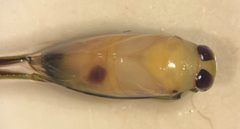
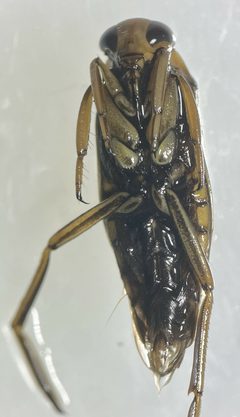
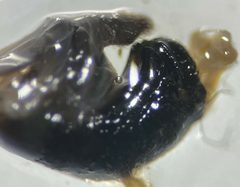
Pronunciation
How to pronounce Notonecta: /ˌnoʊtoʊˈnɛktə/
These audio files are automatically generated. While they are not always 100% accurate, they are a good starting point.
Identification
Distinguished from water boatmen (Corixidae) by: triangular body cross-section versus flattened dorsum; bold contrasting color patterns versus fine transverse black lines on brown; unmodified front legs versus spoon-shaped tarsal segments for scooping detritus; four-segmented free rostrum versus beak to . Backswimmers swim upside down and surface to trap air with abdominal hairs; water boatmen remain right-side up and cruise bottom sediments. Backswimmers are primarily and rarely attracted to lights; water boatmen are frequently attracted to lights at night. Notonecta may be distinguished from each other by depth preferences and geographic distribution.
Images
Habitat
Freshwater aquatic environments including ponds, slow-moving streams, fountains, swimming pools, and other artificial water bodies. partition by depth: some occupy shallow water (<0.3 m) near margins with dense vegetation, while others prefer deeper water (>0.5 m) in habitat centers. Shallow-water species tolerate higher temperatures; deep-water species are intolerant of solar heating in shallow water.
Distribution
distribution with records from North America (including Winnipeg region, Canada; Connecticut; Arizona), South America (Colombia), Europe (Denmark, Norway), and Asia (Turkey, Lake Van). Specific have more restricted ranges; for example, Notonecta viridis occurs in Lake Van, Turkey, and Notonecta undulata and N. insulata co-occur in Connecticut ponds.
Seasonality
Activity patterns vary by latitude. In northern temperate regions (Winnipeg, Canada), distinct seasonal distribution and patterns occur. In Lake Van, Turkey, specimens collected May through October. fly and may disperse seasonally; activity observed in late spring and early summer in some regions.
Diet
Life Cycle
Hemimetabolous development with , nymph, and stages. Nymphs develop through multiple instars (at least five instars documented). In northern temperate regions, seasonal patterns are synchronized with climate. stage not explicitly documented in available sources. time varies; some show distinct breeding seasons with recruitment establishing spatial patterns that persist through the breeding season.
Behavior
Swims upside down using oar-like hind legs in rapid, agile locomotion. Surfaces periodically to capture air using hydrophobic abdominal hairs. Active hunter in open water, pursuing mobile prey. activity pattern; fly well but rarely attracted to artificial lights at night. Exhibits mutual with conspecifics and other Notonecta , though interspecific predation may be limited. Some species show spatial segregation by depth, established during recruitment and maintained through breeding season.
Ecological Role
in freshwater planktonic and littoral . Exerts strong selection pressure driving evolution of inducible defenses in prey , including altered swimming , body elongation, and crest development in Daphnia. Bioindicator for characterization; Notonecta viridis serves as biological indicator of Yolçatı habitat in Lake Van. Contributes to regulation of mosquito populations through larval .
Human Relevance
Occasionally encountered in swimming pools and artificial water features, where they may deliver painful bites if handled. Bites described as comparable to stings in intensity. Beneficial for of mosquito larvae. Subject of ecological research on -prey dynamics, resource partitioning, and inducible defenses. Sometimes confused with water boatmen by casual observers.
Similar Taxa
- Corixidae (water boatmen)Superficially similar oval body shape and aquatic , but distinguished by flattened dorsum, spoon-shaped front for detritus feeding, rostrum, bottom-cruising , light attraction, and lack of painful bite.
Misconceptions
Water boatmen are frequently misidentified as backswimmers and vice versa, though they belong to different with distinct ecologies. Some reports attributing bites to water boatmen likely involve backswimmers, as water boatmen lack the mouthparts to pierce human skin. The 'water boatman' is sometimes erroneously applied to backswimmers.
More Details
Color polymorphism
Some Notonecta exhibit melanism; Notonecta shooterii shows both pale (leucochroic) and dark (melanchroic) forms, with dark forms showing female-biased sex ratios in some .
Depth partitioning
Coexisting Notonecta may partition by water depth through physiological differences rather than competitive exclusion; shallow-water species tolerate higher temperatures while deep-water species avoid solar-heated shallows.
Prey defenses
Notonecta triggers inducible morphological and behavioral defenses in Daphnia longicephala, including altered swimming velocity, increased body length, extended crest, and elongated tail spine—demonstrating strong selection pressure on prey .
Sources and further reading
- BugGuide
- Wikipedia
- GBIF taxonomy match
- iNaturalist taxon
- NCBI Taxonomy
- Catalogue of Life
- Bug Eric: Backswimmer or Water Boatman?
- Bug Eric: June 2014
- Seasonal Distribution and Life History of Notonecta Undulata in the Winnipeg Region, Canada
- Van Gölü Kıyı Habitatlarında Notonecta viridis Delcourt, 1909 (Hemiptera: Notonectidae) ve Bazı Chironomidae (Diptera) Türlerinin Biyolojik Gösterge Değerleri The Biological indicator values of Notonecta viridis Delcourt, 1909 (Hemiptera: Notonectidae) and Some Chironomidae (Diptera) Species in the Van Lake Shore Habitats
- Long-term analysis and effectiveness of inducible behavioural and morphological traits of Daphnia longicephala in response to Notonecta
- Population turnover and habitat dynamics in Notonecta (Hemiptera: Notonectidae) metapopulations
- MELANCHROISM IN NOTONECTA BOREALIS BUENO AND HUSSEY (HEMIP.)
- Within‐Habitat Spatial Separation of Two Notonecta Species: Interactive vs. Noninteractive Resource Partitioning