
Oligota
Mannerheim, 1830
Species Guides
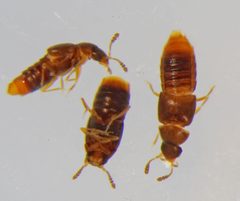
2Oligota is a of small rove beetles in the Staphylinidae. Multiple have been documented as of mites, particularly spider mites (Tetranychus urticae), and are studied for their potential use in . The genus has a distribution with species recorded across North America, Europe, and Asia. Individual species show specialized predatory and associations ranging from decaying organic matter to agricultural crop environments.
Pronunciation
How to pronounce Oligota: //ˌɒlɪˈɡoʊtə//
These audio files are automatically generated. While they are not always 100% accurate, they are a good starting point.
Identification
Oligota are small rove beetles in the tribe Hypocyphtini. Specific diagnostic features for the are not documented in available sources. Identification to species level requires examination of morphological characters not described here.
Images
Habitat
vary by . Some species inhabit decaying organic matter and fungal substrates, including rotting fungi and moist decomposing material. Others occur in agricultural settings on crop foliage, particularly where spider mite prey is abundant. Greenhouse environments have been documented for some .
Distribution
distribution. documented from North America (O. minuta, O. oviformis), Europe including Belarus and Slovenia (O. oviformis, O. inexspectata, O. pseudoparva, O. ruficornis), and Asia (O. kashmirica benefica in Japan, O. flavicornis). GBIF records include Denmark, Norway, and Sweden.
Diet
Predatory on mites. Multiple feed on the two-spotted spider mite Tetranychus urticae. Prey stage preferences vary with developmental stage; first instar larvae prefer immobile prey stages ( and quiescent stages), while later instars and consume all spider mite life stages.
Host Associations
- Tetranychus urticae - preytwo-spotted spider mite, documented for O. kashmirica benefica, O. oviformis, and O. flavicornis
- Pueraria lobata - kudzu vine, plant of prey mite in laboratory studies of O. kashmirica benefica
Life Cycle
Complete with , larval, pupal, and stages. Three larval instars documented for O. kashmirica benefica; feeding rate increases with larval growth. Development occurs within decaying fungal substrates for some . Adult females exhibit egg-covering in O. kashmirica benefica.
Behavior
Larvae exhibit two foraging : active searching and ambush behavior when targeting mobile prey stages. females of O. kashmirica benefica cover after oviposition, a behavior with adaptive significance for offspring survival. Stage-specific prey preferences change with development.
Ecological Role
in decomposer and agricultural . Contributes to regulation of mite , including pest such as Tetranychus urticae. Potential agent for in greenhouse and field crop systems.
Human Relevance
Studied as agents for spider mite management in agricultural settings. Oligota kashmirica benefica, O. flavicornis, and O. oviformis have been investigated for use in . Susceptibility to such as spirodiclofen has been documented for O. flavicornis, affecting compatibility with chemical control programs.
Similar Taxa
- Feltiella acarisugaBoth are of Tetranychus urticae found in similar agricultural ; Feltiella is a predatory gall midge (Diptera: Cecidomyiidae) distinguished by being a fly rather than a , with larval rather than as the primary stage
- Phytoseiulus persimilisBoth are of Tetranychus urticae used in ; Phytoseiulus is a predatory mite (Acari: Phytoseiidae) distinguished by being an arachnid rather than an insect, with different and characteristics
- Amblyseius swirskiiBoth are of Tetranychus urticae in greenhouse systems; Amblyseius is a predatory mite (Acari: Phytoseiidae) distinguished by being an arachnid with different prey range and environmental tolerances
More Details
Taxonomic Note
The Oligota was described by Mannerheim in 1830 (some sources cite 1831). Eight were documented from Belarus as of 2020, including three new records: O. inexspectata, O. pseudoparva, and O. ruficornis.
Research Focus
Most detailed biological studies focus on O. kashmirica benefica and O. flavicornis due to their potential as agents. Natural history of many remains poorly documented.
Pesticide Interactions
O. flavicornis shows reduced at spirodiclofen concentrations of 60 mg a.i. L−1 and above, with lengthened preadult development, decreased longevity and , and reduced growth parameters. This affects integration with chemical control programs.
Sources and further reading
- BugGuide
- Wikipedia
- GBIF taxonomy match
- iNaturalist taxon
- NCBI Taxonomy
- Catalogue of Life
- Biology of Oligota Oviformis Casey1 (Coleoptera: Staphylinidae)
- Distribution and Prey Records for Oligota minuta (Coleoptera: Staphylinidae), a Predator of Mites
- Prey stage preference and feeding behaviour of Oligota kashmirica benefica (Coleoptera: Staphylinidae), an insect predator of the spider mite Tetranychus urticae (Acari: Tetranychidae)
- CONFIRMATION OF PRESENCE OF A PREDATORY GALL MIDGE, Feltiella acarisuga, (Vallot, 1827) AND STAPHYLINID PREDATOR Oligota oviformis Casey, 1893 OF A TWO SPOTTED SPIDER MITE (Tetranychus urticae, Koch, 1836) IN SLOVENIA
- Rove beetles of Belarus: the genus Oligota Mannerheim, 1830 (Coleoptera: Staphylinidae: Aleocharinae)
- Oviposition Behavior of Oligota kashmirica benefica NAOMI (Coleoptera: Staphylinidae). II. Preference of Oviposition Sites on a Leguminous Arrowroot.
- Oviposition Behavior of Oligota kashmirica benefica NAOMI (Coleoptera: Staphylinidae). I. Adaptive Significance of Egg-Covering Behavior by Adult Females.
- Effects of spirodiclofen on life history traits and population growth of a spider mite predator Oligota flavicornis (Coleoptera: Staphyllinidae) based on the age‐stage two‐sex life table theory