
Notonecta undulata
Say, 1832
Grousewinged Backswimmer
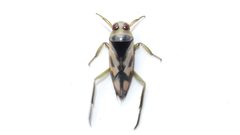
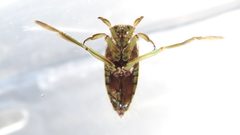
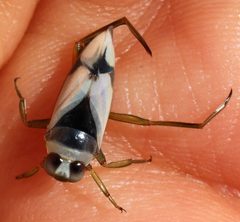
Notonecta undulata, commonly known as the grousewinged , is an aquatic true (Hemiptera: Notonectidae) found across North America. measure 10–12 mm in length and are distinguished from other backswimmers by their 4-segmented and wing pattern featuring a large black spot on the wing line. The inhabits small ponds and lakes with slow-moving water, swimming upside down beneath the water surface to capture prey. It is a with documented preference for mosquito larvae, and has been studied as a potential agent.
Pronunciation
How to pronounce Notonecta undulata: /ˌnoʊtəˈnɛktə ˌʌndjʊˈleɪtə/
These audio files are automatically generated. While they are not always 100% accurate, they are a good starting point.
Identification
Distinguished from water boatmen (Corixidae) by the segmented (4-segmented) beak and unmodified front legs—water boatmen have highly modified, scoop-shaped front legs. Differs from other Notonecta by the 4-segmented and size (10–12 mm). The wing pattern with a large black spot on the line is also characteristic. The Notonectinae (including N. undulata) is distinguished from Anisopinae by 4-segmented beak and antennae and larger size.
Images
Habitat
Primarily inhabits small ponds and lakes with slow-moving water, though capable of occupying lotic environments including small streams and rivers when resources are limited or competition in lentic is high. Prefers habitats with abundant vegetation providing cover and food resources. Temperature ranges from 4 to 32°C; prefers pH 6.0–7.1. Survives high temperatures temporarily through cuticular lipid monolayer that facilitates water uptake and prevents dehydration.
Distribution
Documented in southern Manitoba, Saskatchewan, Alberta, and the western United States. Broader distribution across North America within the Nearctic region. Records include Vermont and other parts of the United States and Canada.
Seasonality
. First females become and reproductively mature in July, producing a second generation. Adults maturing after July enter reproductive ending by late October. All individuals overwinter as adults. deposition begins in early spring; eggs develop through 5 nymphal instars during spring and summer. Preoviposition period lasts 16 days; 5–14 days. Oviposition is continuous in summer.
Diet
of aquatic and terrestrial prey falling on water surfaces. Documented prey includes small crustaceans, corixid nymphs and , nymphs, , and fish . Shows strong preference for mosquito larvae over other invertebrate prey.
Life Cycle
Hemimetabolous development with 5 nymphal instars. are elongate ovals (1.7 mm × 0.6 mm), attached to plants or suspended objects within the water column. Two per year () with in stage. Reproductive occurs in adults maturing after July.
Behavior
Spends most time at water surface, using and legs to cling to underside of surface tension. Swims upside down to search for prey; stops swimming to float back to surface. Capable of to disperse and seek new ; rate increases with pressure. Maximizes habitat conditions by flying to settle in new areas.
Ecological Role
Human Relevance
Suggested as a prudent agent for mosquitoes, including Aedes aegypti, a for and . May be encountered by humans in swimming pools and artificial water bodies. Can deliver painful bites if handled.
Similar Taxa
- Corixidae (water boatmen)Superficially similar aquatic , but distinguished by beak to , scoop-shaped modified front legs, and flattened body profile versus triangular cross-section in backswimmers
- Other Notonecta speciesN. undulata specifically distinguished by 4-segmented , size (10–12 mm), and wing pattern with large black spot on line
More Details
Taxonomic history
First completely described by H. B. Hungerford in 1917 in the Kansas University Science Bulletin. Taxonomic classification has remained stable for over 40 years, though the remains poorly documented with most scientific literature from the 1920s–1970s and few publications after the 1990s.
Physiological adaptations
Possesses cuticular lipid monolayer that allows water uptake and prevents dehydration during temporary exposure to high temperatures (>32°C). Five attachment points ( legs and ) with associated receptors aid in locomotion and prey capture at the water surface film.
Sources and further reading
- BugGuide
- Wikipedia
- GBIF taxonomy match
- iNaturalist taxon
- NCBI Taxonomy
- Bug Eric: Backswimmer or Water Boatman?
- Pensoft Editorial Team | Blog - Part 134
- Uncategorized | Blog - Part 30
- The mini grasshoppers that outlived dinosaurs: the fascinating world of Tetrigidae | Blog
- Mantispidae | Beetles In The Bush
- Scathophagidae | Beetles In The Bush
- Seasonal Distribution and Life History of Notonecta Undulata in the Winnipeg Region, Canada
- Indirect prey effects: Some morphological and life history responses of Daphnia pulex exposed to Notonecta undulata1