
Corixidae
Leach, 1815
Water Boatmen, Lesser Water Boatmen
Subfamily Guides
2- Corixinae(water boatman)
- Cymatiainae
is a of aquatic true bugs in the order Hemiptera, commonly known as water boatmen or lesser water boatmen. The family comprises approximately 500 across 33-55 distributed worldwide in freshwater , with a few species inhabiting saline waters. Members are distinguished from similar aquatic by their right-side-up swimming posture, flattened body shape, and modified front legs adapted for feeding. The family exhibits diverse feeding strategies including herbivory, carnivory, detritivory, and omnivory.
Pronunciation
How to pronounce Corixidae: //kɒˈrɪksɪˌdiː//
These audio files are automatically generated. While they are not always 100% accurate, they are a good starting point.
Identification
can be distinguished from the similar-appearing backswimmers (Notonectidae) by several key characters: water boatmen swim right-side-up rather than upside-down; body is flattened top-to-bottom rather than triangular in cross-section with a keel-like dorsum; front legs have modified spoon-shaped for scooping food versus unmodified short legs in backswimmers; rostrum is to the versus four-segmented and free in backswimmers; pattern consists of fine transverse dark lines rather than bold contrasting patches. Water boatmen are generally smaller than most backswimmers. At night, water boatmen are frequently attracted to lights, whereas backswimmers are primarily and rarely attracted to lights.
Images
Appearance
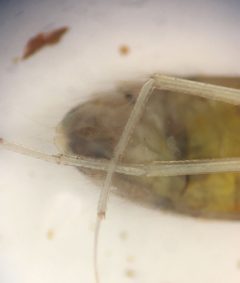
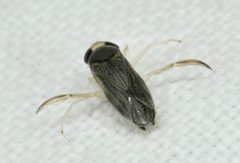
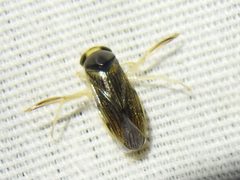
Body elongated and flattened, ranging from 2.5 to 15 mm in length. surface typically brown with fine transverse dark striations on the wings, creating a slightly corrugated appearance. triangular with short, triangular mouthparts; rostrum to head. Forelegs short with spoon-shaped or scoop-like tarsal segments covered in hairs, adapted for gathering food. Four hind legs long with oar-shaped or scoop-shaped for swimming. Overall profile flattened top-to-bottom, not keel-shaped.
Habitat
Freshwater aquatic environments including ponds, slow-moving streams, slow rivers, and lakes. Some occur in saline waters. Typically found in waters with submerged vegetation, leaf litter, and bottom debris where they can forage and oviposit. Occasionally found in artificial environments such as household pools, though less frequently than backswimmers in clean pool conditions.
Distribution
Worldwide distribution in virtually all freshwater . Circumpolar include Callicorixa producta with across Scandinavia, northern Manchuria, Sakhalin Island, Siberia, Alaska, Northwest Territories, and Hudson Bay. Documented from North America, South America (Belize, Peru), Europe, Asia (Turkey, South Korea, Japan), and other regions.
Seasonality
reproductive cycle with active during warmer months. In temperate regions, active primarily spring through fall; in warmer climates, may be active year-round. activity and observed in spring and summer. Attracted to lights at night during active periods.
Diet
Highly variable across and . Some species are herbivorous or algivorous, feeding on aquatic plants and using -injecting mouthparts to liquify plant material. Others are , predatory, or . Subfamily Cymatiainae is entirely predatory. Many species are detritivorous, feeding on organic matter and microorganisms stirred up from bottom sediments.
Life Cycle
Hemimetabolous development (no pupal stage). oviposited on submerged plants, sticks, or rocks. with stage varying by and latitude. Nymphs resemble in form, differing primarily in size and wing development.
Behavior
Swims right-side-up near bottom of water bodies, stirring up sediments during foraging. Capable of as ; frequently attracted to lights at night. Males of many produce stridulatory sounds using specialized pegs on forelegs rubbed against edges; calls function in reproductive , male-male spacing, and species recognition. Synchronized calling observed when multiple males present. Some species show temperature-dependent variation in call structure.
Ecological Role
Important component of freshwater . Serve as prey for amphibians, fish, and other aquatic . Contribute to nutrient cycling through detritivory and sediment disturbance. Some help control mosquito through on larvae; others may compete with or serve as food for predatory aquatic insects.
Human Relevance
Occasionally considered nuisance organisms in swimming pools, particularly when pools are neglected and accumulate and organic debris. Some may bite if handled, though generally less aggressive than backswimmers. Used as indicator organisms for freshwater quality. Serve as food for game fish and are therefore relevant to fisheries.
Similar Taxa
- Notonectidae (backswimmers)Swim upside-down rather than right-side-up; have triangular cross-section with keel-like dorsum; unmodified front legs; four-segmented free rostrum; bold contrasting color patterns rather than fine striations; primarily and rarely attracted to lights
Misconceptions
Water boatmen are frequently confused with backswimmers (Notonectidae) due to superficial similarity in body shape and aquatic . The 'water boatman' is sometimes incorrectly applied to backswimmers. Some reports of aggressive biting by 'water boatmen' in pools likely refer to backswimmers, as lack the mouthparts for effective human biting.
More Details
Stridulation and acoustic communication
Multiple studies document complex acoustic signaling in . Males produce -specific and sex-specific stridulatory signals using foreleg pegs against edges. These signals function in male-male agonistic interactions for spacing, as calling signals for mate attraction, and in species recognition for premating isolation. Females of some also produce sounds, possibly as response signals to males. Call structure varies with water temperature.
Feeding diversity
The is unusual among aquatic Hemiptera in exhibiting the full range of feeding strategies from herbivory to carnivory. This dietary diversity is partitioned at and generic levels, with Cymatiainae being entirely predatory while other groups include algivores and .
Taxonomic scope
The contains approximately 500 in 33-55 depending on classification system. Major genera include Sigara, Corixa, and Cenocorixa. The group has been subject to extensive taxonomic study due to its ecological importance and acoustic signaling complexity.
Sources and further reading
- BugGuide
- Wikipedia
- GBIF taxonomy match
- iNaturalist taxon
- NCBI Taxonomy
- Catalogue of Life
- Curious About Bats? | Bug Squad
- Bug Eric: Backswimmer or Water Boatman?
- Bug Eric: June 2014
- Two New Creeping Water Bug Species Found in Belize and Peru
- Why bugs matter to me... - Buglife Blog - Buglife
- Contribution to the knowledge on distribution of water boatmen (Heteroptera: Corixidae) in Turkey.
- Postglacial Distributional History of the Water Boatman, Arctocorisa carinata (Heteroptera: Corixidae)
- Laut�u�erungen und Verhalten von Sigara striata und Callicorixa praeusta (Corixidae Leach., Hydrocorisae Latr.) Sound production and phono-behaviour of Sigara striata and Callicorixa praeusta (Corixidae Leach., Hydrocorisae Latr.)
- Circumpolar Distribution of Water Boatmen (Hemiptera: Corixidae)
- Habitat Segregation in a Water Boatman (Corixidae) Assemblage: The Role of Predation
- Distributional Records of North American Corixidae (Hemiptera: Heteroptera)
- Stridulation and Its Significance in the Genus Cenocorixa (Hemiptera, Corixidae)
- First report Xenocorixa vittipennis (Horváth) (Hemiptera, Corixoidea, Corixidae) from South Korea and checklist of the Korean Corixoidea.