
Chlosyne
Butler, 1870
Patches and Allies, checkerspots, patches, crescentspots
Species Guides
21- Chlosyne acastus(Sagebrush Checkerspot)
- Chlosyne californica(California patch)
- Chlosyne cyneas(Black Checkerspot)
- Chlosyne damoetas(Rockslide Checkerspot)
- Chlosyne definita(Definite Patch)
- Chlosyne endeis(Banded Checkerspot)
- Chlosyne eumeda(Eumeda Checkerspot)
- Chlosyne fulvia(Fulvia checkerspot)
- Chlosyne gabbii(Gabb's Checkerspot)
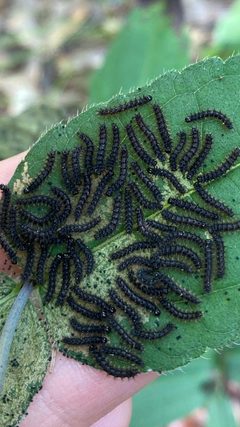
Chlosyne is a of brush-footed butterflies ( Nymphalidae) distributed across North and South America. The genus includes approximately 25-30 commonly known as patches, checkerspots, and crescentspots based on their wing patterns. Species in this genus exhibit diverse ecological strategies, with larvae of many species feeding gregariously in early instars—a trait that has been shown to enhance growth rates and survival in studied species such as C. lacinia and C. janais. typically display orange, black, and white checkered wing patterns that vary considerably among species and geographic regions.
Pronunciation
How to pronounce Chlosyne: //kloʊˈsaɪniː//
These audio files are automatically generated. While they are not always 100% accurate, they are a good starting point.
Identification
Chlosyne are distinguished from similar Nymphalidae by their checkered orange-black-white wing patterns and reduced forelegs. Within the genus, species identification relies on specific wing pattern elements: the presence and arrangement of submarginal spots on the hindwing, the extent and shape of dark marginal bands, and the configuration of pale markings on the forewing. C. lacinia (bordered patch) has broad dark borders with irregular pale spots; C. harrisii (Harris's checkerspot) resembles Euphydryas phaeton but lacks the distinct forewing pattern of that species; C. janais (crimson patch) shows prominent crimson patches on the hindwing. Genitalia examination may be required for definitive identification of similar species.
Images
Habitat
Diverse including open woodlands, meadows, prairies, riparian corridors, and desert scrub. Many are associated with early successional habitats or disturbed areas where plants (primarily Asteraceae) are abundant. Some species occupy specialized habitats: C. acastus in sagebrush steppe, C. harrisii in wet meadows, C. lacinia in agricultural and habitats where sunflowers occur.
Distribution
Widespread across North America from southern Canada through the United States and Mexico, extending into Central and South America. is highest in the southwestern United States and Mexico. Individual ranges vary: C. lacinia occurs from the southwestern U.S. through Mexico and Central America to South America; C. harrisii is restricted to the northeastern United States and adjacent Canada; C. californica is to California and Baja California.
Seasonality
periods vary by and latitude. Most North American species are multivoltine with peak activity in late spring through summer (May-August). Some southern species fly nearly year-round in favorable climates. occurs primarily as pupae or adults, depending on species.
Diet
Larvae feed on plants in the Asteraceae (sunflower family), with documented including Helianthus (sunflowers), Bidens, Ambrosia, Tithonia, and related . Some are within this family. feed on nectar from diverse flowering plants and may also visit moist soil or for minerals.
Host Associations
- Helianthus annuus - larval Primary for C. lacinia; larvae feed gregariously on leaves
- Tithonia tubaeformis - larval Confirmed for C. lacinia saundersii under laboratory conditions
- Odontonema callistachyum - larval for C. janais larvae in neotropical
- Bidens - larval Documented for multiple Chlosyne
- Ambrosia - larval Ragweeds used as larval by several
Life Cycle
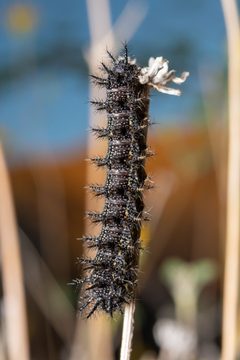
Complete with four stages: , larva, pupa, . Females deposit eggs in clusters on plant foliage. Larvae pass through five to six instars, with early instars typically feeding gregariously in sibling groups. Gregarious feeding facilitates growth by enabling larvae to overcome physical toughness of host leaves. Later instars may disperse and feed solitarily. occurs on or near host plants; pupal coloration varies with substrate (). Development time from egg to adult approximately 30-50 days under favorable conditions, varying with temperature and host plant quality.
Behavior
Larvae exhibit pronounced gregariousness in early instars, forming dense that enhance feeding and may provide some protection from . of many engage in , with males perching on elevated terrain to intercept females. C. californica males exhibit alternative mate-locating tactics: territorial perching on hilltops versus non-territorial patrolling of slopes, with individuals capable of switching between tactics based on and environmental conditions. Females of C. lacinia exhibit drumming behavior with foretarsi and antennal dipping prior to oviposition, using contact to verify plant suitability.
Ecological Role
Larvae function as herbivores on Asteraceae, occasionally reaching pest status on sunflower crops (C. lacinia saundersii). serve as of diverse flowering plants. Larval may influence plant chemistry through induced responses. Some participate in mimicry complexes: C. harrisii is a documented Batesian mimic of the unpalatable Euphydryas phaeton, with which it shares and period.
Human Relevance
C. lacinia saundersii is considered an agricultural pest on sunflowers in some regions, with larvae capable of causing significant defoliation. The is popular among watchers and photographers due to accessible and distinctive wing patterns. Some serve as study organisms for research on larval , chemical , and behavioral plasticity in mate location.
Similar Taxa
- EuphydryasSimilar checkerspot wing patterns and shared in some regions; distinguished by different wing venation and larval plant associations (often Scrophulariaceae or Valerianaceae versus Asteraceae for Chlosyne)
- PhyciodesSimilar size and crescent-spot wing patterns; distinguished by more rounded wing margins and different pattern details, particularly the arrangement of pale spots on the hindwing
- PoladryasSimilar checkered appearance; distinguished by larger size and different wing shape
- TexolaSmall checkerspots with similar preferences; distinguished by more restricted distribution and specific wing pattern elements
More Details
Research significance
Chlosyne , particularly C. lacinia and C. janais, have served as important model organisms for studying the evolutionary of larval . Research has demonstrated that gregarious feeding enhances larval growth rates through improved ability to initiate feeding on tough leaves, rather than through social stimulation or defense against . This finding has contributed to broader understanding of the adaptive significance of group living in herbivorous insects.
Taxonomic history
The has undergone periodic revision, with groups recognized based on morphological and molecular data. Currently recognized species groups include the group, Charidryas group, harrisii group, and Thessalia group, though boundaries remain under investigation.
Sensory ecology
C. lacinia has been extensively studied for its use of multimodal sensory cues in plant selection. Females employ both olfactory (antennal) and (foretarsal) chemoreception during preoviposition , with foretarsal contact receptors serving as a backup verification system when olfactory cues are unreliable due to environmental conditions such as low temperature or air turbulence.
Sources and further reading
- BugGuide
- Wikipedia
- GBIF taxonomy match
- iNaturalist taxon
- NCBI Taxonomy
- Catalogue of Life
- Bug Eric: Bosque del Apache National Wildlife Refuge
- Bug Eric: January 2016
- 2018 Arizona Insect Collecting Trip “iReport” | Beetles In The Bush
- The consequences of larval aggregation in the butterfly Chlosyne lacinia
- Foodplant ecology of the butterfly Chlosyne lacinia (Geyer) (Nymphalidae) III. Adult resources
- Alternative Mate‐locating Tactics in Chlosyne californica (Lepidoptera, Nymphalidae)
- Foodplant ecology of the butterfly Chlosyne lacinia (Geyer) Nymphalidae; II. Additional larval food plant data
- Life cycle of Chlosyne lacinia saundersii (Lepidoptera: Nymphalidae) on Tithonia tubaeformis (Jacq.) Cass. under controlled laboratory conditions
- The External Morphology of Foretarsal Receptors Involved with Host Discrimination by the Nymphalid Butterfly, Chlosyne lacinia
- Mimicry in North American checkerspot butterflies: Euphydryas phaeton and Chlosyne harrisii (Nymphalidae)
- New Larval Host Plant and Behavior of <i>Chlosyne Gorgone</i> (Lepidoptera: Nymphalidae)
- Development and Survival ofChlosyne acastus sterope(Lepidoptera: Nymphalidae) Larvae on Three Host Plants in South Central Washington
- Aggregation facilitates larval growth in the neotropical nymphalid butterfly Chlosyne janais
- A Comprehensive Natural History Review of Chlosyne lacinia (Geyer, 1837; Lepidoptera: Nymphalidae): Patterns of Phenotypic Variation and Geographic Distribution
- THE ROLE OF SENSORY STRUCTURES AND PREOVIPOSITION BEHAVIOR IN OVIPOSITION BY THE PATCH BUTTERFLY, CHLOSYNE LACINIA
- Identifying the proximal cue(s) for pupal color variation in the bordered patch butterfly, Chlosyne lacinia (Lepidoptera: Nymphalidae)
- The effects of foliar spray application of silicon on plant damage levels and components of larval biology of the pest butterflyChlosyne lacinia saundersii(Nymphalidae)
- Dynamics of Redox Metabolism during Complete Metamorphosis of Insects: Insights from the Sunflower Caterpillar Chlosyne lacinia (Lepidoptera).