
Euphydryas
Scudder, 1872
checkerspot butterflies
Species Guides
7- Euphydryas anicia(Anicia Checkerspot)
- Euphydryas anicia cloudcrofti(Sacramento Mountains checkerspot butterfly)
- Euphydryas chalcedona(Variable Checkerspot)
- Euphydryas chalcedona(Chalcedon checkerspot)
- Euphydryas editha(Edith's Checkerspot)
- Euphydryas gillettii(Gillett's Checkerspot)
- Euphydryas phaeton(Baltimore Checkerspot)
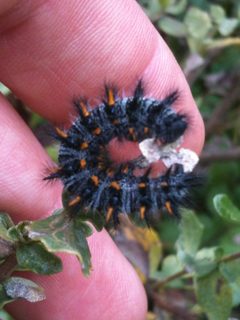
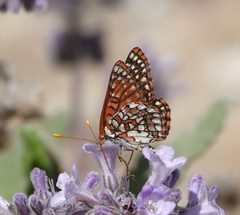
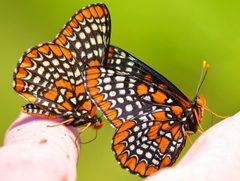
Euphydryas is a of checkerspot in the Nymphalidae. The genus includes that have been extensively studied in and conservation, with some species subject to reintroduction efforts. Several species are declining across their ranges, with climate change identified as a significant factor. Larvae typically feed on specific plants and construct silk webs.
Pronunciation
How to pronounce Euphydryas: /juːˈfaɪdrɪəs/
These audio files are automatically generated. While they are not always 100% accurate, they are a good starting point.
Images
Distribution
Europe, North America, and Asia. Specific distribution varies by : E. aurinia occurs across Europe including the UK; E. editha is found in western North America; E. maturna has been documented in Finland; E. desfontainii and E. aurinia co-occur in Spain; E. phaeton occurs in eastern North America with an Ozark (E. p. ozarkae).
Host Associations
- Melampyrum sylvaticum - pre- plantDocumented for E. maturna in Finland; larvae construct webs on this plant
- Collinsia torreyi - plant used by E. editha at one California site
- Pedicularis semibarbata - plant used by E. editha at adjacent California site
- Fraxinus excelsior - plant (first year)Used by E. maturna; larvae switch to Viburnum opulus in second year
- Viburnum opulus - plant (second year)Used by E. maturna after switching from Fraxinus excelsior
Life Cycle
Larvae of at least some construct silk webs on plants. E. maturna exhibits a two-year development with host plant switching: larvae feed on Fraxinus excelsior in the first year, then switch to Viburnum opulus in the second year. Larvae of E. aurinia have been observed basking in groups. Some species produce multiple per year; E. phaeton in Maryland has two broods annually, with the second brood as caterpillars.
Behavior
Larvae of E. aurinia exhibit basking in groups. E. editha discriminate among plants during oviposition, with some showing prealighting search behavior directed toward dense host patches while others show no significant prealighting discrimination. E. editha bayensis is capable of long-distance (several kilometers) but interhabitat movements appear non-oriented unless within 50 m of suitable .
Ecological Role
Larvae serve as for in Ichneumonidae and Braconidae.
Human Relevance
E. aurinia has been the subject of conservation in the UK since 2005, with reintroduction efforts using donor within the region. E. editha bayensis has been studied extensively for metapopulation dynamics and conservation. Multiple Euphydryas are declining due to climate change and loss, making them subjects of conservation concern and research.
Sources and further reading
- BugGuide
- Wikipedia
- GBIF taxonomy match
- iNaturalist taxon
- NCBI Taxonomy
- Catalogue of Life
- 'Climate Change' May Be a Key Factor in Declining Butterfly Populations | Bug Squad
- A Summit to Save the Butterflies | Bug Squad
- Provisional checklist of European butterfly larval foodplants
- Conservation Translocations: It’s Not Just Beavers - Buglife Blog - Buglife
- Bug Eric: Blodgett Peak Bioblitz Report
- A sunflower surprise: Silvery checkerspot, Chlosyne nycteis — Bug of the Week
- Habitat: Euphydryas editha wrighti
- The parasitoid complex attacking coexisting Spanish populations ofEuphydryas auriniaandEuphydryas desfontainii(Lepidoptera: Nymphalidae, Melitaeini)
- Figure 1 from: Nieminen M (2015) Melampyrum sylvaticum as a pre-diapause host plant of the scarce fritillary (Euphydryas maturna) in Finland. Biodiversity Data Journal 3: e5610. https://doi.org/10.3897/BDJ.3.e5610
- Basking Behaviour in Larvae of the Butterfly Euphydryas Aurinia
- The Population Biology of the Butterfly, Euphydryas editha. IV. Sperm Precedence-A Preliminary Report
- Figure 3 from: Nieminen M (2015) Melampyrum sylvaticum as a pre-diapause host plant of the scarce fritillary (Euphydryas maturna) in Finland. Biodiversity Data Journal 3: e5610. https://doi.org/10.3897/BDJ.3.e5610
- Behavioral Interactions of Parasitoids and Baltimore Checkerspot Caterpillars (Euphydryas phaeton)
- Figure 5 from: Nieminen M (2015) Melampyrum sylvaticum as a pre-diapause host plant of the scarce fritillary (Euphydryas maturna) in Finland. Biodiversity Data Journal 3: e5610. https://doi.org/10.3897/BDJ.3.e5610
- Population Differentiation in Euphydryas editha Butterflies: Larval Adaptation to Different Hosts
- Oviposition host selection in the Ozark Baltimore checkerspot, Euphydryas phaeton ozarkae
- Population Biology of the Butterfly, Euphydryas editha. I. Barriers to Multiple Inseminations
- The Population Biology of the Butterfly, Euphydryas editha. II. The Structure of the Jasper Ridge Colony
- Long‐Distance Dispersal and Colonization in the Bay Checkerspot Butterfly, Euphydryas Editha Bayensis
- Quantification of host preference by manipulation of oviposition behavior in the butterfly Euphydryas editha
- Prealighting Search Behavior and Host Plant Selection by Ovipositing Euphydryas editha Butterflies
- The genome sequence of the Spanish Fritillary, Euphydryas desfontainii (Godart, 1819) (Lepidoptera: Nymphalidae).
- The genome sequence of Cynthia's Fritillary, Euphydryas cynthia (Dennis & Schiffermüller), 1775 (Lepidoptera: Nymphalidae).