
Euphydryas chalcedona
(Doubleday, 1847)
Variable Checkerspot, Chalcedon Checkerspot
Species Guides
7- Euphydryas chalcedona chalcedona(Chalcedon Checkerspot)
- Euphydryas chalcedona colon(Variable Checkerspot (colon subspecies))
- Euphydryas chalcedona hennei(Henne's Chalcedon Checkerspot)
- Euphydryas chalcedona klotsi
- Euphydryas chalcedona macglashanii
- Euphydryas chalcedona svihlae
- Euphydryas chalcedona wallacensis
A checkerspot native to western North America, ranging from Alaska to Baja California and eastward through the Rocky Mountains. display variable coloration with brown or black wings marked by extensive white and yellow checkering and red markings. Wingspan ranges from 3.2 to 5.7 cm. The exhibits -level variation in larval plant specialization, with some populations oligophagous and others more restricted in diet.
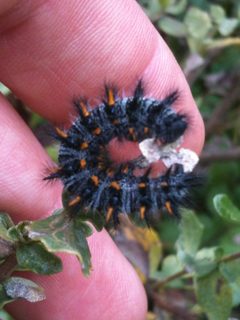
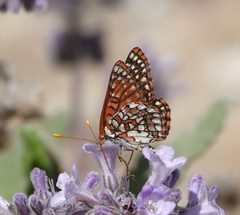
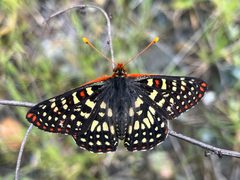
Pronunciation
How to pronounce Euphydryas chalcedona: /juːˈfaɪdriəs kælsəˈdoʊnə/
These audio files are automatically generated. While they are not always 100% accurate, they are a good starting point.
Images
Habitat
Coastal California and areas containing larval plants Diplacus aurantiacus and Scrophularia californica. Scrophularia often occurs in shadier than Diplacus.
Distribution
Western North America from Alaska south to Baja California, extending east through the Rocky Mountains into Colorado, Montana, New Mexico and Wyoming.
Host Associations
- Diplacus aurantiacus - larval plantPrimary in coastal California; nutritionally inferior to Scrophularia but more persistent resource
- Scrophularia californica - larval plantPreferred ; more digestible and nutritious than Diplacus
- Penstemon breviflorus - larval plantUsed by Chico
- Penstemon newberryi - larval plantUsed by Echo Lake ; this population is monophagous on this
Life Cycle
Larvae enter ; seasonal timing of feeding activity and larval development rates closely related to availability of Scrophularia leaves and high-quality Diplacus leaves. Post-diapause larvae may return to diapause instead of completing development under unfavorable conditions.
Behavior
strongly prefer to oviposit on Scrophularia californica but will use Diplacus aurantiacus when Scrophularia is unavailable. Oviposition preferred on sun-exposed . Adult host preference is not related to larval feeding experience. Larvae show strong feeding preference for Scrophularia regardless of previous food or maternal-host type, though larvae reared on Diplacus eat more Diplacus than those reared on Scrophularia. Larvae preferentially feed on Diplacus leaves with the highest nitrogen:resin ratio.
Sources and further reading
- BugGuide
- GBIF taxonomy match
- iNaturalist taxon
- NCBI Taxonomy
- 'Climate Change' May Be a Key Factor in Declining Butterfly Populations | Bug Squad
- Provisional checklist of European butterfly larval foodplants
- Conservation Translocations: It’s Not Just Beavers - Buglife Blog - Buglife
- The coevolution of Euphydryas chalcedona butterflies and their larval host plants
- The coevolution of Euphydryas chalcedona butterflies and their larval host plants
- The coevolution of Euphydryas chalcedona butterflies and their larval host plants
- Population biology of the checkerspot butterfly, Euphydryas chalcedona structure of the Jasper Ridge colony
- Nectar source distribution as a determinant of oviposition host species in Euphydryas chalcedona
- Population differences in larval hostplant use in the checkerspot butterfly, Euphydryas chalcedona
- Nectar Sources as Constraints on the Distribution of Egg Masses by the Checkerspot Butterfly, Euphydryas chalcedona (Lepidoptera: Nymphalidae)