
Euphydryas anicia
(Doubleday, 1847)
Anicia Checkerspot
Species Guides
12- Euphydryas anicia anicia(Anicia checkerspot)
- Euphydryas anicia brucei(Bruce's checkerspot)
- Euphydryas anicia capella
- Euphydryas anicia carmentis
- Euphydryas anicia cloudcrofti(Sacramento Mountains Checkerspot)
- Euphydryas anicia eurytion
- Euphydryas anicia hermosa
- Euphydryas anicia hopfingeri(Hopfinger's Checkerspot)
- Euphydryas anicia magdalena(Magdalena alpine butterfly)
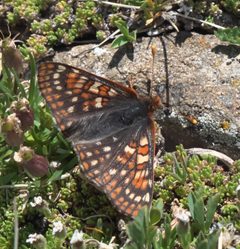
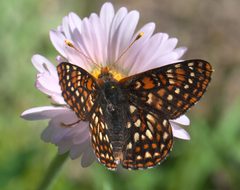
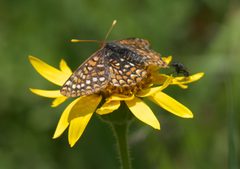
Euphydryas anicia is a checkerspot in the Nymphalidae, distributed across mid to western North America from Yukon and British Columbia south to New Mexico and Arizona. display red wings with black bands and yellow markings, with darker coloration at higher elevations. The exhibits aposematic coloration warning of unpalatability due to sequestered iridoid glycosides. can be exceptionally large, with one alpine Colorado population estimated at 50,000–100,000 individuals. The species is non-migratory with a single period.
Pronunciation
How to pronounce Euphydryas anicia: //juːˈfaɪdɹiəs əˈnɪʃiə//
These audio files are automatically generated. While they are not always 100% accurate, they are a good starting point.
Identification
Distinguished from Euphydryas editha and E. gillettii by lack of white spots on the , presence of a marigold band at the submarginal region, and larger pointed forewings. Distinguished from visually similar E. chalcedona by male genitalia structure. clubs are yellow with black bases. Brown differentiate it from other Nymphalidae. At higher elevations, individuals are noticeably darker.
Images
Habitat
Occurs across diverse elevations and environments including mountain summits, grasslands, canyons, and dry conifer forests. Alpine and subalpine studied at elevations up to 3700 m in Colorado.
Distribution
Mid to western North America: north to Yukon and British Columbia, east to Manitoba, south to New Mexico and Arizona.
Seasonality
occurs once annually from late May to mid-August, timing varying with elevation and geographic range.
Diet
Larvae are herbivores feeding on plants containing iridoid glycosides, including Besseya alpina, B. plantaginea, and Castilleja integra. Diet varies by available local vegetation. are nectarivores, feeding from flowers including penstemon and dogbane; adult males also visit mud puddles.
Host Associations
- Besseya alpina - larval plantsource of catalpol and aucubin
- Besseya plantaginea - larval plantsource of catalpol esters and catalpol
- Castilleja integra - larval plantsource of macfadienoside and catalpol
- Plantago erecta - larval plant
- Symphoricarpos - larval plant
Life Cycle
Females produce 2–3 clusters hidden under plant leaves; eggs hatch after approximately two weeks. Larvae construct silk shelters over host plants for protection, remaining until winter or host plant defoliation. Larvae enter after the third or fourth , typically beginning early autumn. Diapause duration varies with environmental conditions and can extend multiple years. occurs after 3–4 additional molts following diapause termination. Caterpillar mortality rate is approximately 98%.
Behavior
Non-migratory . show greater movement distances than most Euphydryas and other alpine Euphydryas populations, with movement patterns similar to E. chalcedona and more vagile E. editha populations. Female distribution is influenced by -plant and male harassment.
Ecological Role
Larvae sequester iridoid glycosides from plants, retaining these chemical defenses throughout life. These compounds serve as unpalatability signals to , supported by aposematic coloration.
Human Relevance
The cloudcrofti (Euphydryas anicia cloudcrofti) is listed as endangered by the U.S. Fish and Wildlife Service due to climate change, construction, and plants. The is globally ranked G5 (secure), though some in southern Canada are considered vulnerable (G3) to critically imperiled (G1).
Similar Taxa
- Euphydryas edithaDiffers by presence of white spots on , lacking marigold submarginal band, and smaller less pointed forewings
- Euphydryas gillettiiDiffers by presence of white spots on , lacking marigold submarginal band, and smaller less pointed forewings
- Euphydryas chalcedonaVisually similar; reliable distinction requires examination of male genitalia
Sources and further reading
- BugGuide
- Wikipedia
- GBIF taxonomy match
- iNaturalist taxon
- NCBI Taxonomy
- Mantispidae | Beetles In The Bush
- July | 2024 | Beetles In The Bush
- Mating Behavior and Male Investment in Euphydryas anicia (Lepidoptera: Nymphalidae)
- The ecology and population genetics of an alpine checkerspot butterfly, Euphydryas anicia
- Euphydryas anicia (Lepidoptera: Nymphalidae) utilization of iridoid glycosides fromCastilleja andBesseya (Scrophulariaceae) host plants
- Host Plant Suitability in a Specialist Herbivore, Euphydryas anicia (Nymphalidae): Preference, Performance and Sequestration
- Influence of host-plant density and male harassment on the distribution of female Euphydryas anicia (Nymphalidae)
- Observations of late instar larva survival of Cotesia (Hymenoptera: Braconidae) parasitoid attack of Euphydryas anicia cloudcrofti (Lepidoptera: Nymphalidae)