
Euphydryas gillettii
(W. Barnes, 1897)
Gillett's Checkerspot, Gillette's Checkerspot
Euphydryas gillettii is a medium-sized checkerspot native to western North America. The exhibits variable chemical defense through of iridoid glycosides from plants, with defensive compound concentrations varying significantly between based on host plant use. First described by William Barnes in 1897, this montane butterfly has been the subject of ecological research examining host-plant selection and chemical .
Pronunciation
How to pronounce Euphydryas gillettii: //juːˈfaɪdrɪəs ˈdʒɪlɛtaɪ//
These audio files are automatically generated. While they are not always 100% accurate, they are a good starting point.
Identification
Distinguished from other western North American Euphydryas by geographic range and association; precise field identification requires examination of wing pattern details and locality data. Chemical analysis reveals -level differences in iridoid glycoside content that correlate with plant use.
Images
Appearance
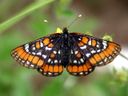
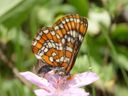
Wingspan 36–45 mm. Pattern typical of checkerspot butterflies with checkered orange and black markings on wing surfaces.
Habitat
Montane environments including valleys, glades, open wooded areas in mountains, and riparian zones near streams. Occupies elevations from lowlands to subalpine zones within its western North American range.
Distribution
Western North America from British Columbia south to Oregon, and from the Rocky Mountains west to the Pacific Ocean. Documented in Idaho, Wyoming, and Alberta.
Seasonality
fly from mid-June to early August in Alberta; period likely varies with elevation and latitude across range.
Host Associations
- Lonicera involucrata - larval foodplantprimary ; bracted honeysuckle
- Lonicera caerulea - larval foodplantsweetberry honeysuckle; observed in Idaho
- Pedicularis groenlandica - oviposition sitelittle pink elephant; laid on this plant in Idaho, though larvae may not feed
- Valeriana occidentalis - larval foodplantwestern valerian; observed in Idaho
Life Cycle
Larvae feed on plants and sequester iridoid glycosides for chemical defense. Captive rearing experiments indicate similar across multiple host plant . and details not documented in available sources.
Behavior
feed on nectar from wild geranium and yellow composite flowers. Oviposition includes laying on plants that may not serve as larval food sources.
Ecological Role
of nectar sources including wild geranium and yellow composites. Larvae function as herbivores on honeysuckles and related plants. Chemical defense compounds sequestered from plants may provide protection against .
Similar Taxa
- Euphydryas edithaOverlapping western North American range; both checkerspot with similar wing patterns; distinguished by specific locality and preferences
- Euphydryas auriniaRelated checkerspot ; E. aurinia is Palearctic in distribution and has been subject to conservation in Britain, whereas E. gillettii is Nearctic
More Details
Chemical Defense Variation
Idaho shows mean iridoid glycoside content of 3.89% dry weight (all individuals contain compounds), while Wyoming population shows mean of 1.27% with 20% of individuals lacking detectable compounds. This variation correlates with differential plant use between populations.
Taxonomic Note
Placed in subgenus Hypodryas by some authorities; basionym Melitaea gillettii.
Sources and further reading
- BugGuide
- Wikipedia
- GBIF taxonomy match
- iNaturalist taxon
- NCBI Taxonomy
- 'Climate Change' May Be a Key Factor in Declining Butterfly Populations | Bug Squad
- Provisional checklist of European butterfly larval foodplants
- Conservation Translocations: It’s Not Just Beavers - Buglife Blog - Buglife
- Factors Affecting Host-plant Use by the Montane Butterfly Euphydryas gillettii (Nymphalidae)
- Variable chemical defence in the checkerspot butterfly Euphydryas gillettii (Lepidoptera: NymphaIidae)