
Omus californicus subcylindricus
Nunenmacher, 1940
Subcylindrical Night-stalking Tiger Beetle
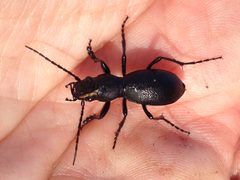
Omus californicus subcylindricus is a of night-stalking tiger beetle in the Carabidae. It is one of several subspecies within the Omus californicus complex, which exhibits considerable morphological and geographic variation across its range in western North America. The subspecies was described by Nunenmacher in 1940 and is distinguished by its subcylindrical body form compared to other members of the complex.
Pronunciation
How to pronounce Omus californicus subcylindricus: /ˈoʊməs ˌkælɪˈfɔrnɪkəs ˌsʌbsəˌlɪndrɪkəs/
These audio files are automatically generated. While they are not always 100% accurate, they are a good starting point.
Identification
Distinguished from other Omus californicus by its subcylindrical body shape; specific diagnostic features relative to other subspecies such as O. c. californicus, O. c. intermedius, and O. c. angustocylindricus require detailed examination of external and male genitalia.
Images
Habitat
Associated with forested in the Sierra Nevada and Coast Ranges of California; larvae construct burrows in suitable substrates within these montane and foothill environments.
Distribution
Known from California, USA; specifically recorded from the western slope of the Sierra Nevada and Coast Ranges. Distribution records indicate presence in North America with confirmed occurrences in the United States.
Seasonality
active from May through September; peak activity varies with elevation and local climate conditions. Adults are and may be encountered at night along logging roads, under logs, or in shadowed areas during cloudy days.
Life Cycle
Larvae construct burrows in soil; third instar larvae spend the majority of their developmental period in these burrows. emerge from larval burrows after completing development. The complete requires at least one year and may extend to two or more years.
Behavior
are and cryptic, hiding during daylight hours. They have been observed hunting in unusual situations, including tide pools at low tide where they capture and consume amphipods. Adults do not readily come to . Larvae maintain consistent orientation in their burrows, tossing soil pellets in a fixed direction.
Ecological Role
as both larvae and ; larvae ambush prey from burrow entrances while adults actively hunt. Larval burrows serve as indicators of presence and suitability.
Human Relevance
Of interest to entomologists and coleopterists due to its restricted distribution and taxonomic complexity within the O. californicus complex. The contributes to understanding of speciation patterns in montane .
Similar Taxa
- Omus californicus californicusNominate with which O. c. subcylindricus shares range; distinguished by body form and aedeagal .
- Omus californicus intermediusAnother in the complex with overlapping or adjacent distribution; distinguished by subtle morphological differences and geographic occurrence.
- Omus californicus angustocylindricus with similar subcylindrical body form found in northern California and southern Oregon; distinguished by geographic range and specific morphological features.
More Details
Taxonomic Complexity
The Omus californicus complex exhibits extensive morphological variation across its geographic range, leading to recognition of multiple . Some researchers have suggested that certain currently assigned to subspecies may represent undescribed species based on differences in larval and male genitalia.
Conservation Considerations
Like many tiger beetles with restricted montane distributions, O. c. subcylindricus may be vulnerable to alteration and climate change. The ' association with specific forest habitats makes it potentially sensitive to logging and fire suppression practices.
Research Challenges
Study of this is complicated by its habits and cryptic . Successful collection often requires searching at night along forest roads or turning logs during daylight, rather than traditional daytime collecting methods.
Sources and further reading
- BugGuide
- GBIF taxonomy match
- iNaturalist taxon
- Catalogue of Life
- Encyrtid Holdings | Entomology Research Museum
- Bohart Museum: Learn about California's State Insect on UC Davis Picnic Day | Bug Squad
- A rare opportunity to do fall insect collecting in western North America | Beetles In The Bush
- Diversity in Tiger Beetle Larval Burrows | Beetles In The Bush
- Sex Attraction Pheromone Improves Detection of a Threatened Beetle
- Cimbicidae | Beetles In The Bush