
Adephaga
Ground and Water Beetles, adephagans
Family Guides
8- Amphizoidae(Trout-stream Beetles)
- Carabidae(ground beetles)
- Dytiscidae(predaceous diving beetles)
- Gyrinidae(Whirligig Beetles)
- Haliplidae(Crawling Water Beetles)
- Noteridae(Burrowing Water Beetles)
- Rhysodidae(Wrinkled Bark Beetles)
- Trachypachidae(False Ground Beetles)
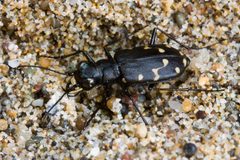
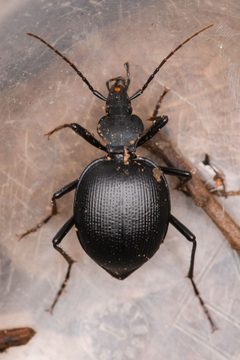
is the second-largest suborder of beetles, comprising over 40,000 across 10 . The suborder includes ground beetles (Carabidae), tiger beetles, predaceous diving beetles, and whirligig beetles. Members are characterized by specialized anatomical features including visible notopleural and a first abdominal sternum separated by hind . The vast majority of species belong to the family Carabidae.

Pronunciation
How to pronounce Adephaga: //əˈdɛfəɡə//
These audio files are automatically generated. While they are not always 100% accurate, they are a good starting point.
Identification
Adephagans are distinguished from other suborders by the combination of: visible notopleural in ; first abdominal sternum completely separated by hind ; simple without clubs or pectination; and presence of paired pygidial glands. The transverse fold of the hind wing near the wing tip, with nervure ending at this fold, provides additional diagnostic characters. Larvae have well-chitinized , often with elongated , five-segmented legs with two claws on the foot-segment, , and no mandibular molae.
Images
Habitat
span extreme diversity including caves, rainforest , alpine zones, aquatic environments, and arid regions. Specific structural adaptations occur in particular lineages: Gyrinidae inhabit the air-water interface, Rhysodinae occupy heartwood, and Paussinae carabids live within nests. Many are associated with sandy substrates, saline flats, and riparian zones.
Distribution
Global distribution with representatives on all continents except Antarctica. The suborder originated in the Late Permian, with divergence from sister groups completed by the early Triassic approximately 240 million years ago. Both aquatic and terrestrial forms appear in late Triassic fossil records. Familial and tribal diversification spans the Mesozoic, with explosive radiation of some tribes during the Tertiary.
Diet
Most are . Non-predatory feeding strategies include: consumption (Haliplidae), seed-feeding (harpaline carabids), fungus-feeding (rhysodine carabids), and snail-feeding (licinine and cychrine carabids). Some species are ectoparasitoids of insects (brachinine and lebiine carabids) or millipedes (peleciine carabids).
Life Cycle
Development includes , larval, and stages. Some are , notably pseudomorphine carabids. Larvae are active with well-chitinized . Larval (stemmata) are relatively large and simple, with two pairs having binocular fields of vision that slightly overlap. Reproductive anatomy differs from other beetles: ovaries are polytrophic, chambers alternate with egg chambers in ovarian tubes, and consist of coiled single follicles. Four are present.
Behavior
Defensive chemical delivery occurs through three mechanisms: oozing (non-muscle-lined glands, limited discharge), spraying (muscle-lined glands, forceful ejection typical of carabids), and (boiling noxious spray ejected with popping sound, restricted to Brachininae carabids and relatives). Secretions vary chemically among : gyrinids produce norsesquiterpenes (gyrinidal, gyrinidione, gyrinidone); dytiscids discharge aromatic aldehydes, esters, and benzoic acid; carabids produce carboxylic acids (formic, methacrylic, tiglic acids) plus aliphatic ketones, saturated esters, phenols, aromatic aldehydes, and quinones. Proposed functions include deterrence, antimicrobial defense, wetting, , water surface propellants, and oviposition site conditioning.
Ecological Role
Predatory adephagans function as significant in terrestrial and freshwater . Chemical secretions serve as defensive compounds and potentially as antimicrobial agents. Some secretions may function as (Gyrinidae) or surface propellants. The suborder includes important bioindicators and contributes to nutrient cycling through diverse feeding strategies including detritivory and herbivory in particular lineages.
Human Relevance
Tiger beetles are popular among entomologists and naturalists due to charismatic appearance and . Some serve as bioindicators for quality. The bombardier beetle (Brachininae) is frequently cited in creation-evolution debates due to its explosive chemical defense mechanism. No significant agricultural or medical importance is documented.
Similar Taxa
- PolyphagaThe largest suborder, distinguished from by hidden notopleural , first abdominal sternum not separated by hind , and typically clubbed or pectinate . Polyphaga lack the characteristic pygidial gland system of Adephaga.
- ArchostemataPrimitive suborder with fewer than 50 , distinguished by presence of a jugular and different wing venation. have visible notopleural like but lack the separated first abdominal sternum.
- MyxophagaSmall suborder of aquatic beetles, distinguished by reduced wing venation and different larval . Myxophaga have only two versus four in .
More Details
Phylogenetic History
Former classifications divided into Geadephaga (terrestrial: Carabidae and Trachypachidae) and Hydradephaga (aquatic ). This scheme is no longer valid as Hydradephaga is not monophyletic. Modern analysis supports the clade Dytiscoidea, which includes many aquatic adephagans but excludes Gyrinidae. Rhysodidae is now considered a subgroup of Carabidae rather than a distinct family, and is frequently treated as distinct from Carabidae.
Chemical Gland Accessory Structures
Dytiscidae and Hygrobiidae possess additional paired prothoracic glands secreting steroids. Gyrinidae are unique in having an extended external opening of the pygidial gland.
Larval Vision
Tiger larvae possess stemmata with binocular fields of vision that overlap to create an enlarged binocular field. Each stemmatum has a -lens forming a single refractive unit with a flat . Retinal disparity between peripheral and central portions enables distance judgment for prey capture.
Sources and further reading
- BugGuide
- Wikipedia
- iNaturalist taxon
- NCBI Taxonomy
- Catalogue of Life
- ID Challenge #12 | Beetles In The Bush
- Carabidae | Beetles In The Bush | Page 2
- Eye to eye to eye to eye with a tiger beetle larva | Beetles In The Bush
- Treatise of Western Hemisphere “Cicindelitae” | Beetles In The Bush
- A “Really” Big-headed Tiger Beetle | Beetles In The Bush
- Where siblings mingle: Ellipsoptera marginata vs. E. hamata | Beetles In The Bush