
Dytiscidae
Leach, 1815
predaceous diving beetles, diving beetles
Subfamily Guides
10- Agabinae
- Colymbetinae
- Copelatinae(copelatine diving beetles)
- Coptotominae
- Cybistrinae
- Dytiscinae(predaceous diving beetles)
- Hydrodytinae
- Hydroporinae
- Laccophilinae
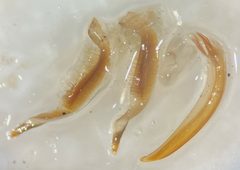
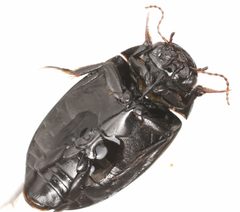
, the predaceous diving beetles, is a of aquatic beetles containing over 4,000 described . range from 0.9 mm to 4.75 cm in length, with most species between 1–2.5 cm. They are characterized by enlarged, flattened hind legs adapted for swimming and a streamlined, oval body shape that reduces drag underwater. The family exhibits remarkable chemical , producing unique defensive steroids found nowhere else in the animal kingdom. Larvae, known as "water tigers," are elongate with sharp, pincer-like that inject digestive into prey.
Pronunciation
How to pronounce Dytiscidae: //daɪˈtɪsɪdiː//
These audio files are automatically generated. While they are not always 100% accurate, they are a good starting point.
Identification
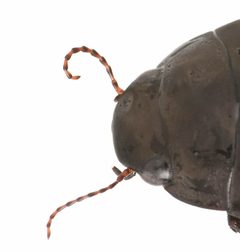
can be distinguished from other aquatic beetles by several features: the surface is not more strongly convex than the (unlike Noteridae and most Hydrophilidae); are threadlike, glabrous, and longer than width (not clubbed as in Hydrophilidae and Gyrinidae); are flat and undivided (unlike the divided eyes of Gyrinidae); and the scutellum is concealed (except in Celina). The hind legs are enlarged and flattened with dense setae, moving in synchrony during swimming. Males of many have suction cup-like palettes on the forelegs for gripping females during mating; females often have furrows on the that interfere with male grip.
Images
Habitat
Occurs in virtually all freshwater worldwide, including ponds, lakes, streams, rivers, rock pools, and temporary wetlands. Some inhabit brackish water. A few species are terrestrial, living in leaf litter or moist soil. Specialized subterranean (stygobitic) species occur in caves, wells, and groundwater systems, particularly in Western Australia. Species distribution within habitats is influenced by fish presence (a major limiting factor), aquatic vegetation , water clarity, and substrate color. Some species tolerate urban environments; others require fishless, unpolluted waters.
Distribution
distribution across all continents except Antarctica. Highest diversity in tropical and temperate regions. The European Dytiscus latissimus and Brazilian Megadytes ducalis represent the largest known . The Australian Limbodessus atypicali from subterranean waters is among the smallest. Fossil record extends to the Late Jurassic with †Palaeodytes gutta from the Karabastau Formation.
Seasonality
Most are , with breeding periods of 2–3 months typically in spring and autumn. of many species overwinter, often in plant material and sediments at the bottom of unfrozen water bodies. Some species estivate during summer dry spells or enter . activity for occurs during favorable conditions.
Diet
Both and larvae are predatory. Larvae (water tigers) capture prey with pincer-like , inject digestive through a canal near the mandible tips, and suck liquefied tissues; they prey on animals equal to or larger than themselves, including tadpoles, small fish, and aquatic . Adults consume living prey and carrion, functioning as scavengers; diet includes invertebrates, small vertebrates, and mosquito larvae. occurs both within and between .
Life Cycle
are deposited in aquatic plant stems (slits cut by ovipositor in some ), moist soil, debris by shore, or within frog spawn in ephemeral . Larvae pass through three instars, molting before . Mature larvae crawl from water to burrow in mud for pupation, emerging as after approximately one week. Some can complete development rapidly, with eggs hatching within 24 hours. Lifespan extends to several years in some species.
Behavior
are adept swimmers using modified hind legs as oars, capable of forward and backward movement with low turning . They surface periodically to replenish air stored beneath the ; some smaller can remain submerged for weeks using respiration via specialized setae. When disturbed, adults may release defensive secretions, play dead (), or kick with hind legs. Smaller species reduce activity or disperse when threatened. Adults are strong fliers and colonize new by seeking light reflections on water surfaces.
Ecological Role
Primary in freshwater lacking fish, regulating of and small vertebrates. Serve as bioindicators of water quality due to sensitivity to pollution and preference for unpolluted . Potential agents for mosquito populations through larval . Prey for fish, birds, mammals, reptiles, and parasitic mites. Contribute to nutrient cycling through scavenging and carrion consumption.
Human Relevance
Source of unique steroids for pharmaceutical research and development. Edible in some cultures: Cybister consumed in Mexico, Japan, China, Taiwan, Thailand, and New Guinea. Used in traditional practices in East Africa, where bites are induced for perceived pubertal benefits. Featured in Cherokee creation mythology, where the brought mud from the bottom to form land. Popular in aquarium keeping. Subject of extensive scientific research in , chemical , and evolutionary .
Similar Taxa
- HydrophilidaeWater scavenger beetles have clubbed , convex surface, and often possess a keel between the legs—features absent in .
- GyrinidaeWhirligig beetles have divided and clubbed , unlike the undivided flat and threadlike antennae of .
- NoteridaeBurrowing water beetles have a more convex surface and enlarged molar portions on the , which lack.
More Details
Chemical defenses
Pygidial and prothoracic glands secrete defensive compounds including benzoic acid, phenols, and unique pregnane steroids such as 11-deoxycorticosterone that can induce regurgitation in fish . These steroids are not known from any other animal group.
Sexual conflict
Males possess adhesive palettes on forelegs for gripping females during mating; females have evolved furrowed that weaken male grip, representing an evolutionary arms race over mating control.
Respiratory adaptations
Air storage beneath supports 30 minutes underwater; combined with cutaneous respiration, survival extends to 24–36 hours. Some Hydroporinae possess tracheal gills formed by specialized setae on elytra and surface, enabling weeks-long submersion without surfacing.
Sources and further reading
- BugGuide
- Wikipedia
- GBIF taxonomy match
- iNaturalist taxon
- NCBI Taxonomy
- Catalogue of Life
- Bug Eric: Review: Diving Beetles of the World
- Super Crop Challenge #15 | Beetles In The Bush
- beetle species | Blog
- More Eocene insects | Beetles In The Bush
- Bug Eric: The Grasshopper Hunt
- South Africa | Blog - Part 2
- Chemical Ecology and Biochemistry of Dytiscidae
- Chemical Ecology and Biochemistry of Dytiscidae
- Bridging Ecology and Systematics: 25 Years of Study of Larval Morphology of World Dytiscidae
- A SYNOPSIS OF THE DYTISCIDAE OF THE GALAPAGOS ISLANDS, ECUADOR, WITH DESCRIPTION OF RHANTUS GALAPAGOENSIS SP.NOV. (COLEOPTERA: DYTISCIDAE)
- The Unique Australian Subterranean Dytiscidae: Diversity, Biology, and Evolution
- Observations on the genus Leuronectes Sharp, morphological aspects and geographic distribution (Coleoptera, Dytiscidae, Agabini)
- NEW DATA ON DYTISCIDAE, HYDROPHILIDAE, HYDRAENIDAE, DRYOPIDAE AND HETEROCERIDAE (COLEOPTERA) OF NORTH OSSETIA
- NEW RECORDS OF HALIPLIDAE, DYTISCIDAE, HYDROPHILIDAE AND SCIRTIDAE (COLEOPTERA) FROM LIPETSK OBLAST