
Carabidae
Latreille, 1802
ground beetles
Subfamily Guides
15- Brachininae(bombardier beetles)
- Broscinae
- Carabinae(ground beetles)
- Cicindelinae(tiger beetles)
- Elaphrinae
- Gehringiinae
- Harpalinae(harp beetles)
- Loricerinae
- Nebriinae
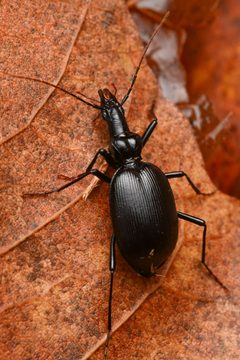
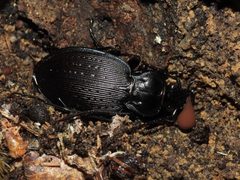
is one of the largest of beetles, comprising over 40,000 described worldwide. Members are predominantly predatory, with elongated bodies, thread-like , and prominent forward-directed . The family includes diverse forms from fast-running tiger beetles to flightless tyrant , occupying nearly every terrestrial . Many species serve as important agents of agricultural pests.
Pronunciation
How to pronounce Carabidae: //kəˈræbɪdiː//
These audio files are automatically generated. While they are not always 100% accurate, they are a good starting point.
Identification
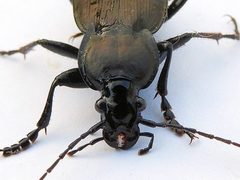
possess with segments longer than wide, resembling a single thread rather than bead-like. are exposed and directed forward, not concealed beneath the . Most have a streamlined, somewhat flattened body form adapted for rapid running. The are typically hard and smooth to , often with metallic coloration. Legs are relatively long and slender, suited for locomotion.
Images
Habitat
occupy virtually all terrestrial including forests, grasslands, deserts, wetlands, and agricultural fields. Some tribes are restricted to specific environments; for example, Anthiini is largely restricted to arid, sandy regions of Africa such as the Karoo and Kalahari. Many favor moist microhabitats under stones, logs, or leaf litter, while others inhabit open ground surfaces.
Distribution
distribution with more than 40,000 worldwide. Approximately 2,000 species occur in North America and 2,700 in Europe. Center of diversity varies by group; the tribe Anthiini is predominantly African with some species extending into the southern Palearctic.
Diet
Predominantly predatory, feeding on other insects, spiders, slugs, and soft-bodied . Some are known to specialize on particular prey; for example, in agricultural systems provide significant suppression of slugs in corn and soybean fields. A minority of species may supplement with plant material or scavenge.
Behavior
Most are fast-running, active hunters that rely on speed and agility to capture prey. Many are , though some hunt diurnally. When threatened, some species release defensive secretions from pygidial glands; members of the tribe Anthiini can eject concentrated organic acids or quinones in a strong jet. capability varies widely—many ground-dwelling species are flightless, while others are capable fliers. Some species exhibit relationships with other insects.
Ecological Role
Significant in terrestrial , regulating of other . In agricultural , they provide valuable ecosystem services as natural enemies of crop pests, particularly slugs in conservation agriculture systems. Their presence indicates healthy, undisturbed soil . Some serve as models in mimicry complexes, including the unusual case of lizards (Eremias lugubris) mimicking anthiine .
Human Relevance
are generally beneficial to humans due to their on agricultural and garden pests. They are increasingly recognized as key allies in , particularly for slug control in no-till farming systems. Some large are collected for the pet trade. A few species can deliver defensive chemical sprays that may irritate human and skin.
Similar Taxa
- TenebrionidaeDarkling beetles resemble but have bead-like () segments, concealed beneath the , and typically slower, more deliberate movement. Some darkling beetles exhibit -standing when disturbed.
Sources and further reading
- BugGuide
- GBIF taxonomy match
- iNaturalist taxon
- NCBI Taxonomy
- Catalogue of Life
- Carabidae | Beetles In The Bush | Page 2
- Tyrant ground beetles | Beetles In The Bush
- Bug Eric: ID Tip: Ground Beetle or Darkling Beetle?
- ID Challenge #12 | Beetles In The Bush
- ID Challenge #1 | Beetles In The Bush
- Ground Beetles Key Allies for Slug Control in Conservation Agriculture