
Omus californicus californicus
Eschscholtz, 1829
California Night-stalking Tiger Beetle
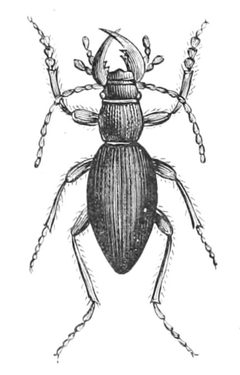
Omus californicus californicus is the nominate of the California night-stalking tiger beetle, a flightless, carabid to California. are active primarily in spring and early summer, with larvae occupying permanent burrows in soil. The exhibits strong fidelity to specific substrates and moisture conditions. Unlike tiger beetles in the Cicindela, Omus species are to nocturnal hunters that do not rely on vision for prey capture.
Pronunciation
How to pronounce Omus californicus californicus: /ˈoʊmʊs kælɪˈfɔrnɪkəs kælɪˈfɔrnɪkəs/
These audio files are automatically generated. While they are not always 100% accurate, they are a good starting point.
Identification
are readily identified to by their activity, flightless condition ( or reduced, hind wings absent or ), and robust body form. Within the genus, O. californicus are distinguished by geographic range and subtle morphological differences, particularly in male genitalia. O. c. californicus is found in the Coast Ranges from Mendocino County southward and in the Sierra Nevada foothills. The is most reliably distinguished from O. submetallicus by examination of the in males and by differences in the shape of the pronotum. Larval burrows are ~5-6mm in diameter, circular with a slight D-shaped flattening, and typically found in moist to mesic forested .
Images
Habitat
Occupies moist to mesic in coastal and montane regions, including mixed evergreen forests, redwood forests, and riparian corridors in oak woodlands. are often found in areas with deep litter layers and decaying wood, where they shelter during daylight hours. The shows strong substrate fidelity, with larvae requiring specific soil moisture and texture conditions for burrow construction. Adults have been observed hunting in intertidal zones at low tide in Mendocino County, capturing amphipods in tide pools.
Distribution
to California. The nominate occurs in the Coast Ranges from approximately Mendocino County south to the San Francisco Bay area, and in the western Sierra Nevada foothills. Records exist from Humboldt, Mendocino, Sonoma, Marin, and adjacent counties. The subspecies is parapatric or with O. c. intermedius (more northerly) and O. c. angustocylindricus (eastern Sierra and Cascade Range).
Seasonality
are active primarily from May through September, with peak activity in June and July in most locations. Activity is or , with adults emerging after dusk to forage. The timing of adult varies with elevation and local climatic conditions, with lower elevation active earlier in the season.
Diet
are of small . Documented prey includes amphipods in intertidal , small insects, and presumably other soil-dwelling arthropods. Larvae are sit-and-wait predators that capture prey passing near their burrow entrances using their large, sickle-shaped .
Life Cycle
Larvae occupy permanent burrows in soil, constructing vertical to slightly inclined tunnels with a characteristic circular entrance. Third instar larvae create burrows approximately 5-6mm in diameter. Larvae are ambush that maintain position at the burrow entrance, retreating when disturbed. occurs within the burrow. The likely requires two or more years, based on observations of related tiger . are long-lived relative to tiger beetles, with individuals persisting through much of the activity season.
Behavior
and forager that does not rely on vision for prey capture, unlike tiger beetles. are flightless and move by rapid running. When disturbed, adults seek shelter under debris, logs, or in soil crevices. Adults are readily attracted to (tuna or fish) in some , though this is reportedly inconsistent in O. c. californicus compared to the nominate form. Larvae maintain strict orientation within their burrows, with the flattened side of the burrow entrance accommodating the .
Ecological Role
in forest floor and riparian . The contributes to regulation of small in its . As a flightless, habitat- species, it may serve as an indicator of intact forest floor with minimal disturbance. The larval burrowing activity contributes to soil aeration and mixing.
Human Relevance
Subject of interest to coleopterists due to its restricted distribution and the taxonomic complexity of the Omus californicus . The is not of direct economic importance. loss and fragmentation in its California range represent potential conservation concerns, though formal conservation status has not been assessed for this specifically.
Similar Taxa
- Omus submetallicusSympatric in parts of northern California; distinguished by subtle differences in pronotal shape, elytral microsculpture, and male genitalia. Historically confused with O. californicus lecontei in some regions.
- Omus californicus intermediusParapatric occurring further north in the Coast Ranges and Cascades; distinguished by geographic range and subtle morphological differences, particularly in male aedeagal structure.
- Omus californicus angustocylindricusParapatric of the eastern Sierra Nevada and Cascade Range; distinguished by geographic range and body proportions, with more cylindrical body form.
- Cicindela species tiger beetles in the same but different tribe; distinguished by diurnal activity, presence of functional wings, typically more boldly patterned , and different larval burrow characteristics.
More Details
Taxonomic History
The of Omus californicus has been contentious, with various authors treating the complex as containing multiple or as a single variable species with . The subspecific classification remains under study, with molecular data potentially clarifying relationships among the geographically isolated .
Collection Methods
are most effectively collected by searching at night with headlamps, by turning logs and debris in suitable during daylight, or by pitfall trapping. Baiting with fish or tuna is effective for some but reportedly inconsistent for O. c. californicus. Larvae can be collected by excavating burrows or by 'fishing' with grass stems to induce a strike response.
Sources and further reading
- BugGuide
- GBIF taxonomy match
- iNaturalist taxon
- Catalogue of Life
- Encyrtid Holdings | Entomology Research Museum
- California Has No State Bee--Yet! | Bug Squad
- Bohart Museum: Learn about California's State Insect on UC Davis Picnic Day | Bug Squad
- Grasshoppers of Colorado
- A rare opportunity to do fall insect collecting in western North America | Beetles In The Bush
- Diversity in Tiger Beetle Larval Burrows | Beetles In The Bush
- Distribution and Conservation Status ofOmus submetallicusG. Horn and Its Confusion withOmus californicus leconteiG. Horn (Coleoptera: Carabidae)