
Cicindela
Linnaeus, 1758
common tiger beetles
Species Guides
41- Cicindela albissima(Coral Pink Sand Dunes tiger beetle)
- Cicindela amargosae(Great Basin tiger beetle)
- Cicindela ancocisconensis(Appalachian tiger beetle)
- Cicindela arenicola(St. Anthony Dune Tiger Beetle)
- Cicindela bellissima(Pacific Coast Tiger Beetle)
- Cicindela columbica(Columbia River tiger beetle)
- Cicindela decemnotata(Badlands Tiger Beetle)
- Cicindela denikei(Laurentian Tiger Beetle)
- Cicindela denverensis(Green Claybank Tiger Beetle)
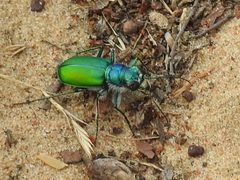
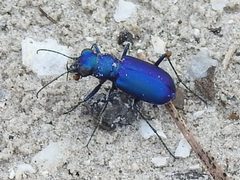
Cicindela is a large of tiger beetles characterized by metallic, often brightly colored bodies with ivory or cream-colored markings. The genus occurs worldwide and contains over 850 , though remains unsettled with numerous subgenera debated as independent genera. Members are fast-running, visually oriented of small . The name derives from Latin 'cicindela' meaning '', referring to their metallic, sometimes flashing appearance.
Pronunciation
How to pronounce Cicindela: //ˌsɪsɪnˈdiːlə//
These audio files are automatically generated. While they are not always 100% accurate, they are a good starting point.
Identification
Distinguish from other tiger by combination of body proportions, structure, and male genitalia characteristics. Within the genus, subgenera are distinguished by body shape (robust vs. elongated), leg proportions, and details of male genitalia. identification relies on maculation patterns, body color, association, and subtle morphological details such as coloration and pronotal . Similar species in the same habitat may be distinguished by : some land quickly after short flights while others fly further with characteristic bouncing landings.
Images
Habitat
Most abundant and diverse in open, sandy near water bodies: riverbanks, lake and seashores, sand dunes, dry lakebeds, and clay banks. Some occupy woodland paths, prairie barrens, and rocky shores. Several species have adapted to postindustrial secondary habitats including coal heaps, sand pits, sludge-drying beds, and highway embankments. Habitat specificity varies: some species are confined to particular substrates (fine-grained vs. coarse sand), while others show broader .
Distribution
Worldwide distribution. Particularly diverse in North America, with extensive representation across the Great Plains, Rocky Mountains, and eastern forests. Present across Palearctic region. Specific regional faunas documented for Colorado Front Range, Nebraska Sandhills, Texas, New England, Eastern Canada, Alberta, and northern Moravia (Czech Republic).
Seasonality
activity patterns vary by . Spring-fall active species spend summer as larvae and pupae in soil tunnels. Summer-active species replace spring species at the same localities. Activity generally concentrated in cooler months, with adults vulnerable to overheating on hot substrates during midday.
Diet
of small including ants and other arthropods. Pursue prey using vision, running at high speeds that can exceed their visual processing capacity, requiring intermittent stops to refocus before continuing pursuit. Larvae are ambush predators that seize passing prey from burrow entrances.
Life Cycle
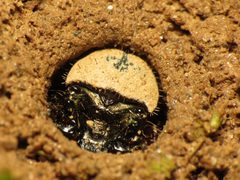
Larvae construct vertical burrows in soil where they live as ambush , presenting flat flush with burrow entrances to capture passing prey. occurs in soil tunnels. Some have spring-fall activity with summer larval/pupal dormancy; others are active in summer.
Behavior
, fast-running with stereotyped escape . When disturbed, fly with stereotyped take-off sequences lasting approximately 0.12 seconds, involving coordinated leg movements where the second pair of legs powers the jump while the first pair supports in a V-position. speed averages ~0.6 m/s with maximum acceleration ~7 m/s². Running speed approximately one-quarter of flight speed. Some land quickly after short flights; others fly further with bouncing, tumbling landings. When threatened, may alight facing the threat to reduce profile, or hunker down in sand depressions. Thermoregulatory behaviors include seeking shade under vegetation and elevating body on 'tip-toe' posture using long legs to reduce ground contact. Males compete for access to females, sometimes forming 'conga line' of multiple males attempting to mate with one female.
Ecological Role
of small in open, early-successional . Larvae serve as subterranean predators in soil . Presence indicates well-drained, open habitats with sparse vegetation. Some function as for particular soil types and disturbance regimes.
Human Relevance
Popular among entomologists and naturalists for their charisma, speed, and metallic beauty. Subject of extensive field guides and ecological research. Some threatened or endangered due to loss from development, natural , and reclamation of postindustrial sites. Conservation concerns exist for habitat-specific species with restricted ranges.
Similar Taxa
- Other Cicindelinae genera (e.g., Calomera, Cylindera)Formerly classified within Cicindela; distinguished by body proportions, structure, and male genitalia. Some authorities treat traditional Cicindela subgenera as separate .
- Carabidae (ground beetles)Tiger beetles now classified as Cicindelinae within Carabidae; distinguished by large , long legs, activity, and distinctive running-hunting .
More Details
Taxonomic instability
The is in constant taxonomic flux, with authorities disagreeing on whether dozens of traditional subgenera should be treated as independent genera. The rank of has been used extensively, with little consistency in vs. subspecies treatment across classifications. Over 850 species are recognized conservatively, with up to 2,300 species estimated by some counts and several thousand published names applied collectively.
Structural coloration
The metallic appearance results from structural properties of the —layers that reflect various wavelengths of light—rather than pigments. This structural coloration contributes to despite the bright appearance, particularly when combined with disruptive ivory patterning.
Convergent evolution
Unrelated in similar may exhibit remarkable convergence in coloration and pattern. For example, Cicindela lengi and C. formosa share similar appearance and habitat preferences but belong to different subgenera with distinct body proportions, leg lengths, and male genitalia.
Sources and further reading
- BugGuide
- Wikipedia
- GBIF taxonomy match
- iNaturalist taxon
- NCBI Taxonomy
- Catalogue of Life
- Cicindela scutellaris flavoviridis (chartreuse tiger beetle) | Beetles In The Bush
- Cicindela lengi vs. Cicindela formosa | Beetles In The Bush
- Bug Eric: Springtime Tiger Beetles
- Revision of the Palearctic Cicindela campestris species complex—Part 1: On the taxonomy, identification and ecology of Cicindela herbacea Klug, 1832 and Cicindela javetii Chaudoir, 1861 (Coleoptera, Cicindelidae)
- Take-off and Flight Behaviour of the Tiger-Beetle Species Cicindela hybrida in a Hot Environment (Coleoptera: Cicindelidae)
- Postindustrial habitats - a chance for surviving of cliff tiger beetle Cicindela germanica (Coleoptera: Carabidae)
- Supplemental Information 2: Observations of predatory behaviour in Calomera littoralis and Cicindela hybrida
- Microhabitat segregation and physiological differences in co-occurring tiger beetle species, Cicindela oregona and Cicindela tranquebarica
- Habitat preferences of tiger beetles (Coleoptera: Carabidae: Cicindela) in anthropogenic coal-mine landscape in Prostřední Suchá, Czech Republic
- Locomotory Behaviour in a Population of the Tiger Beetle Species Cicindela hybrida on a Small, Hot, Sandy Area (Coleoptera: Cicindelidae)
- Diet-Driven Variations in Longevity and Fecundity of the Endangered Tiger Beetle Cicindela anchoralis (Coleoptera: Carabidae).