
Cicindela arenicola
Rumpp, 1967
St. Anthony Dune Tiger Beetle, Idaho Dunes Tiger Beetle
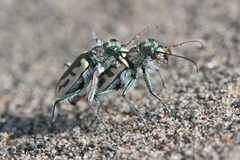
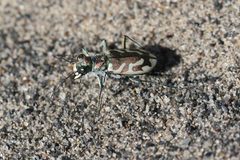
Cicindela arenicola is a rare, tiger restricted to sand dune in southern Idaho and southwestern Montana. First described by Rumpp in 1967 from the St. Anthony Dune system of the Snake River Valley, this is one of several closely related sand dune endemics in the C. maritima species group. display striking coloration with bold white elytral markings, green and highlights on the and pronotum, and dense white on the sides and undersurface. The species is considered globally imperiled due to its extremely limited range and ongoing degradation from plants, cattle trampling, and off-road vehicle traffic.
Pronunciation
How to pronounce Cicindela arenicola: //ˌkɪˈkɪndələ ˌærɪˈniːkələ//
These audio files are automatically generated. While they are not always 100% accurate, they are a good starting point.
Identification
Distinguished from the closely related C. waynei (Bruneau Dune Tiger ) by its generally bronze to coppery-red rather than green coloration, less expanded white markings, and absence of the upward-projecting tooth on the male that characterizes C. waynei. Distinguished from C. theatina (Colorado Dune Tiger Beetle) and other C. maritima group by geographic restriction to the Snake River Plain and specific sand dune associations. Fresh burrows with flat, horizontally-angled tunnels can indicate presence when adults are not active.
Images
Appearance
exhibit bold white maculations on the , with green and metallic highlights on the and pronotum. The sides and undersurface are covered with dense white hairs. The overall coloration ranges from coppery-red to greenish-red. Some individuals in south-central Idaho show green elytra with expanded white markings, resembling intergradation with C. waynei. The body is robust and adapted for rapid running on sand surfaces. Adults create distinctive burrows with flat, horizontally-angled tunnels that dive a few inches back into the sand.
Habitat
Strictly associated with active sand dune . are found on sloping, south-facing dune above flatter sand plains, and in sparsely vegetated areas of dunes where they appear somewhat less wary than on open dune surfaces. has been degraded by grasses (particularly downy brome, Bromus tectorum), cattle trampling, and off-road vehicular traffic.
Distribution
to the Snake River Plain of southern Idaho, primarily the St. Anthony Dune system in southeastern Idaho where the was first described. A small also occurs in the Centennial Sandhills of southwestern Montana. The species has one of the most restricted ranges among North American tiger beetles.
Seasonality
are most active during warm days in spring and fall. They retreat to burrows in the sand when conditions become very hot or cold. Adults hibernate during winter and emerge from burrows in spring to mate and lay . Activity patterns are bimodal (spring-fall), with fall activity being somewhat less predictable depending on moisture availability.
Life Cycle
hibernate in burrows during winter and emerge in spring to mate and lay . Larvae develop in burrows within the sand dune substrate; specific details of larval development and have not been extensively documented. First instar larvae may be present over an extended period, making timing of management activities an important conservation consideration.
Behavior
are extremely active and wary, making them difficult to approach for observation or photography. They dig burrows in sand for nightly and for shelter during excessively hot or cold conditions. Burrow placement appears non-random, with adults often digging in troughs between sand ripples where sand may be more stable. Adults in sparsely vegetated dune areas appear slightly less skittish than those on open dune surfaces. When disturbed, adults may dart away rapidly; their running capabilities make them challenging subjects for field photography.
Ecological Role
As a predatory , likely functions as an within sand dune . Larvae are known to be parasitized by tiphiid wasps in the Methocha, indicating a role in supporting . The ' presence indicates intact, active sand dune ecosystems with minimal vegetational encroachment.
Human Relevance
Considered for listing under the U.S. Act due to imperiled status, though federal listing has not been accorded. Listed as globally imperiled by the Idaho Department of Fish and Game and the Bureau of Land Management. Subject of habitat restoration efforts using herbicides (particularly imazapic) to control downy brome and restore native sand dune vegetation. Serves as a flagship for sand dune conservation in the Intermountain West. Research on this species has contributed to understanding of sand dune tiger and conservation management techniques.
Similar Taxa
- Cicindela wayneiClosely related formerly considered ; differs in green rather than bronze coloration, more expanded white markings, and presence of upward-projecting tooth on male . Restricted to Bruneau Dunes State Park in southwestern Idaho.
- Cicindela theatinaAnother C. maritima group restricted to single sand dune system in Colorado; similar and but geographically separated and with different coloration patterns.
- Cicindela albissimaRelated sand dune with vivid white coloration, restricted to Coral Pink Sand Dunes State Park in southwestern Utah; similar conservation status and threats.
More Details
Taxonomic history
C. waynei was until recently considered a geographic variant of C. arenicola; the two are now treated as separate based on consistent differences in coloration, maculation, and male mandibular . in south-central Idaho show intergradation of characters between the two species.
Conservation management
Herbicide treatment with imazapic has been successfully used to restore by reducing downy brome without negative impacts on native vegetation or tiger beetles. Laboratory confirmed low of imazapic to tiger beetles using C. repanda as a surrogate .
Population status
Despite prohibition of insect collecting, cattle grazing, and off-road vehicles within protected areas, continue to show evidence of decline due to ongoing threats from human trampling and applications to adjacent rangelands.
Sources and further reading
- BugGuide
- Wikipedia
- GBIF taxonomy match
- iNaturalist taxon
- NCBI Taxonomy
- St. Anthony Dune Tiger Beetle | Beetles In The Bush
- Cicindelidae | Beetles In The Bush | Page 9
- Saving endangered species with herbicides | Beetles In The Bush
- ID Challenge #13 – Addendum | Beetles In The Bush
- Bruneau Sand Dune tiger beetles caught in the act! | Beetles In The Bush