
Cicindela theatina
Rotger, 1944
Great Sand Dunes tiger beetle, Colorado Dune Tiger Beetle
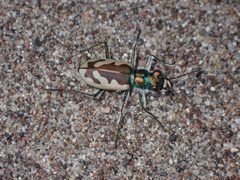
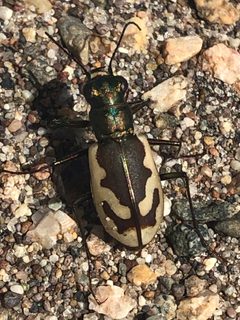
Cicindela theatina is a sand dune tiger restricted to approximately 290 km² in and around Great Sand Dunes National Park, Colorado. measure about 13 mm in length and display distinctive violin-shaped markings on the with iridescent green-blue . The exhibits classic thermoregulatory of sand-dwelling tiger beetles, including basking, stilting, and burrowing to cope with extreme temperature fluctuations. Its entire range falls within protected lands, contributing to its relatively secure conservation status despite its extremely limited distribution.
Pronunciation
How to pronounce Cicindela theatina: //ˌsɪsɪnˈdɛlə ˌθiːəˈtiːnə//
These audio files are automatically generated. While they are not always 100% accurate, they are a good starting point.
Identification
Distinguished from the only co-occurring similar , Cicindela lengi (blowout tiger beetle), by: complete broad white marginal band encircling the (versus narrower, often interrupted band in C. lengi); greenish to coppery-brown coloration (versus reddish in C. lengi); and metallic green-blue and pronotum. The violin-shaped elytral marking is also diagnostic.
Images
Habitat
Sparsely vegetated active sand dunes and sandy . are found on open dune , particularly south-facing slopes, and in areas with scattered vegetation that provides partial cover.
Distribution
to the San Luis Valley of south-central Colorado, USA. Range encompasses approximately 290 km², entirely within Great Sand Dunes National Park and The Nature Conservancy's Medano-Zapata Ranch to the west.
Seasonality
active during cooler morning and evening hours; dig into burrows during midday heat and at night. Mating occurs in late May, with larvae appearing in June. Adults emerge in July following approximately one year in larval stage.
Diet
Active ; specific prey items not documented but presumed to include small arthropods typical of sand dune tiger beetles.
Life Cycle
Approximately 2.5 year life span. Mating in late May; laid in June; larval stage lasts slightly more than one year; occurs in early summer; in July. Larvae construct burrows in sand for and protection.
Behavior
Highly active and skittish, making approach difficult. Exhibits thermoregulatory including basking (flattening against warm sand), stilting (elevating body on long legs), shade-seeking, and burrowing to avoid temperature extremes. dig burrows in sand for overnight and during unfavorable conditions.
Ecological Role
Apex in its sand dune ; likely regulates of smaller arthropods.
Human Relevance
Subject of conservation interest due to extremely restricted range; petitioned for federal listing in 2007. Entire protected within national park and conservation ranch lands. Popular target for insect collectors and photographers due to rarity and striking appearance.
Similar Taxa
- Cicindela lengiOnly sympatric tiger ; distinguished by reddish coloration, narrower elytral markings, and lack of complete marginal band
- Cicindela arenicolaClosely related sand dune from Idaho; differs in more coppery-red to greenish-red coloration and geographic separation
- Cicindela wayneiRelated sand dune from Idaho; greenish with distinctive upward-projecting tooth on male
More Details
Conservation status
Petitioned for federal listing in 2007 by WildEarth Guardians; not yet listed. Considered relatively secure due to complete protection of within Great Sand Dunes National Park and The Nature Conservancy's Medano-Zapata Ranch. Classified as globally imperiled by some authorities due to extreme range restriction.
Thermoregulatory adaptations
Dense lateral and setae protect against abrasion from wind-blown sand. employ multiple to maintain optimal body temperature across dune temperature ranges from 40°F to nearly 140°F.
Sources and further reading
- BugGuide
- Wikipedia
- GBIF taxonomy match
- iNaturalist taxon
- NCBI Taxonomy
- ID Challenge #15 | Beetles In The Bush
- Cicindelidae | Beetles In The Bush | Page 8
- ID Challenge #13 – Addendum | Beetles In The Bush
- St. Anthony Dune Tiger Beetle | Beetles In The Bush
- Bruneau Sand Dune tiger beetles caught in the act! | Beetles In The Bush