
Methocha
Latreille, 1804
Species Guides
1- Methocha stygia(ant-like wasp)
Pronunciation
How to pronounce Methocha: /məˈθoʊ.kə/
These audio files are automatically generated. While they are not always 100% accurate, they are a good starting point.
Identification
Females can be distinguished from the ants they resemble by their active hunting over ground, the visible sting apparatus when captured, and -like rather than antennal elbow structure. Males are readily identified as tiphiid wasps by wing venation and body form. The is distinguished from other tiphiids by the combination of wingless females, -like habitus, and specialized association with tiger larvae.
Images
Appearance
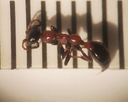
Females are wingless with elongated bodies, slender legs, and a -waisted petiole that superficially resembles ants in the Pseudomyrmex. They possess a well-developed sting apparatus. Males are fully winged with more typical wasp-like proportions. Both sexes have a relatively hairless, smooth .
Habitat
Sandy creek beds, receding bodies of water, and areas with loose soil suitable for tiger larval burrows. Often found in open, sparsely vegetated ground where tiger beetles are abundant.
Distribution
Worldwide distribution except Australia. Documented from North America, Europe, and Asia with records from Denmark, Norway, and Sweden.
Seasonality
females are highly seasonal and active primarily during periods when tiger larvae are accessible in their burrows. Most of the year they are rarely encountered.
Host Associations
- Cicindelidae (tiger beetles) - Females actively hunt tiger larvae in their burrows, sting and paralyze them, then lay on the immobilized .
Life Cycle
Females locate tiger larval burrows, entice the larva to attack by mimicking prey movement, evade the larva's , then rapidly sting the vulnerable underside to paralyze it. An is laid on the paralyzed , and the larva consumes the beetle larva. Males are collected with , suggesting aerial mate-searching .
Behavior
Females exhibit specialized aggressive hunting : they deliberately provoke tiger larvae to strike, allow themselves to be grasped by the larva's sickle-shaped to gain entry to the burrow, then evade and sting the . This represents a remarkable case of -prey role reversal and specialized . Females are highly active ground hunters, moving rapidly between burrows.
Ecological Role
regulator of tiger beetles. As a specialized , likely influences tiger and may affect -prey relationships in ground .
Human Relevance
Subjects of entomological research due to their remarkable behavioral and morphological adaptations. Occasionally encountered by tiger collectors and researchers. Sting is mild and usually does not pierce skin.
Similar Taxa
- Pseudomyrmex (ants)Females superficially resemble these slender, large-eyed ants in body form, size, and ground-foraging . Distinguished by anatomy, sting apparatus, and active hunting of tiger burrows rather than generalized foraging.
- Myzinum (tiphiid wasps)Also parasitize cicindelid larvae but differ in and hunting ; Myzinum females are winged and do not exhibit mimicry.
- Anthrax (bee flies)Also parasitize tiger larvae but are dipterans with very different ; females oviposit at burrow entrances without engaging the directly, and larvae attach externally rather than being provisioned in burrows.
More Details
Taxonomic Uncertainty
placement has varied between Tiphiidae and Thynnidae depending on classification system used. The is currently under revision with several undescribed species known, particularly from Texas.
Collection Challenges
Females are rarely collected due to their specialized and brief seasonal activity. Most museum specimens are males captured in . Active searching at tiger during peak activity periods is the most effective collection method.
Sources and further reading
- BugGuide
- Wikipedia
- GBIF taxonomy match
- iNaturalist taxon
- NCBI Taxonomy
- Cicindelidae | Beetles In The Bush | Page 9
- Hymenoptera | Beetles In The Bush | Page 7
- Working with Cerceris fumipennis—Epilogue | Beetles In The Bush
- parasitic wasps | Beetles In The Bush
- Bee Fly Parasitism of Tetracha virginica | Beetles In The Bush
- ID Challenge #11 | Beetles In The Bush
- Predatory behaviour in the ant-like wasp Methocha stygia (Say) (Hymenoptera: Tiphiidae)