
Myzinum
Latreille, 1803
New World Banded Thynnid Wasps
Species Guides
6Myzinum is a of thynnid wasps containing approximately 63 recognized , with 10 species occurring in North America. measure 7–24 mm and exhibit extreme : males are slender with long, straight and a prominent curled pseudostinger at the tip, while females are robust with short, coiled antennae and stout legs adapted for digging. These are of scarab beetle , particularly Phyllophaga species, and are used as agents. They are most diverse in the Neotropics and are commonly observed visiting autumn wildflowers such as goldenrod and thoroughwort.
Pronunciation
How to pronounce Myzinum: //ˈmaɪzɪnəm//
These audio files are automatically generated. While they are not always 100% accurate, they are a good starting point.
Identification
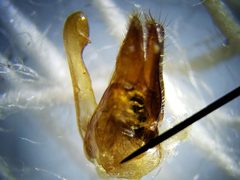
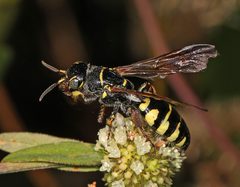
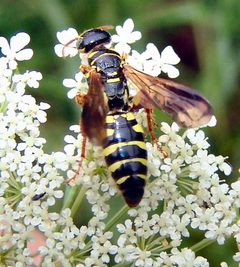
Males and females are dramatically different in appearance, to the point that they may appear to be different or even . Males have a slender, missile-shaped body, long straight , and a curled spine (pseudostinger) at the abdominal tip formed by external genitalia. Females are larger-bodied with a robust , short coiled antennae, and noticeably stouter legs. Species-level identification is extremely difficult even for ; a revised key for Nearctic species exists but the remains taxonomically challenging.
Images
Habitat
Found in open including fields, meadows, and prairies. visit flowers for nectar, particularly autumn-blooming such as goldenrod (Solidago) and thoroughwort (Eupatorium). Females require access to soil for digging up scarab beetle .
Distribution
New World distribution, with greatest diversity in the Neotropics. In North America, occurs east of the Rocky Mountains and in the Southwest; 10 recognized north of Mexico.
Seasonality
are active primarily in late summer and autumn, coinciding with bloom periods of goldenrod and thoroughwort.
Diet
feed on nectar from flowers. Larvae are internal that consume scarab beetle .
Host Associations
- Phyllophaga - primary May beetle white ; female dig up grubs, sting them into brief paralysis, and lay a single on each
- Scarabaeidae - Broader of scarab beetles whose larvae are parasitized
Life Cycle
Female locate scarab beetle below ground, dig them up, sting them into temporary paralysis, and lay a single on each . The grub recovers and reburies itself. The wasp larva hatches, bores into the host, and feeds slowly while the grub continues to live and feed. Eventually the wasp larva kills the host, pupates, and emerges as an the following summer.
Behavior
Males are more frequently observed than females because they spend more time on flowers and gather in groups on vegetation in early evening ('slumber parties'). Females are less conspicuous due to time spent underground locating and parasitizing . The male pseudostinger is a visual deterrent but cannot sting.
Ecological Role
agent for scarab beetle , particularly pest such as Phyllophaga. As , they invariably kill their , potentially regulating populations in grasslands and agricultural systems.
Human Relevance
Used as agents against white , which are significant agricultural and turf pests. The has been the subject of taxonomic revision due to historical confusion in identification.
Similar Taxa
- MethochaAlso tiphiid/thynnid wasps that parasitize tiger larvae; historically confused with Myzinum but targets different group (Cicindelinae rather than Scarabaeidae)
- TiphiaRelated tiphiid wasps that also parasitize scarab ; separation requires examination