
Myzinum maculatum
(Fabricius, 1793)
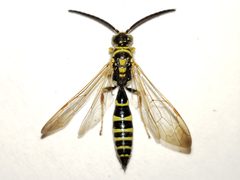
Myzinum maculatum is a of thynnid native to North America. It is a of scarab beetle , particularly Phyllophaga (May beetle) larvae, and has been employed as a agent for turf grass pests. The species exhibits pronounced : males are slender with long straight and a prominent curled pseudostinger, while females are robust with short coiled antennae and stout legs adapted for digging.
Pronunciation
How to pronounce Myzinum maculatum: //maɪˈzaɪnəm ˌmækjʊˈleɪtəm//
These audio files are automatically generated. While they are not always 100% accurate, they are a good starting point.
Identification
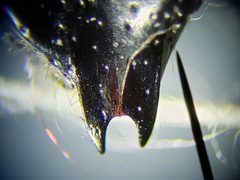
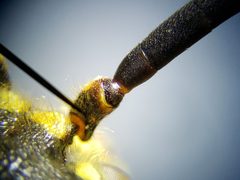
Distinguished from other Myzinum by subtle morphological characters requiring expert examination (species separation is notoriously difficult even for ). Males recognized by slender build, long straight , and curled abdominal pseudostinger. Females recognized by robust , short coiled antennae, and stout legs. From other thynnid : Myzinum males uniquely combine pseudostinger with long straight antennae; females uniquely combine robust build with coiled antennae. helps: active late summer through autumn, associated with goldenrod and thoroughwort blooms.
Images
Appearance
Medium-sized with striking . Males: slender, missile-shaped body; long, straight ; prominent curled spine (pseudostinger) at abdominal tip formed by external genitalia. Females: larger, robust ; short, coiled antennae; stouter legs for excavation. Both sexes visit flowers, with males more frequently observed due to extended flower-visiting .
Habitat
Open including prairies, meadows, and fields. Associated with turf grass environments where scarab larvae occur. frequent flowering vegetation, particularly autumn-blooming composites.
Distribution
North America east of the Rocky Mountains and in the Southwest. Precise range boundaries undocumented; occurs across most of North America north of Mexico.
Seasonality
active late summer through autumn (August–October), coinciding with bloom of goldenrod (Solidago) and thoroughwort (Eupatorium). Males observed in evening on vegetation.
Host Associations
- Phyllophaga - Scarab beetle ('white grubs'), particularly May beetle larvae. Female locate grubs underground, excavate them, sting to paralyze briefly, and oviposit. Larval wasp consumes internally, eventually killing it.
Life Cycle
development: female locates scarab below ground, digs to expose it, stings into brief paralysis, and lays single on . Host recovers and reburies, but larva hatches and bores into grub, feeding internally while host continues to feed and grow. Eventually larval wasp kills host, pupates, and emerges as the following summer. Uniparental or biparental pattern not specified.
Behavior
Males gather in evening ('slumber parties') on vegetation, bedding down in groups. Both sexes visit flowers for nectar; males more conspicuous due to extended flower-visiting. Females exhibit , digging in soil to locate . Males possess pseudostinger (non-functional in defense, part of genitalia) that appears intimidating but is harmless.
Ecological Role
agent of scarab beetle , particularly in turf grass . Acts as , regulating densities. contribute to pollination as flower visitors. Serves as food source for potential and (thick-headed flies observed attacking related ).
Human Relevance
Explicitly used as agent for turf grass pests. Valued in for scarab suppression in lawns and golf courses. Non-aggressive; pseudostinger of males appears threatening but is harmless. No documented medical or economic negative impacts.
Similar Taxa
- Other Myzinum speciesTen recognized north of Mexico, extremely difficult to distinguish morphologically even for experts. M. maculatum separation requires examination using revised keys (Kimsey 2009).
- Male vs. female Myzinum (within species) so extreme that genders were historically mistaken for different , , or . Recognition as requires knowledge of genus-specific dimorphism pattern.
- Other ThynnidaeMyzinum males distinguished by combination of pseudostinger and long straight ; females by robust build with coiled antennae and legs. Other thynnids lack this specific character combination.
Misconceptions
The male pseudostinger is frequently mistaken for a functional stinger, causing unnecessary alarm. It is actually part of the external genitalia and harmless. The extreme has led to males and females being misidentified as different or even higher .
More Details
Taxonomic history
Originally placed in Tiphiidae; now classified in Thynnidae following phylogenetic revision. Myzinum underwent taxonomic revision by Lynn Kimsey (2009) to clarify North American .
Research challenges
-level identification within Myzinum remains problematic; M. maculatum and require expert examination. applications may not distinguish between species, using 'Myzinum' generally.