
Phyllophaga
Harris, 1826
May beetles, June bugs, June beetles, July beetles
Species Guides
105is a large of New World scarab beetles comprising over 900 . are , attracted to artificial lights, and feed on foliage of trees and shrubs. Larvae are soil-dwelling white that feed on plant roots. The genus is economically significant as both adults and larvae can cause damage to agricultural crops and turf. Some species exhibit flightlessness and activity, representing derived traits within the genus.

Pronunciation
How to pronounce Phyllophaga: //ˌfɪ.ləˈfeɪ.ɡə//
These audio files are automatically generated. While they are not always 100% accurate, they are a good starting point.
Identification
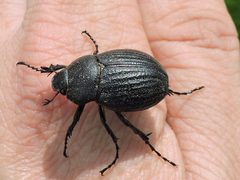
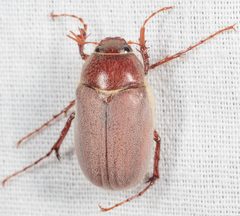
Distinguished from similar scarab by combination of size range, coloration, and hairiness. Separation from Polyphylla (lined June beetles) by lack of prominent longitudinal stripes on . Distinguished from Rhizotrogus and other Melolonthinae by geographic distribution (New World only) and specific antennal structure. -level identification is challenging and typically requires examination of genitalia; some species recognizable by unique traits such as flightlessness, activity, or distinct surface sculpturing (e.g., P. cribrosa with cribrose elytra and longitudinal furrows).
Images
Habitat
occur in diverse terrestrial including forests, grasslands, agricultural fields, and urban areas. Larvae inhabit soil in pastures, lawns, gardens, nurseries, golf courses, and agricultural fields. Some are restricted to specific habitats such as sand dunes or shortgrass prairie. Soil type and moisture influence larval distribution and survival.
Distribution
New World distribution: North America (Nearctic) and South America (Neotropical). Present from southern Canada through the United States, Mexico, and Central America to Argentina. Greatest in North America, with over 400 documented in the United States and Canada alone.
Seasonality
are active primarily in spring and early summer (May–July in temperate regions), with specific timing varying by and latitude. Some species active later in summer. Adults are and attracted to lights. Larvae are present year-round in soil, with activity increasing in spring.
Diet
feed on foliage of trees and shrubs, including deciduous trees and various ornamental plants. Larvae feed on roots of grasses, cereals, and other plants, including agricultural crops such as corn, wheat, and soybeans, as well as vegetables and young ornamental trees.
Host Associations
- trees and shrubs (adult foliage feeding) - food sourceVarious deciduous ; are leaf feeders
- grasses - larval food sourcePrimary for larval root feeding; includes turf grasses and pasture grasses
- agricultural crops - larval food sourceCorn, wheat, soybeans, and other crops damaged by root-feeding larvae
- vegetables and garden plants - larval food sourceLettuce, raspberries, strawberries, potatoes, and young ornamental trees
Life Cycle
duration varies by : most commonly one year, but some species require three years. Females lay 60–75 over approximately two weeks in midsummer, depositing them in soil. Eggs are initially elliptical (1.5 × 2.1 mm) and become more spherical as the larva develops. Eggs hatch in about 18 days. Larvae pass through three instars, growing from 8 mm at hatching to 40–45 mm at maturity. Larvae twice before winter and overwinter as , becoming active on warm winter days. occurs after the final larval instar. may overwinter before emerging in spring. In three-year species, larvae overwinter twice and adults once.
Behavior
are and strongly attracted to artificial lights, often appearing in great numbers. activity occurs after sunset. Some are flightless and (e.g., P. cribrosa, P. lanceolata), crawling on ground and clinging to low vegetation. Larvae typically rest in a characteristic comma-like position immediately below the soil surface. Larvae move horizontally through soil, attacking plants in along rows.
Ecological Role
Larvae are significant root herbivores in soil , affecting plant composition and agricultural productivity. function as folivores, contributing to nutrient cycling through leaf consumption. The serves as a critical for multiple including Pelecinidae, Tiphiidae (Myzinum), and Scoliidae, which regulate densities. Larvae are prey for birds (crows, skunks, moles, amphibians, and small mammals), with bird foraging (peeling back turf) serving as an indicator of . Some are considered ecosystem engineers through their soil burrowing activities.
Human Relevance
Major agricultural and turf pest. Larval feeding on crop roots causes yield losses in corn, wheat, soybeans, and other crops; damage appears as poorly growing patches that turn brown in dry weather. defoliate trees and shrubs, with causing significant damage. In turf and lawns, larval damage attracts vertebrate that further damage sod. Management includes crop with non- plants, , and foliar applications. Some occasionally damage new plantings in former grasslands due to limited adult abilities.
Similar Taxa
- PolyphyllaBoth are large Melolonthinae with 'June beetles'; Polyphylla distinguished by prominent longitudinal stripes on and more restricted associations (often sand dunes)
- RhizotrogusSimilar white larvae and ; Rhizotrogus is primarily Palearctic in distribution, overlapping only minimally with in the Nearctic
- MelolonthaSimilar and ecological role; Melolontha is Palearctic, with having more pronounced and different seasonal activity patterns
Misconceptions
The 'May beetle,' 'June bug,' and 'July ' are applied inconsistently across and regions, leading to confusion. Not all species are or capable of —some derived species are and flightless, contrary to the typical characterization of the . The three-year of some species is often overlooked, with management strategies sometimes incorrectly assuming cycles.
More Details
Etymology
Generic name derived from Greek phyllon (φυλλον, 'leaf') and phagos (φαγος, 'eater'), referring to folivorous habits.
Parasitoid associations
Larvae are primary for Pelecinus polyturator (Pelecinidae), Myzinum spp. (Tiphiidae/Thynnidae), and multiple Scoliidae and Tiphiidae . Some Pyrgotidae flies pursue in to oviposit under .
Species diversity
With over 900 , is one of the most speciose in the New World. Species identification is challenging and often requires examination of male genitalia; female genitalia also used for definitive identification.
Derived traits
Some (P. cribrosa, P. lanceolata, P. epigaea, P. zavalana) exhibit flightlessness and activity, representing evolutionary shifts from the ancestral , -capable condition. These species often have limited and are associated with specific such as dry grasslands or sand dunes.
Sources and further reading
- BugGuide
- Wikipedia
- GBIF taxonomy match
- iNaturalist taxon
- NCBI Taxonomy
- Catalogue of Life
- Bug Eric: The American Pelecinid Wasp
- May | 2016 | Beetles In The Bush
- economic pests | Beetles In The Bush
- Bug Eric: Wasp Wednesday: Myzinum
- Acrididae | Beetles In The Bush | Page 4
- The “black bringer of light” | Beetles In The Bush
- The Life History of Phyllophaga lanceolata (Say) and Phyllophaga crinita Burmeister*