
Pelecinidae
pelecinid wasps
Genus Guides
1- Pelecinus(American pelecinid wasps)
is a of parasitic in the superfamily Proctotrupoidea, containing only one living , Pelecinus, with three extant restricted to the Americas. The family was highly diverse during the Cretaceous, with fossils from 43 species in a dozen genera found across North America, Europe, and Asia dating back to the early Cretaceous (121–124 mya). Today, the family is represented by a single genus with three species: Pelecinus polyturator (widespread from southern Canada through South America), P. thoracicus (Mexico), and P. dichrous (South America). All species are of scarab beetle larvae.
Pronunciation
How to pronounce Pelecinidae: /pɛlɛˈsɪnɪdiː/
These audio files are automatically generated. While they are not always 100% accurate, they are a good starting point.
Identification
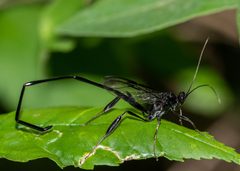
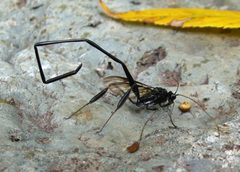
Instantly recognizable by the female's extremely long, thread-like and large size (over 2 inches). The swollen hind tibiae and black coloration are additional diagnostic features. Males are much smaller with shorter, widened abdomens and are rarely encountered, particularly at northern latitudes. Distinguished from giant ichneumons (Megarhyssa spp.) by the uniformly black coloration and unique abdominal proportions; ichneumons typically display patterned coloration and different body proportions.
Images
Appearance
Females are large, black measuring 51–62 mm in body length, with an extraordinarily elongated, thread-like comprising most of the body length. The hind tibia is distinctly swollen, giving the appearance of bell-bottomed legs. Males are much smaller (12–25 mm) with a shorter, widened abdomen at the tip. Both sexes lack a stinger and have the same glossy black coloration and inflated hind tibiae, though this character is less pronounced in males.
Habitat
Mesic bottomland forests, hardwood forest understories, woodland edges, riparian corridors, and landscaped urban parks. In South America, found in humid mountain ranges. are often observed near blacklights or resting on foliage in shaded areas.
Distribution
New World only. Pelecinus polyturator: southern Canada through the United States (east of Rocky Mountains), Mexico, Central America, and South America to Argentina; P. thoracicus: Mexico; P. dichrous: South America. Historical fossil distribution included North America, Europe, and Asia during the Mesozoic and early Cenozoic.
Seasonality
most common during August, with activity beginning in July and persisting into September; rarely observed in October. In South America, peak activity in March coinciding with rainy season in some regions.
Host Associations
- Phyllophaga anxia - common June beetle, primary in agricultural settings
- Phyllophaga spp. - May beetle larvae in soil
- Scarabaeidae larvae - subterranean scarab beetle generally
Life Cycle
Females use their elongated to probe soil and locate subterranean scarab beetle . A single is laid directly on or near a grub. The larva develops as a , though whether it is an internal or external has not been documented. Prepupal and pupal stages have been found in pasture soils. The complete duration is unknown.
Behavior
Females are fastidious groomers, folding their elongated to rub it with their hind legs. are attracted to blacklights. Males are extremely rare in northern , suggesting parthenogenetic may predominate in these areas. The female's oviposition involves penetrating soil to depths where scarab larvae occur.
Ecological Role
agent of scarab beetle pests, particularly Phyllophaga that damage agricultural crops and turf. As a , regulates of subterranean larvae in soil .
Human Relevance
Non-stinging and harmless to humans. Occasionally encountered in gardens and parks, sometimes causing alarm due to the female's large size and elongated resembling a stinger. Valued as a natural agent for agricultural pest scarabs.
Similar Taxa
- Megarhyssa spp. (giant ichneumons)similar large size and elongated body parts, but distinguished by patterned coloration, different abdominal structure, and (wood-boring horntails rather than soil-dwelling scarabs)
- Ichneumonidae (ichneumon wasps)general resemblance in body plan, but distinguished by smaller average size, different abdominal proportions, and lack of the characteristic swollen hind tibiae
Misconceptions
The female's extremely long is frequently mistaken for a dangerous stinger, causing unnecessary fear. The is incapable of stinging and is entirely harmless to humans. The rarity of males has led to speculation about , though this remains incompletely confirmed.
More Details
Fossil record
was highly diverse during the Cretaceous, with 43 in a dozen documented from fossils. Extinct genera include Archaeopelecinus, Cathaypelecinus, Eopelecinus, Megapelecinus, and numerous others from Jurassic and Cretaceous deposits across Asia, Europe, and North America. The represents a relict lineage with dramatically reduced modern diversity.
Reproductive biology
Geographical has been speculated based on the extreme rarity of males in northern (only 5 males recorded in Wisconsin, with 40+ year gaps between collections). Thelytoky (development of females from unfertilized ) would be unusual in Hymenoptera, where normally produces males from unfertilized eggs.
Taxonomic status
The contains only one living , Pelecinus, with three . This extreme relictual diversity contrasts with the family's rich fossil history, leading to informal characterization as 'living fossils'—a term acknowledging their ancient lineage and past diversity despite evolutionary derivation.
Sources and further reading
- BugGuide
- Wikipedia
- GBIF taxonomy match
- iNaturalist taxon
- NCBI Taxonomy
- Catalogue of Life
- Pelecinidae | Beetles In The Bush
- Hymenoptera | Beetles In The Bush | Page 5
- Bug Eric: The American Pelecinid Wasp
- First record of Pelecinus polyturator (Drury, 1773) (Hymenoptera: Pelecinidae) from Ceará state, Brazil
- A NOTE ON PELECINUS POLYTURATOR (HYMENOPTERA: PELECINIDAE), A PARASITE OF PHYLLOPHAGA ANXIA (COLEOPTERA: SCARABAEIDAE)
- Distribution of <i>Pelecinus Polyturator</i> in Wisconsin (Hymenoptera: Pelecinidae), With Speculations Regarding Geographical Parthenogenesis