
Polyphylla
Harris, 1841
Lined June Beetles
Species Guides
26- Polyphylla aeolus(Kelso Dunes June Beetle)
- Polyphylla anteronivea(Saline Valley Snow-front June Beetle)
- Polyphylla arguta
- Polyphylla avittata(spotted Warner valley dunes June beetle)
- Polyphylla barbata(Mount Hermon June Beetle)
- Polyphylla cavifrons
- Polyphylla comes(High Mountain June Beetle)
- Polyphylla crinita(Long-haired June Beetle)
- Polyphylla decemlineata(Ten-lined June Beetle)
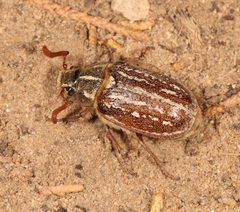
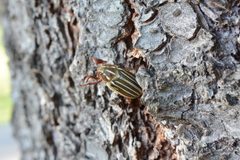
Polyphylla is a of scarab beetles in the Scarabaeidae, Melolonthinae, containing approximately 50–85 distributed across North America, Central America, southern and central Europe, northern Africa, and southern Asia. The genus is commonly known as "lined June beetles" due to the distinctive white elytral that form longitudinal stripes on most species. are and strongly attracted to lights, while larvae are root-feeders with extended development periods.

Pronunciation
How to pronounce Polyphylla: //ˌpɒlɪˈfɪlə//
These audio files are automatically generated. While they are not always 100% accurate, they are a good starting point.
Identification
Distinguished from the more common and diverse Phyllophaga (May beetles) by larger body size, more robust and somewhat flattened build, and especially by the prominent white longitudinal stripes on the formed by pale . Male specimens are readily identified by their spectacularly enlarged, fan-shaped with elongated antennomeres—structures used for detecting female . The genus is further distinguished by activity and strong attraction to lights. -level identification requires examination of specific elytral scale patterns and male genitalia.
Images
Habitat
Primarily associated with sandy soils and dune systems, though also found in forests and orchards. Many show strong specificity to particular sand dune formations. are encountered in open areas near their larval plants; larvae occur underground feeding on roots.
Distribution
Disjunct distribution spanning: North America (most diverse in southwestern United States), Central America, southern and central Europe, northern Africa, and southern Asia from Asia Minor eastward to Japan. North American diversity concentrated in sand dune of the Great Plains and southwestern deserts.
Seasonality
activity peaks in late spring through summer (June–July in temperate regions). Males fly actively beginning in late afternoon, with peak activity at dusk and early night. Activity ceases shortly to several hours after sunset. In arid regions, triggered by rainfall events.
Diet
Larvae feed on roots of various plants; specific associations vary by . of some species have been observed feeding on pine needles and other plant material, though adult feeding habits are incompletely documented and some species may not feed as adults.
Life Cycle
laid on soil near plants. Larvae hatch and immediately burrow down to feed on roots. Larval development extends two to three years before . emerge to mate; females of some are flightless, particularly those restricted to sand , and remain near the ground surface to release .
Behavior
Males exhibit distinctive -tracking : beginning in late afternoon with rapid, irregular several meters above ground, transitioning at dusk to rapid upwind flight followed by slow zig-zag return flight indicative of osmoclinotaxic orientation. Upon detecting female pheromone, males alight within centimeters of the female. Multiple males frequently converge on a single female. Males produce loud, buzzing flight and conspicuously splay their fan-like while actively searching. Attraction to lights is pronounced; males often collide with light sources or nearby objects with audible impact. Females of sand-dwelling rarely collected due to flightlessness and burrowing behavior.
Ecological Role
Larvae function as root herbivores, potentially impacting plant health in localized areas. serve as prey for and may contribute to nutrient cycling through feeding activities. The represents a component of scarab beetle diversity in sand dune , where their specialized associations make them indicators of dune ecosystem integrity.
Human Relevance
Occasionally encountered by entomologists and naturalists at blacklight events; valued by collectors due to large size, striking appearance, and relative rarity compared to common scarabs. Some may cause minor damage to orchard or forestry plantings through larval root-feeding. The 'June beetle' leads to confusion with the more abundant Phyllophaga species.
Similar Taxa
- PhyllophagaSimilar 'May/June beetle' and general scarab body plan, but distinguished by smaller size, lack of prominent elytral striping, less robust build, and less dramatically enlarged male
- PrionusSimilarly large, scarabs attracted to lights and lures in sand dune , but distinguished by elongated body form, extremely long in males (not fan-like), and different elytral texture without pale striping
Misconceptions
The 'June beetle' is widely applied to both Polyphylla and the far more common Phyllophaga, leading to frequent misidentification by the public. Many Polyphylla remain poorly known, with females of numerous species undescribed due to their flightless, burrowing habits.
More Details
Female rarity in collections
Females of many , particularly sand dune , are flightless and rarely encountered by standard collecting methods. The best technique for locating females is to listen for the sound of males hitting the ground or vegetation after locating a female, then searching the immediate area.
Species diversity
counts vary between sources (approximately 50–85 species), reflecting taxonomic uncertainty and the difficulty of collecting adequate material for some poorly known species.
Sources and further reading
- BugGuide
- Wikipedia
- GBIF taxonomy match
- iNaturalist taxon
- NCBI Taxonomy
- Catalogue of Life
- What a Night for Moths and Spectators! | Bug Squad
- Like a Moth to a Flame: Moth Night at Bohart Museum of Entomology | Bug Squad
- Super duper June bugs | Beetles In The Bush
- Bug Eric: National Moth Week Recap, 2015
- 2018 New Mexico/Texas Insect Collecting Trip “iReport” | Beetles In The Bush
- Bug Eric: Results of the Red Rock Canyon Open Space Bioblitz
- Love Apple (Paris polyphylla): Biology, Uses and Conservation