
Phyllophaga cribrosa
(LeConte, 1853)
Ribbed Phyllophaga
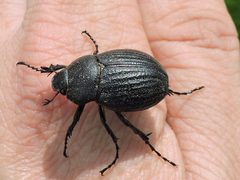
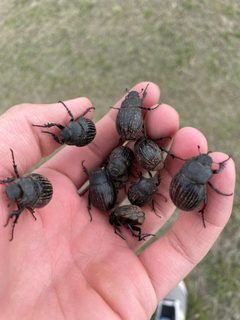
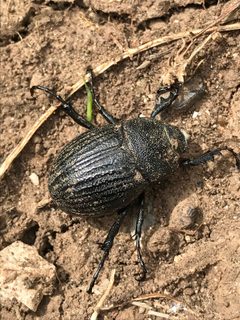
Phyllophaga cribrosa is a flightless scarab beetle in the Melolonthinae, distinguished from most by its , ground-dwelling habits. are recognized by their oval, convex, shining black bodies with a distinctive cribrose (sieve-like) surface texture and longitudinal elytral furrows. The occurs in dry across the south-central United States and northern Mexico, where it has been documented as an occasional agricultural pest.
Pronunciation
How to pronounce Phyllophaga cribrosa: //ˌfɪl.oʊˈfɑː.ɡə ˈkrɪb.roʊ.sə//
These audio files are automatically generated. While they are not always 100% accurate, they are a good starting point.
Identification
The combination of flightless habit, activity, oval convex body, shining black coloration, and cribrose elytral surface with distinct longitudinal furrows distinguishes P. cribrosa from other Phyllophaga . Two closely related species, P. epigaea and P. zavalana, occur in Texas but lack the distinct elytral furrows present in P. cribrosa. Most other Phyllophaga are and capable of .
Images
Appearance
are oval and strongly convex with a smooth, shining black . The bear distinct longitudinal furrows and a cribrose (perforated, sieve-like) surface texture. are 10-segmented and . The overall form resembles certain darkling beetles (Tenebrionidae), likely due to convergent to arid environments. Adults are flightless, with reduced or non-functional wings.
Habitat
Dry grasslands, shortgrass prairie, and gypsum-capped mesa environments. are found on the ground or clinging to low vegetation. The shows particular association with red clay soils and gypsum exposures in northwestern Oklahoma. Agricultural fields in former grasslands may also harbor due to limited adult ability.
Distribution
South-central United States (Oklahoma, Texas, New Mexico, Indiana) and northern Mexico (Coahuila, Nuevo León). The western Oklahoma represents a notably western occurrence within the .
Seasonality
have been observed in June in northwestern Oklahoma, with activity during daylight hours. Specific across the full range remains poorly documented.
Diet
feed on foliage; larvae feed on roots of grasses and other plants. Documented as an occasional pest of crops, particularly when agricultural fields replace former grassland .
Host Associations
- grasses - larval food sourcelarvae feed on roots
- crops - occasional pestdamage results from limited when grasslands are converted to agriculture
Life Cycle
Complete with , larva (white ), pupa, and stages. Larvae are subterranean root-feeders. Adults are flightless, restricting and promoting local persistence.
Behavior
and ground-dwelling, in contrast to the , -capable habits of most Phyllophaga. crawl on the ground and climb low vegetation. Flightlessness limits , making vulnerable to fragmentation but persistent within suitable patches.
Ecological Role
Larvae function as root herbivores in grassland . contribute to herbivory on low vegetation. The ' limited makes it a poor colonizer of new but a persistent resident where established.
Human Relevance
Occasional agricultural pest, particularly in new crop plantings on former grassland. Limited economic impact due to restricted distribution and ability. Subject of entomological interest due to distinctive and atypical habits within a large, taxonomically challenging .
Similar Taxa
- Phyllophaga epigaeaSimilar oval, convex, black form but restricted to Texas and lacks distinct elytral furrows
- Phyllophaga zavalanaSimilar overall appearance but restricted to Texas and lacks distinct elytral furrows
- Tenebrionidae (darkling beetles)Convergent similarity in body form and use; distinguished by structure and elytral surface texture
More Details
Taxonomic note
The was originally described as Tostegoptera cribrosa by LeConte in 1853 before transfer to Phyllophaga. The Phyllophaga contains over 400 North American species, making species-level identification challenging and often requiring examination of genitalia; P. cribrosa is exceptional in being readily identifiable by external characters.
Conservation implication
Flightlessness and limited make vulnerable to conversion, though the ' of some agricultural settings may buffer against complete loss.