
Tenebrionidae
Latreille, 1802
Darkling beetles, Чернотелки
Subfamily Guides
8- Alleculinae(Comb-clawed Darkling Beetles)
- Blaptinae(darkling beetles)
- Diaperinae
- Lagriinae(Long-jointed Beetles)
- Phrenapatinae(darkling beetles)
- Pimeliinae
- Stenochiinae
- Tenebrioninae(darkling beetles (subfamily))
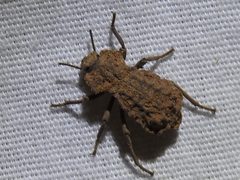
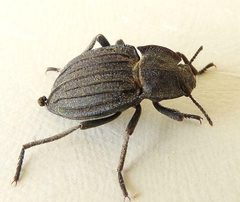
is one of the largest of beetles, with more than 20,000 described distributed globally. Members are predominantly , consuming decaying plant matter, fungi, and lichens. The family exhibits remarkable ecological diversity, from desert sand dunes to forest floor . Several species are significant pests of stored products, while others serve as important decomposers and bioindicators of health. Notable adaptations include fog-basking in desert-dwelling and chemical defense mechanisms in many species.

Pronunciation
How to pronounce Tenebrionidae: /tɛnəˈbriːəʊnɪdaɪ/
These audio files are automatically generated. While they are not always 100% accurate, they are a good starting point.
Identification
Distinguished from other by the combination of: heavily sclerotized and typically dull ; with 11 segments that are neither strongly clubbed nor serrate; with five segments (fourth segment small and concealed); and frequently reduced hind wings. Eleodes are recognized by their characteristic -stand defensive posture and tuberculate elytral . Desert-dwelling Onymacris species with white are distinguished from by coloration and geographic distribution in the Namib Sand Sea. Lagriinae larvae are identified by their -like appearance combined with six legs and coleopteran head capsule.
Images
Habitat
Extremely diverse, encompassing arid deserts, steppe and forest-steppe zones, woodland edges, floodplain forests, and anthropogenic environments. Specific microhabitats include: sandy ridges and dunes; soil beneath woody and shrub vegetation; loose soil up to 10 cm depth for oviposition; bark of dead and decaying trees; slopes with sparse, sun-exposed vegetation; and open glades with dry, well-drained substrates. Some inhabit acacia thickets, while others occur in riparian zones or human-modified landscapes such as agricultural fields and stored product facilities.
Distribution
distribution with highest diversity in arid and semi-arid regions. Documented from: North America (Great Plains from Canada to Mexico, western states); South America (Brazil); Africa (Namib Desert, North Africa to southern Sahara limits and northern Somalia); Europe (Western Europe to England, southern Norway, Switzerland, Finland; Eastern Europe to forest-steppe; Middle and Southeast Europe); Asia (Front Asia, North India, Mongolia, China, Japan, Korea, Kazakhstan, Central Asia, Far East); and introduced worldwide including stored product pests. Specific study sites in the Chechen Republic include the Tersko-Sunzhensky ridge, Tersko-Kumskaya lowland, and Terek floodplain.
Seasonality
activity varies by and climate. In temperate regions, peak abundance typically occurs April–May due to mass and from sites. Specific records include: Blaps lethifera adults emerging early April; Opatrum sabulosum appearing in traps late March to early April; Dendarus crenulatus adults present from late March through November; Tenebrio obscurus adults appearing late June to July. Field collections in the Chechen Republic documented activity from April through October 2015, with seasonal dynamics varying by species and ecological group.
Diet
Predominantly detritivorous, feeding on decaying plant material, fungi, mosses, and lichens. Some consume green vegetation and various crop plants. Larvae of many species feed on decaying wood, guano, and other insects. Several species are significant pests of stored products: Tenebrio molitor, Tenebrio obscurus, Tribolium confusum, Tribolium castaneum, and Gnathocerus cornutus infest food supplies. Mealworms (larvae of Tenebrio molitor) have been documented digesting polystyrene (Styrofoam) through gut bacterial action.
Life Cycle
Development typically includes , larva, pupa, and stages, with considerable variation in duration and strategy. Blaps lethifera: spring type, overwinters as larvae and adults, females lay eggs in second decade of May. Blaps halophila: adults overwinter in soil or litter, eggs laid in loose soil up to 10 cm depth. Opatrum sabulosum: lifespan 1–2 years, overwinters in litter or upper soil layer, eggs laid early May to early June, larvae appear late May to late June, adults emerge July–August. Pedinus femoralis: overwinters as adults of varying ages and larvae, extended egg-laying period through entire vegetation period resulting in overlapping larval cohorts. Tenebrio obscurus: one per year, adults appear late June–July. Tenebrio molitor: females lay 150–200 eggs, young adults appear late July–early August. Oodes-celis polita: adults and larvae overwinter, eggs laid May–July, larval development 4–6 months with partial . Gonocephalum pusillum: overwintering adults emerge early April, two abundance peaks (late April and late July–August), eggs laid late April–early May, larval development approximately one month. Dendarus crenulatus: adults appear late March, present until November, larvae live in soil.
Behavior
Many exhibit defensive when disturbed, elevating the and emitting foul-smelling secretions from abdominal glands. Eleodes species are famous for this "-stand" posture. Blaps halophila is flightless and active primarily in morning and evening hours, preferring dry sites where and larvae are vulnerable to moist conditions. Tenebrio molitor fly in evening and night. Pedinus femoralis leads a hidden lifestyle in soil and litter. Onymacris species exhibit fog-basking: positioning body to collect condensation on , which runs to the mouth for water intake. Some species show background-matching behavior for avoidance. Mass of beetles have been observed, particularly in Eleodes species crossing highways in early evening.
Ecological Role
Important decomposers in natural and anthropogenic , processing decaying plant material and contributing to nutrient cycling. Serve as convenient model organisms for studying patterns of formation and functioning of faunistic complexes. Used as bioindicators of anthropogenic changes in steppe ecosystems, with sensitivity of and larvae to temperature and humidity changes linked to patterns. group by abundance in steppe zones of some regions. Some function as pests in agricultural and stored product contexts. Food source for various including birds, reptiles, and small mammals. In the Namib Desert, Onymacris species represent a charismatic component of the fauna with specialized adaptations to arid conditions.
Human Relevance
Several are major pests of stored grain and food products, causing economic losses worldwide. Tenebrio molitor larvae (mealworms) are widely used as feed for captive reptiles, amphibians, and birds, and are increasingly utilized in (human consumption) and as a protein source in animal feed. Mealworms have demonstrated ability to digest polystyrene plastic, with potential applications in waste management. Some species damage crops: Dendarus crenulatus and larvae damage crops; Crypticus quisquilius sometimes damages various crop plants. Darkling beetles are frequently encountered by firewood collectors when splitting logs, where they overwinter beneath bark. Subject of scientific research on speciation, to arid environments, and evolutionary . Popular in educational and museum contexts, including live displays.
Similar Taxa
- Carabidae (ground beetles)Similar elongate body form and ground-dwelling habits, but distinguished by thread-like inserted between and , prominent predatory mandibles, and typically .
- Staphylinidae (rove beetles)Both contain found in decaying matter and soil, but rove beetles have greatly shortened exposing most of the , and more flexible bodies.
- Lagriidae (now Lagriinae within Tenebrionidae)Formerly treated as separate ; larvae of Lagriinae such as Goniadera have distinctive -like with heavy , but share characteristics with other .
- Cerambycidae (longhorn beetles)Larvae of both may be found in decaying wood, but cerambycid larvae are typically soft-bodied, pale, and C-shaped, with very long in ; tenebrionid larvae are heavily sclerotized and elongate.
More Details
Research significance
The Onymacris in the Namib Desert serves as a model system for studying ecological drivers of speciation, trait evolution, and -prey dynamics. Research includes mark-recapture survivability analyses, experiments using clay and 3D-printed models, and investigation of genetic basis of white coloration in sand dune .
Temperature sensitivity
Gnathocerus cornutus has documented temperature limits of 15–32°C for development and cannot complete its below 10°C, illustrating the thermal constraints affecting stored product pest .
Collection methods
Soil pitfall traps with preservative (0.5L plastic cups, 20 traps per at 10m intervals) have proven effective for sampling darkling beetles, with sampling once per decade recommended for monitoring seasonal dynamics.
Sources and further reading
- BugGuide
- GBIF taxonomy match
- iNaturalist taxon
- NCBI Taxonomy
- Catalogue of Life
- UC Davis Doctoral Student Iris Quayle to Study Darkling Beetles in Africa | Bug Squad
- Quick: What Critter Eats Styrofoam? | Bug Squad
- Insects roasting on an open fire: Bess beetles, Passalidae, carpenter ants, Formicidae, darkling beetles, Tenebrionidae, and longhorn beetles, Cerambycidae — Bug of the Week
- Beetles roasting on an open fire: Roundheaded borers, Cerambycidae; Flatheaded borers, Buprestidae; and Darkling beetles, Tenebrionidae — Bug of the Week
- Black olives with legs | Beetles In The Bush
- Answers to ID Challenge #5 – Artrópodes em casca de árvore morta | Beetles In The Bush
- Biology of Palembus (Martianus) dermestoides Chevrolat (Coleoptera; Tenebrionidae)
- РОДОВОЙ АНАЛИЗ ЖУКОВ-ЧЕРНОТЕЛОК (COLEOPTERA, TENEBRIONIDAE) ЧЕЧЕНСКОЙ РЕСПУБЛИКИ