
Pimeliinae
Latreille, 1802
Tribe Guides
12Pimeliinae is a of darkling beetles (Tenebrionidae) comprising multiple tribes distributed across arid and semi-arid regions worldwide. The subfamily includes notable groups such as the Sepidiini of the Afrotropical Realm, whose members Ocnodes and Psammodes are known as "toktokkies" for their distinctive tapping communication . Several exhibit morphological adaptations for life, including conical peg on tibiae. The subfamily encompasses both flightless and flying , with some of the largest tenebrionid species such as Stridulomus sulcicollis (~80 mm).
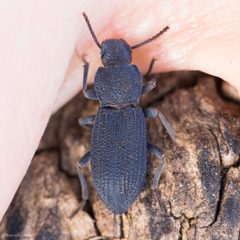
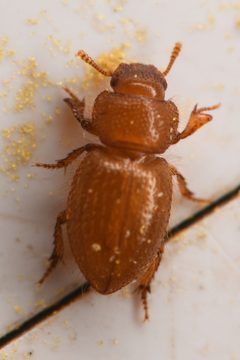
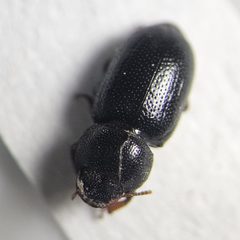
Pronunciation
How to pronounce Pimeliinae: //pɪˈmɛli.iːˌnaɪ//
These audio files are automatically generated. While they are not always 100% accurate, they are a good starting point.
Images
Habitat
Ground-dwelling in arid and semi-arid environments including desert, Puna, and Atacaman biogeographic provinces. Collection records indicate presence on soil surfaces of farms, under rocks, in mountain areas, storage facilities, and jungle margins. Some lineages show morphological adaptations for life.
Distribution
Widely distributed throughout the Afrotropical Realm with several reaching the southern Western Palaearctic; present in the southern Iberian Peninsula and western Maghreb (northern and western Morocco); South American in Peru, Bolivia, Chile, and Argentina; northern Chile (25°–31° South); Cuatrociénegas Protected Area in Coahuila, Mexico; Sindh province, Pakistan; Arabian Peninsula.
Behavior
Tapping for sexual communication observed in some Sepidiini, primarily in the Ocnodes and Psammodes, producing the "toktokkies". Many larger are flightless and not capable of sustained ; this condition has been documented in Uloma simplex and is under observation in other .
Human Relevance
Some cause economic damage to agricultural crops and pose food safety risks in processing, manufacturing, distribution, and retail segments through of stored products. Pimelia capito and Trachyderma phalistinia recorded as pests in agricultural areas of Sindh, Pakistan.
Similar Taxa
- TenebrioninaeBoth are within Tenebrionidae; distinguished by morphological characters including cardo and stipes of and prelabium not covered by , margin of postgenae with maxillary ridge or emargination, and elytral base without vertical in Pimeliinae
More Details
Morphological diagnostic characters
Cardo and stipes of and prelabium not covered by ; margin of postgenae with maxillary ridge or emargination; 11-segmented ; mesocoxae with visible (reduced in Sepidiina and some Molurina); large scutellum extending across entire width of mesothoracic peduncle; elytral base without vertical .
Notable size records
Stridulomus sulcicollis represents the largest known tenebrionid at approximately 80 mm in length.
Taxonomic diversity
The tribe Sepidiini alone comprises six subtribes, 55 , 33 subgenera, and 1009 and . The genus Philorea contains 15 species in Peru; the genus Pilobalia contains 26 species and two subspecies in Peru.
Sources and further reading
- BugGuide
- Wikipedia
- iNaturalist taxon
- NCBI Taxonomy
- Catalogue of Life
- A catalogue of the tribe Sepidiini Eschscholtz, 1829 (Tenebrionidae, Pimeliinae) of the world
- The genus Philorea in Peru: checklist and distribution records (Coleoptera: Tenebrionidae: Pimeliinae: Physogasterini)
- A Revision of the Genus Eschatomoxys Blaisdell (Tenebrionidae: Pimeliinae: Edrotini) with Notes on the Biology
- Revision of the subgenus Mesopraocis Flores & Pizarro-Araya of the Neotropical genus Praocis Eschscholtz (Coleoptera, Tenebrionidae, Pimeliinae)
- The genus Pilobalia Burmeister 1875 in Peru: updated checklist and distribution records (Coleoptera: Tenebrionidae: Pimeliinae: Nycteliini)
- Taxonomy of the North Moroccan and Iberian species of the subgenus Amblypteraca (Coleoptera: Tenebrionidae: Pimeliinae: Pimelia)
- The Tribe Cossyphodini (Coleoptera: Tenebrionidae: Pimeliinae) of the Arabian Peninsula, with Notes on Biology and Ecology
- A new species of Stenomorpha Solier (Coleoptera: Tenebrionidae: Pimeliinae: Asidini) from Cuatrociénegas, Mexico with a key to the furcata species group
- Taxonomy of subfamily Tenebrioninae (Latreille, 1802) and Pimeliinae (Latreille, 1802) (Coleoptera: Tenebrionidae) with new record from Sindh, Pakistan.
- A Revision ofCraniotusLeconte (Coleoptera: Tenebrionidae: Pimeliinae: Asidini), with Descriptions of New Insular Species from Mexico and Notes on Distribution and Biology