
Uloma
Dejean, 1821
Species Guides
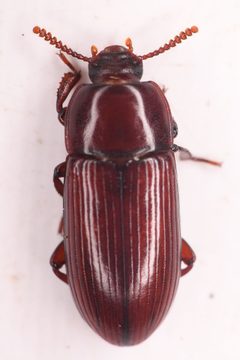
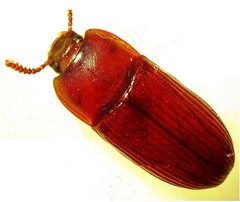
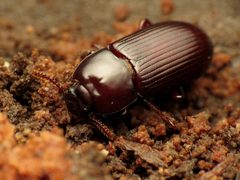
6Uloma is a of darkling beetles in the Tenebrionidae comprising more than 200 and worldwide. The genus is particularly diverse in China, with at least 37 recorded species. stages have been described for few species, revealing oligopod larvae and exarate pupae with in some species. Members are primarily associated with decaying wood in forest .
Pronunciation
How to pronounce Uloma: /juːˈloʊmə/
These audio files are automatically generated. While they are not always 100% accurate, they are a good starting point.
Images
Habitat
have been collected beneath bark of rotten trunks and in decaying wood in warm, moist forests. Laboratory rearing indicates association with soft parts of rotten wood.
Distribution
Worldwide distribution with more than 200 and . In China, recorded from Fujian, Hainan, Guangdong, Sichuan, Chongqing, and Guizhou provinces. In Russia, four species occur: one in the European part and Russian Caucasus, one with transpalaearctic range, and two sympatric species restricted to Primorsky krai in the Russian Far East.
Seasonality
of U. intricornicula collected in January (Hainan), May (Chongqing), June–July (Sichuan, Guizhou), and August (Guizhou, Guangdong), suggesting year-round activity with regional variation.
Diet
Larvae and have been reared on soft parts of rotten trunks and decaying wood.
Life Cycle
Complete with , larva, pupa, and stages. Larvae are oligopod, subcylindrical, with sharp tail-end. Pupae are exarate. observed in pupal pronotum in some .
Behavior
found beneath bark of rotten trunks. in pupal stage: male pupae have sparse pronotum , females have denser tubercles.
Ecological Role
Decomposer in forest , associated with decaying wood.
More Details
Taxonomic diversity
The comprises more than 200 and worldwide, with 37 species recorded from China. Only two Chinese species have described stages: Uloma metogana and U. intricornicula.
Molecular identification
Molecular phylogenetic analyses using mtDNA COI sequences have been used to associate larvae with in U. excisa excisa.
Sources and further reading
- BugGuide
- Wikipedia
- iNaturalist taxon
- NCBI Taxonomy
- Catalogue of Life
- Identification and morphological description of the larva of Uloma (Uloma) excisa excisa Gebien, 1914 (Coleoptera: Tenebrionidae: Ulomini)
- Uloma (Uloma) intricornicula Liu, Ren & Wang, 2007 (Coleoptera, Tenebrionidae, Ulomini): Descriptions of the larva and pupa and new distributional records
- Composition and distribution of the genus Uloma Dejean, 1821 (Coleoptera: Tenebrionidae) in Russia
- Figure 5 from: Niu Y, Ren G, Liu S (2023) Uloma (Uloma) intricornicula Liu, Ren & Wang, 2007 (Coleoptera, Tenebrionidae, Ulomini): Descriptions of the larva and pupa and new distributional records. Biodiversity Data Journal 11: e107036. https://doi.org/10.3897/BDJ.11.e107036
- Figure 8 from: Niu Y, Ren G, Liu S (2023) Uloma (Uloma) intricornicula Liu, Ren & Wang, 2007 (Coleoptera, Tenebrionidae, Ulomini): Descriptions of the larva and pupa and new distributional records. Biodiversity Data Journal 11: e107036. https://doi.org/10.3897/BDJ.11.e107036
- Figure 2 from: Niu Y, Ren G, Liu S (2023) Uloma (Uloma) intricornicula Liu, Ren & Wang, 2007 (Coleoptera, Tenebrionidae, Ulomini): Descriptions of the larva and pupa and new distributional records. Biodiversity Data Journal 11: e107036. https://doi.org/10.3897/BDJ.11.e107036
- Figure 1 from: Niu Y, Ren G, Liu S (2023) Uloma (Uloma) intricornicula Liu, Ren & Wang, 2007 (Coleoptera, Tenebrionidae, Ulomini): Descriptions of the larva and pupa and new distributional records. Biodiversity Data Journal 11: e107036. https://doi.org/10.3897/BDJ.11.e107036
- Figure 4 from: Niu Y, Ren G, Liu S (2023) Uloma (Uloma) intricornicula Liu, Ren & Wang, 2007 (Coleoptera, Tenebrionidae, Ulomini): Descriptions of the larva and pupa and new distributional records. Biodiversity Data Journal 11: e107036. https://doi.org/10.3897/BDJ.11.e107036
- Figure 9 from: Niu Y, Ren G, Liu S (2023) Uloma (Uloma) intricornicula Liu, Ren & Wang, 2007 (Coleoptera, Tenebrionidae, Ulomini): Descriptions of the larva and pupa and new distributional records. Biodiversity Data Journal 11: e107036. https://doi.org/10.3897/BDJ.11.e107036
- Figure 6 from: Niu Y, Ren G, Liu S (2023) Uloma (Uloma) intricornicula Liu, Ren & Wang, 2007 (Coleoptera, Tenebrionidae, Ulomini): Descriptions of the larva and pupa and new distributional records. Biodiversity Data Journal 11: e107036. https://doi.org/10.3897/BDJ.11.e107036
- Figure 3 from: Niu Y, Ren G, Liu S (2023) Uloma (Uloma) intricornicula Liu, Ren & Wang, 2007 (Coleoptera, Tenebrionidae, Ulomini): Descriptions of the larva and pupa and new distributional records. Biodiversity Data Journal 11: e107036. https://doi.org/10.3897/BDJ.11.e107036
- Figure 7 from: Niu Y, Ren G, Liu S (2023) Uloma (Uloma) intricornicula Liu, Ren & Wang, 2007 (Coleoptera, Tenebrionidae, Ulomini): Descriptions of the larva and pupa and new distributional records. Biodiversity Data Journal 11: e107036. https://doi.org/10.3897/BDJ.11.e107036