
Asidini
Fleming, 1821
Genus Guides
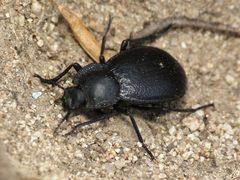
8Asidini is a tribe of darkling beetles (Tenebrionidae: Pimeliinae) containing more than 30 and over 260 described in North America alone. Members are primarily flightless and inhabit arid and semi-arid environments across western North America and Mexico. The tribe is notable for exhibiting diverse defensive strategies including and of chemically defended Eleodes species.


Pronunciation
How to pronounce Asidini: /ˌæ.sɪˈdaɪ.naɪ/
These audio files are automatically generated. While they are not always 100% accurate, they are a good starting point.
Identification
Asidini can be distinguished from other Pimeliinae tribes by combinations of morphological characters including tarsal structure and elytral form. Within the tribe, such as Stenomorpha and Craniotus are recognized by specific diagnostic features; Stenomorpha historically suffered from taxonomic confusion due to lack of modern revision until recent systematic work. elytral varies considerably and is used to assess mimetic relationships with Eleodes model species.
Images
Habitat
Arid and sub-arid including desert regions, scrublands, and associated environments. Specific documented localities include the Sierra Transvolcanica and southern Transverse ranges in Mexico, California vernal pools, and the Cuatrociénegas Protected Area in Coahuila, Mexico. Insular occur on Mexican islands.
Distribution
Western North America from the United States through Mexico. All ten North American are restricted to the western half of the continent. The tribe has broader global distribution in arid regions worldwide, with significant diversity in Mexico including insular .
Behavior
Members exhibit two contrasting defensive strategies: (background matching or pattern disruption) and of chemically defended Eleodes . Flightlessness is widespread throughout the tribe, potentially limiting and contributing to patterns observed in Stenomorpha.
Similar Taxa
More Details
Taxonomic History
The Stenomorpha within Asidini historically contained 88 with no modern species-level revision for nearly 175 years. Recent systematic work by Fran Keller and colleagues recognized 51 valid species with seven new subgenera, while synonymizing or recombining 37 formerly recognized species.
Defensive Strategy Evolution
Phylogenetic analysis of North American Asidini reconstructs as the ancestral defensive state, with two independent origins of and multiple evolutionary reversals. The tribe represents a promising system for studying the evolution of defensive phenotypes due to the coexistence of strongly to weakly cryptic alongside varying degrees of mimetic fidelity.
Sources and further reading
- BugGuide
- Wikipedia
- iNaturalist taxon
- Catalogue of Life
- Fran Keller: Entomologist, Teacher, Artist, Author | Bug Squad
- The evolution of Batesian mimicry within the North American Asidini (Coleoptera: Tenebrionidae)
- A new species of Stenomorpha Solier (Coleoptera: Tenebrionidae: Pimeliinae: Asidini) from Cuatrociénegas, Mexico with a key to the furcata species group
- A Revision ofCraniotusLeconte (Coleoptera: Tenebrionidae: Pimeliinae: Asidini), with Descriptions of New Insular Species from Mexico and Notes on Distribution and Biology