
Microschatia
Solier, 1836
Species Guides
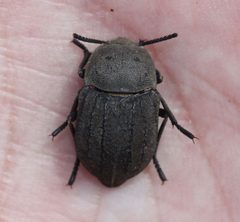
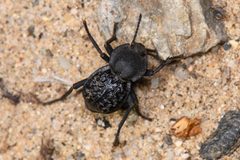
4Microschatia is a of darkling beetles ( Tenebrionidae) found in arid regions of southwestern North America. The genus was established by Solier in 1836 and contains approximately 15 described . These beetles inhabit dryland environments and are adapted to xeric conditions. The genus is taxonomically well-established within the Tenebrionidae, though detailed biological studies remain limited for many species.
Pronunciation
How to pronounce Microschatia: /ˌmaɪkroʊˈskæt.i.ə/
These audio files are automatically generated. While they are not always 100% accurate, they are a good starting point.
Identification
Members of Microschatia can be distinguished from other Tenebrionidae by a combination of morphological features, though specific diagnostic characters require examination of . The genus name refers to the reduced or shortened nature of certain body structures. -level identification relies on subtle differences in elytral , body proportions, and punctation patterns. Comparison with closely related genera in the same geographic region is necessary for accurate determination.
Images
Habitat
Arid and semi-arid drylands of southwestern North America, including desert scrub, chaparral, and dry grassland . occur in areas with well-drained soils and sparse vegetation cover.
Distribution
Southwestern North America, including portions of the southwestern United States and northwestern Mexico. The is to the Nearctic region with concentration in the Sonoran and Chihuahuan Desert areas.
Similar Taxa
- Other Tenebrionidae genera in southwestern North AmericaCo-occur in similar arid ; Microschatia distinguished by -specific morphological characters including body form and elytral structure
More Details
Species Diversity
The includes 15 described : M. inaequalis, M. impar, M. polita, M. rockefelleri, M. robusta, M. punctata, M. morata, M. championi, M. cedrosensis, M. araneoides, M. diversa, M. planata, M. solieri, M. sulcipennis, and M. costulata. Several species are named after prominent collectors or locations.
Etymology
The name derives from Greek 'micro-' (small) and 'schatio' (divided or cleft), likely referring to reduced or shortened structures visible in the original .