
Blaptinae
Leach, 1815
darkling beetles
Tribe Guides
5- Amphidorini
- Blaptini
- Opatrini(darkling beetles)
- Pedinini
- Platynotini
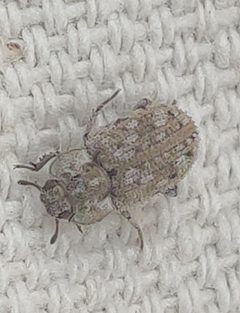
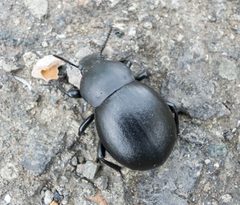
Blaptinae is a large of darkling beetles (Tenebrionidae) containing approximately 283 and 4,000 , classified into 8 tribes. The subfamily was resurrected and redefined in 2021 based on morphological and molecular evidence, with seven tribes transferred from Tenebrioninae. Members are among the most widespread and abundant darkling beetles in arid regions globally, often dominating local faunas in desert . Ovoviviparity has been documented in at least one tribe (Platynotini), where females carry fully developed first-instar larvae.
Pronunciation
How to pronounce Blaptinae: /blapˈtiːnai/
These audio files are automatically generated. While they are not always 100% accurate, they are a good starting point.
Identification
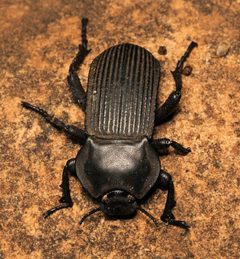
Blaptinae can be distinguished from other Tenebrionidae by the combination of morphological characters that supported its 2021 resurrection, including features of the mouthparts, wing structure, and genitalia. Within Blaptinae, tribes are distinguished by characters such as body form, tarsal structure, and male genital . Members of Blaptini are typically medium to large (17–22 mm), black and shiny, with long cylindrical bodies and flightless condition.
Images
Habitat
Arid and semi-arid environments, including deserts, steppes, and high-elevation plateaus. In desert , members often form the component of local faunas. High-elevation representatives occur on the Qinghai-Xizang (Tibetan) Plateau at elevations of 3,300–4,500 m.
Distribution
in arid regions worldwide. Particularly abundant and diverse in the Palaearctic region, including deserts of Central Asia (Iran, Turkmenistan), the Tibetan Plateau, and African deserts (Namib, Kalahari).
Life Cycle
Larvae of some (e.g., Nalepa, Gnaptorina) are subcylindrical, yellowish-brown, 30–35 mm in length, with distinct thoracic and abdominal segmentation. Larvae are collected in the field together with , suggesting overlapping or extended breeding periods.
Behavior
Flightlessness has been documented in multiple (e.g., Nalepa, Pseudognaptorina), representing an to stable, wind-swept environments. Ovoviviparity occurs in Platynotini, with females retaining fully developed first-instar larvae in the bursa copulatrix.
Ecological Role
component in several desert , contributing substantially to and ecosystem processes in arid environments.
Similar Taxa
- TenebrioninaePreviously contained many tribes now placed in Blaptinae; distinguished by molecular and morphological characters including mouthpart and genitalia structure
- PimeliinaeAnother large of Tenebrionidae with arid-adapted ; distinguished by different tarsal and elytral characteristics
Sources and further reading
- BugGuide
- Wikipedia
- iNaturalist taxon
- NCBI Taxonomy
- Catalogue of Life
- Contribution to the knowledge of the genus Dendarus Dejean, 1821 (Coleoptera: Tenebrionidae: Blaptinae: Dendarini) from Iran, Turkmenistan and some adjacent territories
- Systematic review of the genus Pseudognaptorina Kaszab, 1977 (Coleoptera, Tenebrionidae, Blaptinae, Blaptini) from the Qinghai-Xizang Plateau, with description of six new species
- Systematic Review of the Genus Nalepa Reitter, 1887 (Coleoptera, Tenebrionidae, Blaptinae, Blaptini) from the Tibetan Plateau, with Description of Six New Species and Two Larvae
- Phylogeny-based reinterpretation of the genus Blaps Fabricius, 1775 (Coleoptera, Tenebrionidae, Blaptinae) from China, with description of two new species.
- Description of five larvae of the genus Gnaptorina Reitter, 1887 from Xizang, China (Coleoptera, Tenebrionidae, Blaptinae), with molecular species delimitation and diagnoses.