
Cerambycidae
Latreille, 1802
Longhorn beetles, Long-horned beetles, Longicorn beetles
Subfamily Guides
8- Cerambycinae(Round-necked Longhorn Beetles)
- Disteniinae(disteniid longhorn beetles)
- Lamiinae(Flat-faced Longhorn Beetles)
- Lepturinae(flower longhorn beetles)
- Necydalinae
- Parandrinae
- Prioninae(Tooth-necked and Aberrant Longhorn Beetles)
- Spondylidinae
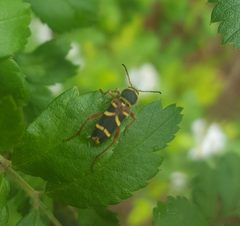
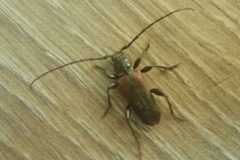
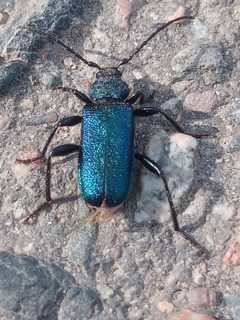
is a large of beetles comprising approximately 35,000 described worldwide. Members are characterized by exceptionally long , often exceeding body length, which gives rise to their . The family exhibits diverse ecological strategies, with larvae predominantly developing in woody tissues and showing varied feeding habits including pollen, nectar, and foliage consumption. Many species are important ecological decomposers of dead and dying wood, while some are significant forest pests.
Pronunciation
How to pronounce Cerambycidae: //sɛˌræmˈbɪsɪˌdiː//
These audio files are automatically generated. While they are not always 100% accurate, they are a good starting point.
Identification
can be distinguished from other by the combination of long (typically longer than body in most ), elongated body, and with five visible segments (though fourth segment is often small and concealed). They differ from Buprestidae (jewel beetles) by their longer antennae and more cylindrical rather than flattened body form. They can be separated from Chrysomelidae (leaf beetles) by antenna length and body proportions. Within Coleoptera, the family is most readily confused with Disteniidae, which are now often treated as a separate family but share similar overall .
Images
Habitat
Larvae develop predominantly in woody substrates including living trees, dead standing timber, fallen logs, stumps, and roots. Specific microhabitats vary by and : Prioninae larvae typically inhabit roots and lower boles of trees; Cerambycinae often in branches and twigs; Lamiinae in diverse wood types including hardwoods and conifers. are found in association with larval , on flowers, or on foliage. Some species occupy specialized habitats such as grasslands (root-boring Prioninae) or high-elevation forests.
Distribution
distribution with highest diversity in tropical regions. Particularly -rich in Neotropical, Afrotropical, and Indo-Malayan regions. Well-represented across North America, Europe, and Asia with decreasing diversity at higher latitudes. Some exhibit restricted distributions (e.g., Borneostyrax in Borneo), while others are nearly cosmopolitan.
Seasonality
activity periods vary markedly by and latitude. Temperate species typically active from late spring through summer (May–August), with some early spring (e.g., Molorchus spp.) active in April–May. Tropical species may be active year-round. Many species exhibit peak activity during specific periods, often correlated with flowering of plants or optimal temperature conditions. Some species are attracted to artificial light.
Diet
: variable, including pollen, nectar, flowers, foliage, bark, and fungi; some do not feed as adults. Larvae: wood-borers that feed on phloem, cambium, and xylem tissues of woody plants; some species require specific tree species while others are .
Host Associations
- Angiosperms (hardwoods) - larval developmentmajor group for most Cerambycinae and many Lamiinae
- Gymnosperms (conifers) - larval developmentprimary for many Lamiinae and some Cerambycinae; Monochamus specialized on conifers
- Cornus florida (flowering dogwood) - visitation, possible larval Tilloclytus geminatus and related -mimics observed on flowers
- Pinus spp. (pines) - larval developmentMonochamus scutellatus and related breed in dead/dying pines
- Quercus gambelii (Gambel oak) - probable larval Prionus heroicus associated with this oak in New Mexico and Oklahoma
- Salix lapponum (downy willow) - exclusive larval Saperda populnea lapponica specialized on this
Life Cycle
Complete with four stages: , larva, pupa, . Eggs laid in bark crevices, wounds, or directly into wood. Larvae are elongate, legless or with reduced legs, and bore through wood creating galleries; development typically takes 1–3 years depending on and wood quality. occurs in a near the wood surface or within the gallery. Adults emerge by chewing exit holes. Some tropical species exhibit ovoviviparity (retention of eggs until larvae hatch), documented in Borneostyrax from Borneo.
Behavior
of many stridulate by rubbing thoracic segments together, producing audible squeaks for defense or communication. Males of some species (e.g., Monochamus) emit that attract both sexes to oviposition sites. Mate guarding observed in Monochamus scutellatus, where males remain with females during oviposition. -mimicking species (e.g., Tilloclytus, Molorchus, Euderces) exhibit rapid, erratic movements resembling ants. Some root-boring Prioninae attracted to prionic acid lures. Adults of many flower-visiting species are ; others are and attracted to light.
Ecological Role
Primary decomposers of dead and dying wood, facilitating nutrient cycling in forest . Some contribute to tree mortality by attacking stressed or damaged trees, creating for other organisms. Serve as prey for birds, mammals, and other insects. Act as when visiting flowers. Some species function as for plant (e.g., pinewood Bursaphelenchus xylophilus transmitted by Monochamus).
Human Relevance
Major forest pests: Anoplophora glabripennis (Asian longhorned beetle) and related cause extensive tree mortality and are subject to and efforts. Some damage timber and wooden structures. Used as bioindicators for forest health and conservation planning. Subject of significant taxonomic and ecological research due to high diversity and ecological importance. Some species are collected for the pet trade or scientific study.
Similar Taxa
- DisteniidaeFormerly included in ; share elongated bodies and long but differ in antennal insertion and other structural features, now treated as separate by most authorities
- Buprestidae (jewel beetles)Share wood-boring larvae and metallic , but have short, serrate and flattened, often sculptured bodies rather than cylindrical form with long antennae
- Chrysomelidae (leaf beetles)Some elongated forms resemble cerambycids, but have shorter (typically not exceeding body length) and different tarsal structure
More Details
Subfamily diversity
contains multiple with distinct : Cerambycinae (flower visitors, diverse ), Lamiinae (flat-faced longhorns, often ), Prioninae (large root borers, often non-feeding ), Lepturinae (flower longhorns), Spondylidinae, and others. Reproductive strategy differs among subfamilies: Prioninae complete gametogenesis in pupa with non-feeding adults, while Lamiinae continue production through adult life.
Reproductive modes
The exhibits diverse reproductive strategies. Most are , but ovoviviparity (retention of with larvae hatching before deposition) has been documented in Borneostyrax from Borneo—the first confirmed case in . Some Prioninae have non-feeding with degenerate .
Chemical communication
communication is well-developed in the . Monochamus males produce pheromones that attract conspecifics to stressed trees. Prionic acid serves as a long-range attractant for some Prionus , though males often cannot precisely locate sources without additional chemical cues. Antennal detect host volatiles and pheromones.
Sources and further reading
- BugGuide
- GBIF taxonomy match
- iNaturalist taxon
- NCBI Taxonomy
- Catalogue of Life
- Group mimicry in Cerambycidae… and more | Beetles In The Bush
- Cerambycidae | Blog
- Insects roasting on an open fire: Bess beetles, Passalidae, carpenter ants, Formicidae, darkling beetles, Tenebrionidae, and longhorn beetles, Cerambycidae — Bug of the Week
- Picking up good vibrations from big Bornean beetles: flat-faced (Lamiinae) and tooth-necked (Prioninae) longhorn beetles — Bug of the Week
- Bug Eric: Mate Guarding and Oviposition in the White-spotted Sawyer, Monochamus scutellatus (Coleoptera: Cerambycidae)
- February | 2015 | Beetles In The Bush
- Transfer of Bursaphelenchus okinawaensis (Nematoda: Aphelenchoididae) associated with Monochamus maruokai (Coleoptera: Cerambycidae) into M. alternatus (Coleoptera: Cerambycidae) and Psacothea hilaris (Coleoptera: Cerambycidae)
- New species of Cerambycidae from Panama, with new distribution records (Coleoptera: Cerambycidae)
- On the Reproduction of Prionoplus reticularis (Coleoptera, Cerambycidae), with General Remarks on Reproduction in the Cerambycidae
- Single Sensillum Recordings Reveal Antennal Responses of Monochamus alternatus and Monochamus saltuarius (Coleoptera: Cerambycidae) to Pheromones and Host Volatiles.