
Alleculinae
Laporte, 1840
Comb-clawed Darkling Beetles
Tribe Guides
4- Alleculina(comb-clawed beetles)
- Gonoderina
- Mycetocharina
- Xystropodina
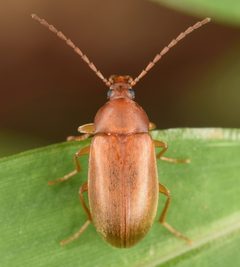
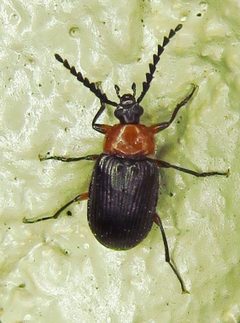
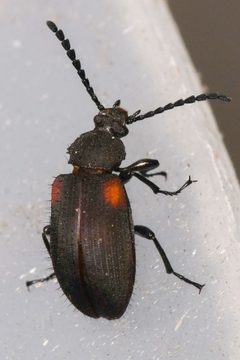
Alleculinae is a of comb-clawed beetles within the Tenebrionidae, containing over 230 divided into two tribes: Alleculini and Cteniopodini. Members are characterized by oval bodies, threadlike , relatively long legs, and notably elongated with combed claws on the hind tarsi bearing fine teeth. The subfamily has worldwide distribution and was formerly treated as a separate family (Alleculidae) before being incorporated into Tenebrionidae.
Pronunciation
How to pronounce Alleculinae: //ˌælɛˈkjuːlɪni//
These audio files are automatically generated. While they are not always 100% accurate, they are a good starting point.
Identification
Distinguished from other Tenebrionidae by the combed claws on hind with fine teeth. are threadlike rather than bead-like. Differs from ground beetles (Carabidae) in having concealed beneath the rather than exposed forward-directed jaws, and in lacking the rapid running typical of carabids. Some (e.g., Hymenorus) may have antennae superficially resembling ground beetles, but concealed jaws confirm placement in Alleculinae.
Images
Appearance
Oval body shape with threadlike . Legs relatively long with notably elongated . Most distinctive feature is the combed claws of the hind tarsi, which display fine teeth—giving the group its . Body size varies; for example, fossil Asiomira range 4.8–8.12 mm.
Distribution
Worldwide distribution with over 230 . Extant of some genera (e.g., Asiomira) currently restricted to arid landscapes of Central Asia with highest diversity in Tajikistan, though fossil evidence from Eocene Baltic amber suggests ancestral wider range. Species of Cornucistela occur in central Saudi Arabia.
Similar Taxa
- Carabidae (ground beetles)Both groups have elongated bodies and may be found in similar ; distinguished by ground beetles having exposed forward-directed , longer-than-wide antennal segments appearing as single filaments, and rapid running versus Alleculinae having concealed mandibles, threadlike , and combed hind tarsal claws
- Lagriinae (long-jointed beetles)Another recently incorporated into Tenebrionidae alongside Alleculinae; differs in body form and lacks the distinctive combed claws of Alleculinae
- Other Tenebrionidae subfamiliesClassic darkling beetles typically have bead-like antennal segments and lack the elongated with combed claws characteristic of Alleculinae
More Details
Taxonomic History
Alleculinae was formerly treated as a separate (Alleculidae) but has been incorporated into Tenebrionidae as a , along with Lagriinae. This reclassification reflects phylogenetic relationships revealed by molecular studies.
Tribal Classification
The is divided into two tribes: Alleculini and Cteniopodini. Molecular phylogenetic studies indicate that Cteniopodini is monophyletic.
Fossil Record
The Eocene Baltic amber fossil Asiomira dubrovinae represents the first fossil record of the Asiomira and provides evidence for formerly broader geographic ranges of Alleculinae lineages, with modern distributions representing secondary expansion from mid-mountain refugia with arboreal and shrub vegetation.
Sources and further reading
- BugGuide
- Wikipedia
- iNaturalist taxon
- NCBI Taxonomy
- Catalogue of Life
- Bug Eric: ID Tip: Ground Beetle or Darkling Beetle?
- Bug Eric: 2016
- New data on diagnostics and distribution of the little-known comb-clawed beetle Cornucistela serrata (Coleoptera: Tenebrionidae: Alleculinae)
- The first fossilized comb-clawed beetle of the genus Asiomira Dubrovina, 1973 (Coleoptera: Tenebrionidae: Alleculinae) from Baltic Amber and notes on the distribution of extant species of the genus
- First report of complete mitochondrial genome in the subfamily Alleculinae and mitochondrial genome‐based phylogenetics in Tenebrionidae (Coleoptera: Tenebrionoidea)
- Two new species of Mycetochara Guérin-Méneville, 1827 (Coleoptera: Tenebrionidae: Alleculinae) from the Northern Cis-Azov region and the Northwestern Caucasus (Russia) with a new synonymy and a key to species of the European part of Russia