
Trox scaber
Linnaeus, 1767
Hide beetle, Scarab beetle
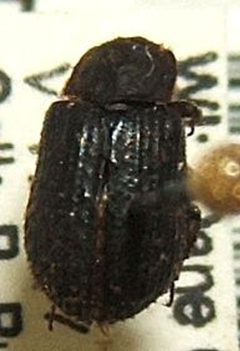
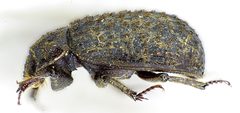
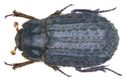
Trox scaber is a small hide in the Trogidae, measuring 5–8 mm. It has a nearly distribution and is strongly associated with bird nests, where both and larvae develop. The feeds on dried animal remains including skin, feathers, fur, and small dry carcasses. It is characterized by rough, sculptured and pronotum with distinctive bristly , and exhibits a remarkable death-feigning when disturbed.
Pronunciation
How to pronounce Trox scaber: /trɔks ˈskeɪbər/
These audio files are automatically generated. While they are not always 100% accurate, they are a good starting point.
Identification
Distinguished from other Trox by the combination of brownish-yellow (not black) bristles, rust-red , and the specific pattern of elytral : 10 thin, evenly shallowly punctured stripes with alternating wider arched and narrower spaces bearing rows of small humps with short strong bristles. The rough surface texture (source of the species name 'scaber') is diagnostic. Similar hide beetles in the Trogidae may be separated by bristle color, antennal coloration, and details of elytral sculpture.
Images
Habitat
Primarily found in the substructure of older large bird nests, including those of tawny owls, other owl , jackdaws, woodpeckers, and various cavity-nesting birds. Also occurs in smaller bird nests, bird carcasses, hides, and occasionally at entrances to underground animal dens. Heat-loving; in Central Europe most common in low-elevation terrain, rare in alpine regions.
Distribution
Nearly . Palaearctic: widespread across Europe (including British Isles, Scandinavia, Mediterranean), North Africa, Asia to Japan and Siberia. Nearctic: Canada (Alberta to Quebec) and USA (widespread including Florida, Texas, Midwest). Neotropical: Argentina, Mexico, Panama. Australian: New South Wales, South Australia, Victoria. Oriental: Malaysia (Sabah). Also recorded from Azores, Canary Islands, Taiwan.
Diet
and larvae feed on small dry carcasses, especially when desiccated; primarily consumes dried skin, feathers, fur, and connective tissue. Has been observed on coyote scat containing fur, suggesting exploitation of any available keratinous or dried animal material.
Life Cycle
Larvae develop in bird nests, particularly those of tawny owls and other owls, as well as hollow tree nests of jackdaws, woodpeckers, and similar cavity nesters. Developmental details otherwise poorly documented.
Behavior
Exhibits strong death-feigning () : when disturbed, freezes in a rigid, random posture and becomes completely immobile, often caked in debris to the point of being unrecognizable as a living insect. Can produce chirping noises by rubbing against . fly only reluctantly.
Ecological Role
Decomposer specializing in the final stages of vertebrate decomposition, consuming dried remains after other carrion insects have departed. Contributes to nutrient recycling in bird nest microhabitats and facilitates breakdown of keratinous materials.
Human Relevance
Occasional presence in human dwellings when attracted to animal remains or associated materials. Generally harmless; no economic or medical significance. May be encountered by forensic entomologists in late-stage decomposition scenarios.
Similar Taxa
- Trox sonoraeSimilar size range and preferences, but T. scaber distinguished by distribution (T. sonorae North American) and specific sculptural details
- Other Trox speciesEuropean fauna includes ~21 in subgenus Trox; separation requires examination of bristle color, antennal coloration, and precise elytral ridge patterns
- Dermestes speciesShare on carrion and dried remains; distinguished by Dermestidae having clubbed with 3–5 segments and different body shape