
Trox sonorae
LeConte, 1854
Hide beetle
Trox sonorae is a small hide beetle in the Trogidae, first described by LeConte in 1854. measure 8–11 millimeters and are typically found on carrion in advanced stages of decay, where they consume dried skin, feathers, fur, and connective tissue. The has been recorded from the Nearctic ecozone (Canada and the United States), Mexico, and China. It is closely allied to scarab beetles and exhibits distinctive defensive .
Pronunciation
How to pronounce Trox sonorae: /trɒks səˈnɔːraɪ/
These audio files are automatically generated. While they are not always 100% accurate, they are a good starting point.
Identification
Distinguished from other small carrion beetles by its rough, debris-covered texture and (death-feigning) when disturbed. The small size (8–11 mm) and association with desiccated carcasses rather than fresh carrion separates it from larger carrion beetles in Silphidae and Histeridae. The family Trogidae can be recognized by their close alliance with Scarabaeidae and their specialized feeding on dried animal matter.
Images
Appearance
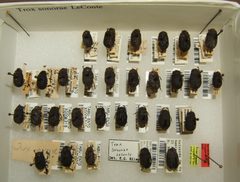
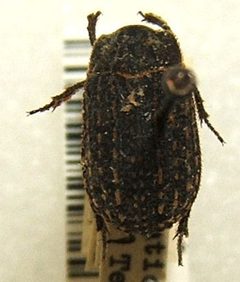
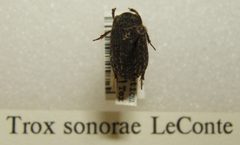
are 8–11 millimeters in length with a rough, textured . The body surface is usually so caked in debris that the appears nearly unrecognizable as an insect. When disturbed, individuals freeze in a rigid, random posture. The overall form is compact and somewhat cryptic, adapted for concealment among dried animal remains.
Habitat
Found in association with carrion in advanced stages of decay, particularly dried carcasses where skin, feathers, fur, and connective tissue remain. Has been observed on coyote scat containing fur from prey animals. Occurs in open including prairies and ranchlands.
Distribution
Nearctic ecozone: Canada (Alberta, Northwest Territories, Saskatchewan), United States (Kansas, Louisiana, Missouri, Nebraska, New Mexico, North Dakota, South Dakota, Texas). Also recorded from Mexico (Chihuahua, Durango, México, Nuevo León, Sonora, Zacatecas) and China (Palaearctic).
Diet
and larvae feed on dried skin, feathers, fur, and connective tissue from desiccated animal carcasses. Has been observed on coyote scat containing fur, suggesting exploitation of animal matter in alternative forms.
Life Cycle
Larval development occurs within dried animal remains, feeding on keratinous materials. Specific details of -laying and sites are not documented for this .
Behavior
Exhibits (death-feigning) when disturbed, freezing in a rigid, random posture so convincingly that specimens are easily mistaken for dead. are frequently covered in debris, enhancing . They are slow-moving and easily overlooked due to small size and camouflage.
Ecological Role
Decomposer specializing in the final stages of vertebrate carcass breakdown, converting dried skin, feathers, and hair into nutrients. Arrives after most other carrion insects have departed, representing a late-successional in carrion decomposition.
Human Relevance
Occasionally encountered by forensic entomologists and biologists studying carrion . Harmless to humans; does not infest living animals or stored products. May be incidentally collected during ecological surveys or scat analysis.
Similar Taxa
- Trox spp.Other hide beetles in the same share similar size, debris-covered appearance, and . Specific identification requires examination of subtle morphological characters not reliably distinguished in field observations.
- Dermestes spp.Skin beetles in Dermestidae also occur on dried carcasses and bones, but have smoother, more rounded bodies with distinct patterns and do not exhibit the extreme of Trox.
- Nicrophorus spp.Burying beetles (Silphidae) are larger (11–22 mm), more robust, and active on fresher carcasses where they bury remains and provide parental care— and distinct from Trox sonorae.
More Details
Etymology
The specific epithet 'sonorae' refers to Sonora, a state in northwestern Mexico within the ' range.
Collection notes
Specimens are easily lost in captivity due to small size, cryptic appearance, and making them difficult to locate even in confined spaces.