
Phyllophaga aemula
(Horn, 1887)
May beetle, June beetle
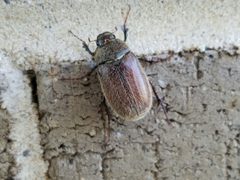
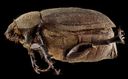
Phyllophaga aemula is a of scarab beetle in the Scarabaeidae, commonly known as a May beetle or June beetle. It belongs to a large of over 400 species in North America, many of which are difficult to distinguish without examination of genitalia. Like other members of its genus, it has subterranean larval stages and aerial . The species was originally described as Lachnosterna aemula by Horn in 1887.
Pronunciation
How to pronounce Phyllophaga aemula: /ˌfɪl.oʊˈfeɪ.ɡə ˈiː.mjʊ.lə/
These audio files are automatically generated. While they are not always 100% accurate, they are a good starting point.
Identification
-level identification within Phyllophaga is notoriously difficult and typically requires examination of male and female genitalia. No distinctive external morphological features have been documented that reliably separate P. aemula from other members of the without dissection.
Images
Distribution
Found in North America. GBIF records indicate presence in the eastern and south-central United States, specifically: Alabama, Arkansas, Florida, Georgia, Louisiana, Maryland, Mississippi, New Jersey, North Carolina, Oklahoma, South Carolina, Texas, and Virginia.
Similar Taxa
- Phyllophaga cribrosaBoth are flightless Phyllophaga , but P. cribrosa is readily distinguished by its cribrose (sieve-like) elytral surface, oval convex shape, and distinct longitudinal elytral furrows. P. aemula lacks these diagnostic features.
- Other Phyllophaga speciesOver 400 exist in North America; most require genitalia examination for definitive identification. P. aemula cannot be reliably distinguished from based on external alone.