
Myzininae
Genus Guides
1- Myzinum(New World Banded Thynnid Wasps)
Myzininae is a of within the Thynnidae (formerly placed in Tiphiidae). The subfamily is best known through the Myzinum, which exhibits extreme . Females are robust, of scarab beetle , while males are slender, non-stinging, and frequently observed on flowers. in this subfamily are found primarily in the Nearctic region, with ten recognized species north of Mexico.
Pronunciation
How to pronounce Myzininae: //ˌmaɪzɪˈnaɪni//
These audio files are automatically generated. While they are not always 100% accurate, they are a good starting point.
Identification
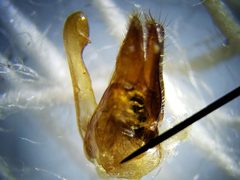
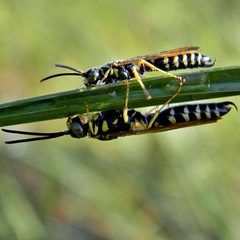
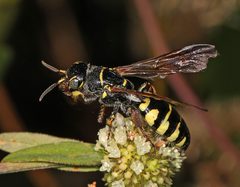
Males and females are strikingly different in appearance and may be mistaken for separate . Females have robust , stout legs adapted for digging, and short, coiled . Males are slender and streamlined with long, straight antennae. Males possess a curled, spine-like pseudostinger at the abdominal tip (part of the external genitalia) that resembles a true stinger but cannot deliver venom. Species-level identification within Myzinum is extremely difficult even for ; a revised key for Nearctic species was published by Kimsey (2009).
Images
Distribution
Primarily Nearctic; found across much of North America east of the Rocky Mountains and in the Southwest. The Myzinum contains ten recognized north of Mexico. Myzinum maculata is specifically noted as common in Florida.
Seasonality
are active in late summer and autumn, with peak abundance coinciding with the blooming of autumn wildflowers such as goldenrod (Solidago) and thoroughwort (Eupatorium).
Host Associations
- Phyllophaga spp. - Female locate scarab beetle underground, sting them into brief paralysis, and deposit a single . The wasp larva consumes the grub from within, eventually killing it.
Life Cycle
Females lay single on paralyzed scarab beetle . The larva hatches and bores into the , feeding internally while the grub continues to live and feed temporarily. The larva eventually kills the host, then pupates and emerges as an the following summer.
Behavior
Males gather in on vegetation in the early evening, a described as "slumber parties." Males spend more time on flowers than females and are therefore more frequently observed. Females are solitary and , spending time underground locating .
Ecological Role
of scarab beetle , including economically important turf pests. Provides of white grubs in turfgrass .
Human Relevance
Potential value in of turfgrass pests. Males lack functional stingers and cannot sting humans; females can sting but are not aggressive. The extreme often causes confusion among observers who mistake males and females for different .
Similar Taxa
- TiphiinaeAlso tiphiid wasps with similar , but Myzininae is distinguished by revised taxonomic placement and specific associations with scarab .
- Other aculeate waspsThe male pseudostinger and extreme in Myzinum are distinctive; most other groups show less pronounced gender differences and males do not possess such prominent genital structures.
More Details
Taxonomic History
Myzininae was historically placed in the Tiphiidae but has been reclassified into Thynnidae based on phylogenetic revisions. The Myzinum was revised for the Nearctic region by Kimsey (2009), who provided updated descriptions and identification keys to address long-standing taxonomic confusion.