
Myzinum frontalis
(Cresson) Cresson
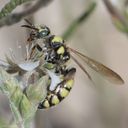
Myzinum frontalis is a of thynnid native to North America. Like other members of the , it is a of scarab beetle , particularly those in the genus Phyllophaga. The species exhibits pronounced , with males being slender with long, straight and a prominent pseudostinger, while females are larger-bodied with robust abdoments, stouter legs, and short, coiled antennae. are active in late summer and autumn, visiting flowers such as goldenrod and thoroughwort.
Pronunciation
How to pronounce Myzinum frontalis: /ˈmɪzɪnəm frʌnˈteɪlɪs/
These audio files are automatically generated. While they are not always 100% accurate, they are a good starting point.
Identification
Males and females appear so different that they may be mistaken for separate or even . Males are recognized by their slender build, long straight , and prominent curled pseudostinger. Females are recognized by their larger, robust body, stout digging legs, and short coiled antennae. Species-level identification within Myzinum is extremely difficult even for experts; M. frontalis requires examination by a using detailed morphological keys.
Images
Appearance
is extreme. Males are slender-bodied with long, straight and possess a curled, spine-like pseudostinger at the abdominal tip (part of external genitalia). Females are substantially larger with robust , stouter legs adapted for digging, and short, coiled antennae. Both sexes have a generally -like appearance typical of the .
Habitat
Found in fields, meadows, and prairie where scarab beetle occur in soil. frequent flowering vegetation in open, sunny areas.
Distribution
Eastern North America, west to the Rocky Mountains, and in the Southwest. Specific range boundaries within this broad area are poorly documented due to taxonomic difficulties in the .
Seasonality
active from late summer through autumn (August to October), with peak activity coinciding with bloom of goldenrod and thoroughwort.
Host Associations
- Phyllophaga - Scarab beetle (white grubs); female dig up grubs, sting them into brief paralysis, and lay single on them
Life Cycle
Female locate scarab beetle underground, dig them up, sting them into temporary paralysis, and deposit a single on each. The wasp larva hatches, bores into the grub, and feeds internally while the continues to live and feed. Eventually the wasp larva kills the host, pupates, and emerges as an the following summer.
Behavior
Males are more frequently observed than females because they spend more time on flowers and gather in groups to roost on vegetation in early evening ("slumber parties"). Females are less conspicuous, spending more time underground searching for . Males likely patrol flowers seeking females for mating.
Ecological Role
agent of scarab beetle , particularly May beetle and June beetle that can damage plant roots. As a , it helps regulate soil-dwelling scarab populations in grassland and forest .
Human Relevance
Potential benefit to agriculture and forestry through suppression of scarab beetle , though quantitative impact is unknown. No documented negative impacts to humans; males possess a pseudostinger but cannot actually sting.
Similar Taxa
- Other Myzinum speciesExtremely difficult to distinguish morphologically; ten recognized north of Mexico, and expert identification using specialized keys is required. Males of different species are especially challenging to separate.
- Male vs. female Myzinum is so pronounced that males and females of the same were historically confused as different ; males are slender with pseudostinger, females are robust with digging legs.
More Details
Taxonomic History
Originally placed in Tiphiidae, the Myzinum has been reassigned to family Thynnidae based on revised classification. -level remains problematic; Dr. Lynn Kimsey published a revised key in 2009 (Zootaxa 2224: 30–50) to help clarify the nearctic fauna.
Flower Associations
Documented visiting Dalea candida (White Prairie Clover) in Colorado, in addition to goldenrod (Solidago) and thoroughwort (Eupatorium).