
Myzinum obscurum
Fabricius
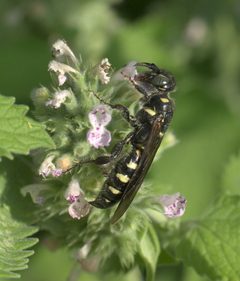
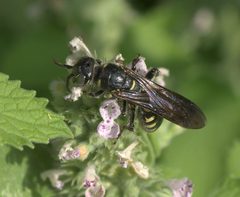
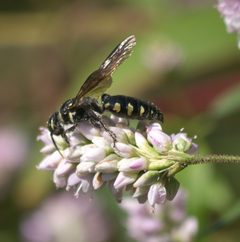
Myzinum obscurum is a of thynnid native to the Eastern United States. Like other members of its , it is a of scarab beetle , particularly those in the genus Phyllophaga. The species exhibits pronounced : males have slender bodies, long straight , and a prominent curled pseudostinger (modified genitalia), while females are larger and more robust with short coiled antennae and stout legs adapted for digging. Taxonomic placement has shifted historically, with the genus formerly placed in Tiphiidae but now recognized in Thynnidae.
Pronunciation
How to pronounce Myzinum obscurum: /ˈmɪzɪnəm əbˈskjʊrəm/
These audio files are automatically generated. While they are not always 100% accurate, they are a good starting point.
Identification
Distinguishing M. obscurum from other Myzinum requires expert examination; the is notoriously difficult taxonomically, with ten North American species that even struggle to separate. Males are readily distinguished from females within the species by body shape, form, and presence of pseudostinger. The genus Myzinum can be separated from similar thynnid genera by the combination of patterns and associations with scarab beetles.
Images
Habitat
Open including fields, meadows, and prairies. Associated with areas supporting scarab beetle in soil. frequently visit flowers for nectar, particularly autumn-blooming composites.
Distribution
Eastern United States. Specific range boundaries within this region not well documented in available sources.
Seasonality
active in late summer and autumn, with peak activity coinciding with bloom of goldenrod (Solidago) and thoroughwort (Eupatorium). Present "right now in most parts of North America, at least east of the Rockies and in the Southwest" during autumn season.
Diet
feed on nectar from flowers. Larvae are internal that consume scarab beetle .
Host Associations
- Phyllophaga - May beetle ; primary . Female dig up grubs, sting to paralyze briefly, and lay single . Larval wasp bores into host and consumes it over extended period, eventually killing it.
Life Cycle
Female locates scarab underground, digs it up, stings it into brief paralysis, and deposits single on . Grub recovers and reburies itself. larva hatches, enters host, and feeds slowly while host continues feeding and growing. Eventually wasp larva kills host, pupates, and emerges as the following summer. Single per year inferred from .
Behavior
Males gather in groups to roost on vegetation in early evening ("slumber parties"). Females spend time underground locating and parasitizing . Both sexes visit flowers, with males more conspicuous due to greater time spent foraging for nectar and mates.
Ecological Role
agent of scarab beetle , particularly Phyllophaga . Contributes to regulation of below-ground herbivore populations. serve as of late-season wildflowers.
Human Relevance
Potential benefit to agriculture and turf management through suppression of white . No documented negative impacts; male pseudostinger is harmless despite threatening appearance.
Similar Taxa
- Other Myzinum speciesTen North American are extremely difficult to distinguish morphologically; expert keys required for species-level identification.
- Methocha (Tiphiidae/Thynnidae)Also of tiger larvae; historically confused with Myzinum but parasitizes different group (Cicindelinae rather than Scarabaeidae).
Misconceptions
Male and female Myzinum are frequently mistaken for different or even different due to extreme . The male pseudostinger is often perceived as a functional stinger, but it is non-venomous genitalia.
More Details
Taxonomic History
The Myzinum was long placed in Tiphiidae. It is now classified in Thynnidae, though many sources and databases still reference the older placement.
Taxonomic Difficulty
Dr. Lynn Kimsey published a revised key for North American Myzinum in 2009 (Zootaxa 2224: 30–50), noting that previous descriptions contained errors and that separation remains challenging even for experts.