
Myzinum carolinianum
(Panzer) Panzer
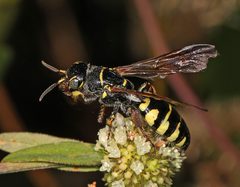
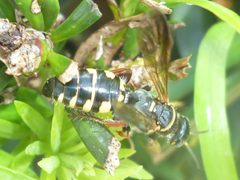
Myzinum carolinianum is a thynnid native to North America. Like other members of its , it is a of scarab beetle , particularly those in the genus Phyllophaga. The species exhibits extreme : males are slender with long, straight and a prominent curved pseudostinger (external genitalia), while females are larger-bodied with robust , stouter legs adapted for digging, and short, coiled antennae. are active in late summer and autumn, frequently visiting flowers such as goldenrod and thoroughwort.
Pronunciation
How to pronounce Myzinum carolinianum: /ˈmaɪ.zɪ.nəm ˌkæ.rəˌlɪˈniː.ə.nəm/
These audio files are automatically generated. While they are not always 100% accurate, they are a good starting point.
Identification
Distinguish from other Myzinum by subtle morphological features requiring expert examination (the is taxonomically difficult, with species historically confused). Separate from other thynnid genera by the combination of: extremely dimorphic sexes, lifestyle on scarab , and autumn flower-visiting . Males may be confused with other slender but the curved pseudostinger is distinctive. Females may be mistaken for ants or wingless female mutillid wasps due to robust build and coiled , but lack the dense velvety hair of mutillids.
Images
Habitat
Open including prairies, meadows, fields, and roadsides. Associated with areas supporting scarab beetle in soil. frequently found on autumn-blooming flowers in sunny, open conditions. Elevational range in some regions extends from approximately 3,400 to 7,200 feet.
Distribution
Eastern and central North America, occurring east of the Rocky Mountains and in the Southwest. Documented from the Great Plains across the eastern United States. Specific range boundaries within the distribution require verification; genus Myzinum as a whole is widespread in North America with ten recognized north of Mexico.
Seasonality
active primarily in late summer and autumn (August through October in most regions). timed to coincide with flowering of goldenrod (Solidago) and thoroughwort (Eupatorium). One per year; adults emerge following , with larvae having overwintered in remains.
Host Associations
- Phyllophaga - Primary ; female locate and excavate white , sting to paralyze temporarily, and lay single on host. Larval wasp consumes grub from within, eventually killing it.
Life Cycle
Female locates scarab below ground through unknown detection mechanism, digs to expose , temporarily paralyzes it with sting, and deposits single on exterior. Host buries itself and resumes feeding. larva hatches, burrows into host, and feeds as internal , allowing host to continue feeding and growing. Eventually larva kills host, pupates within remains or surrounding soil, and emerges the following summer. (one per year).
Behavior
Males frequently gather in groups on vegetation for overnight roosting ('slumber parties'). Both sexes visit flowers for nectar, with males more conspicuous due to greater time spent foraging. Females spend more time searching for in soil. Males cannot sting; female sting used only for host paralysis, not defense.
Ecological Role
agent of scarab beetle , particularly Phyllophaga whose larvae (white ) can damage plant roots and turf. As flower visitors, contribute to pollination of autumn-blooming plants, though this role is secondary to their function.
Human Relevance
Beneficial insect for agriculture and horticulture due to suppression of scarab pest . No negative impacts; male pseudostinger is harmless. Occasionally observed by naturalists and photographers on late-season flowers. Taxonomic difficulty of hampers -specific conservation assessment.
Similar Taxa
- Myzinum quinquecinctumAnother common North American Myzinum ; separation requires expert examination of subtle morphological characters per Kimsey (2009) key.
- Mutillidae (velvet ants)Wingless female mutillids resemble female Myzinum in robust build and coiled , but have dense velvety hair and are solitary hunters rather than of soil-dwelling .
- Methocha (Tiphiidae/Thynnidae)Another thynnid with parasitic on tiger larvae; historically confused with Myzinum but differs in association (Cicindelinae vs. Scarabaeidae) and subtle morphological features.
Misconceptions
Males are frequently mistaken for dangerous stinging due to the prominent curved pseudostinger; the structure is actually external genitalia and completely harmless. is so extreme that males and females of the same are often catalogued separately or misidentified as different species by non-.
More Details
Taxonomic history
Long placed in Tiphiidae, Myzinum was transferred to Thynnidae based on phylogenetic studies. The North American were taxonomically revised by Lynn Kimsey in 2009 (Zootaxa 2224), who provided the first reliable key for distinguishing the ten recognized species north of Mexico. Prior to this work, species boundaries were extremely confused.
Conservation notes
No -specific conservation status established. Like many solitary , vulnerable to loss from agricultural intensification, turfgrass management (reduces ), and use. Dependence on late-season flowers makes autumn nectar sources important for population persistence.