
Myzinum quinquecinctum
(Fabricius, 1775)
five-banded thynnid wasp
Myzinum quinquecinctum is a of thynnid found primarily in eastern North America. Like other members of the Myzinum, it is a of scarab beetle , with females locating and paralyzing underground to lay . The species exhibits pronounced : males are slender with long, straight and a prominent pseudostinger, while females are larger and more robust with short, coiled antennae adapted for digging. Males are frequently observed visiting flowers such as goldenrod and thoroughwort, often in .
Pronunciation
How to pronounce Myzinum quinquecinctum: /ˈmaɪzɪnəm ˌkwɪŋ.kwɪˈsɪŋk.təm/
These audio files are automatically generated. While they are not always 100% accurate, they are a good starting point.
Identification
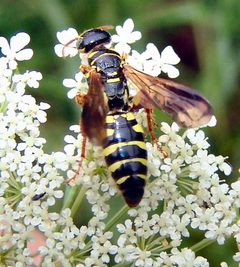
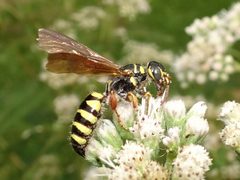
Distinguished from other Myzinum by the five-banded abdominal pattern implied by the specific epithet, though species-level identification in this is difficult even for . Males distinguished from females by slender body, long straight , and curved pseudostinger (versus robust body, short coiled antennae in females). Distinguished from similar flower-visiting by the unique combination of characters and banded . placement (Thynnidae) updated from former Tiphiidae classification.
Images
Habitat
Open including fields, meadows, and prairies. Associated with areas supporting scarab beetle in soil. frequently found on flowers in autumn, particularly goldenrod (Solidago) and thoroughwort (Eupatorium).
Distribution
Eastern North America, primarily east of the Rocky Mountains. Records include northeastern United States (Vermont) and Midwest.
Seasonality
active in autumn, particularly associated with blooming of goldenrod and thoroughwort. Males observed in evening on vegetation during this period.
Host Associations
- Phyllophaga - Scarab beetle , especially 'white grubs' of May beetles; female dig up grubs, sting into brief paralysis, and lay single
Life Cycle
Female locates scarab underground, digs it up, stings it into brief paralysis, and lays single on . Grub recovers and reburies itself. larva bores into host and feeds slowly, allowing host to continue feeding and grow. Eventually larva kills host, pupates, and emerges as the following summer.
Behavior
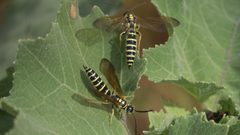
Males spend more time on flowers than females and are more conspicuous. Males gather in evening ('slumber parties') on vegetation. Females spend time underground locating and parasitizing . Both sexes visit flowers for nectar.
Ecological Role
agent of scarab beetle , which can be agricultural and turf pests. As , they invariably kill their . contribute to pollination while visiting flowers.
Human Relevance
Beneficial insect contributing to natural suppression of scarab beetle , including pest such as May beetles. No negative impacts documented; males' pseudostinger is non-functional and not a true stinger.
Similar Taxa
- Other Myzinum species contains ten recognized north of Mexico that are extremely difficult to distinguish; expert identification required
- Male vs. female Myzinum quinquecinctum is so extreme that genders were historically mistaken for different , , or even
- Other thynnid/tiphid waspsSimilar flower-visiting and lifestyle, but Myzinum distinguished by specific associations and extreme
Misconceptions
The male's pseudostinger is often mistaken for a functional stinger, causing unnecessary fear; it is actually part of the external genitalia and harmless. The extreme has historically led to males and females being classified as different or even placed in different or .
More Details
Taxonomic history
This was formerly placed in Tiphiidae, but the Myzinum has been transferred to family Thynnidae based on revised classification. Species-level in this genus remains challenging; Dr. Lynn Kimsey (2009) provided revised descriptions and a key for Nearctic fauna.
Species epithet
The 'quinquecinctum' refers to five bands, presumably on the , though detailed description of this pattern was not found in available sources.