
Myzinum dubiosum
(Cresson) Cresson
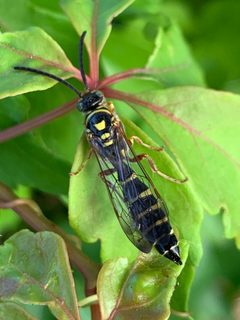
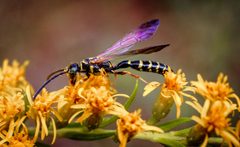
Myzinum dubiosum is a of thynnid in North America. Like other members of the , it exhibits pronounced : males are slender with long, straight and a prominent curled pseudostinger (part of the external genitalia), while females are larger-bodied with robust abdoments, stouter legs adapted for digging, and short, coiled antennae. The species is a of scarab beetle , particularly Phyllophaga species. are active in late summer and autumn, frequently visiting flowers such as goldenrod and thoroughwort.
Pronunciation
How to pronounce Myzinum dubiosum: /ˈmɪzɪnəm duːbiˈoʊsəm/
These audio files are automatically generated. While they are not always 100% accurate, they are a good starting point.
Identification
Males and females appear so different that they may be mistaken for different or even different . The male's curled pseudostinger can be mistaken for a defensive stinger. Females can be distinguished from other robust by their short, coiled and association with soil-dwelling scarab larvae. Species-level identification within Myzinum is extremely difficult even for ; M. dubiosum requires examination of subtle morphological characters per Kimsey (2009).
Images
Habitat
Open including fields, meadows, and prairies. Associated with areas supporting scarab beetle in soil. frequently found on autumn-blooming wildflowers.
Distribution
North America, primarily east of the Rocky Mountains and in the Southwest. Specific range details for M. dubiosum not well documented separately from -level distribution.
Seasonality
active late summer through autumn (August-October), coinciding with bloom of goldenrod (Solidago) and thoroughwort (Eupatorium).
Host Associations
- Phyllophaga - primary Scarab beetle ('white grubs') are the known for Myzinum generally; specific host records for M. dubiosum not documented separately.
Life Cycle
Female locates scarab underground, excavates it, stings it into brief paralysis, and lays single on exterior. Paralyzed grub buries itself; larva hatches, bores into , and feeds internally as . Larva consumes host gradually while host continues feeding, eventually killing it. Wasp pupates in soil and emerges as the following summer.
Behavior
Males gather in groups ('slumber parties') on vegetation in early evening. Females spend less time on flowers than males, being occupied with location. Both sexes visit flowers for nectar.
Ecological Role
of scarab beetle , potentially contributing to natural regulation of white grub . serve as of late-season wildflowers.
Human Relevance
Potential agent for pest scarabs, though not commercially utilized. Males may cause alarm due to pseudostinger appearance, but they are harmless.
Similar Taxa
- Other Myzinum speciesNearly impossible to distinguish morphologically; requires examination using Kimsey (2009) key. Ten recognized north of Mexico.
- Methocha (Tiphiidae/Thynnidae)Formerly confused with Myzinum; also parasitizes tiger larvae rather than scarabs, but external similarity in body form.
- Male Sphecidae or other slender waspsMale Myzinum with long and terminal spine may resemble thread-waisted wasps, but lacks true petiole and has distinctive genital spine.
Misconceptions
The male's curled pseudostinger is frequently mistaken for a functional stinger, causing unnecessary fear. Males are entirely harmless and cannot sting. The extreme has historically led to males and females being described as different or even placed in different .
More Details
Taxonomic history
Originally described in Tiphiidae; Myzinum was moved to Thynnidae based on phylogenetic studies. The -level was revised by Lynn Kimsey in 2009 (Zootaxa 2224), who provided the first workable key for North American species after noting previous treatments had left the genus in 'taxonomic purgatory'.
Species identification difficulty
Even entomologists specializing in this group struggle to distinguish M. dubiosum from . Field identification to is generally not possible without specimen examination.