
Cicindela denverensis
Casey, 1897
Green Claybank Tiger Beetle
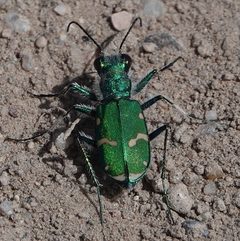
Cicindela denverensis, the green claybank tiger , is a metallic green tiger beetle native to the central and western Great Plains of North America. It inhabits short- and mixed-grass prairie , particularly those with clay soils. The is distinguished by its uniformly green coloration, hairy , and reduced or absent elytral maculations. It is closely related to C. limbalis and C. splendida, with which it forms a problematic characterized by hybridization where ranges overlap.
Pronunciation
How to pronounce Cicindela denverensis: //ˌsɪsɪnˈdiːlə ˌdɛnvəˈrɛnsɪs//
These audio files are automatically generated. While they are not always 100% accurate, they are a good starting point.
Identification
The uniformly green coloration combined with a hairy separates C. denverensis from C. sexguttata, which has a glabrous frons and occurs in eastern woodland . Distinguished from C. decemnotata by the latter's broader maculations, shinier oily appearance, and frequent red tinting. All-green forms of C. limbalis at the northern range limit are differentiated by the "knee" bend in the maculation of C. denverensis. C. scutellaris (except rugifrons) lack maculations and have stockier bodies with Atlantic Coastal Plain distribution. The absence of purple or red on pronotum, , or legs separates it from C. purpurea, C. limbalis, and C. splendida in most of their ranges.
Images
Habitat
Short- and mixed-grass prairie in the central and western Great Plains, especially sites with clay soils. Also recorded from vertical roadside clay banks. Occurs less commonly in sandy areas, where individuals may represent vagrants from nearby clay-based prairies.
Distribution
Central and western Great Plains of North America; documented from Nebraska (Sioux, Sherman counties), North Dakota, Colorado, and adjacent regions. Northern distributional limit in North Dakota; western range extends into Colorado.
Seasonality
active in spring and fall; summer months spent as larvae and pupae in soil tunnels. Spring activity observed from mid-March onward along the Colorado Front Range.
Diet
Predatory; pursues small including ants. Larvae are ambush hunters that seize prey from burrow entrances.
Life Cycle
Spring-fall activity pattern with summer as subterranean larvae and pupae. Larvae construct vertical burrows in soil, presenting flat at entrances to capture passing prey.
Behavior
with rapid running capability; stops periodically to re-focus vision while pursuing prey due to speed exceeding visual processing capacity. Males grip females using toothed that match -specific notches on female pronotum, preventing interspecific mating. Multiple males may attempt to mate with single females, forming stacked .
Ecological Role
of small in prairie ; larvae serve as subterranean ambush predators. Potential for mites (observed on , mesopleura, and hind tibiae).
Human Relevance
Subject of taxonomic debate regarding boundaries within the C. limbalis/C. splendida/C. denverensis complex; of interest to cicindelid and naturalists. vulnerable to loss from prairie conversion and development.
Similar Taxa
- Cicindela sexguttataAlso uniformly green, but has glabrous and occurs in eastern woodland rather than grasslands.
- Cicindela decemnotataSimilar green appearance, but usually has broad maculations, shinier oily , and often shows red tinting.
- Cicindela limbalisAll-green northern forms lack the sharp "knee" bend in maculation; typically shows purple or red coloration on pronotum, , or legs.
- Cicindela splendidaExhibits purple or red coloration on pronotum, , and/or legs; hybridizes with C. denverensis where ranges overlap.
- Cicindela purpureaClosely related member of claybank group; shows purple or red coloration distinguishing it from uniformly green C. denverensis.
- Cicindela scutellaris (subspecies rugifrons)Green with maculations, but stockier body form and Atlantic Coastal Plain distribution.
More Details
Taxonomic Controversy
Phylogenetic analysis of mitochondrial (Woodcock & Knisley 2009) supports treating C. denverensis, C. limbalis, and C. splendida as a single , though they remain distinct based on morphological and ecological criteria. Hybrid individuals occur where distributions overlap, particularly in central Nebraska.
Mite Associations
Specimens have been observed carrying numerous mites on , mesopleura, and hind tibiae; ecological significance unknown.