
Cicindela limbalis
Klug, 1834
Common Claybank Tiger Beetle
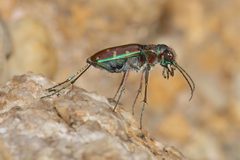
Cicindela limbalis, the common claybank tiger , is a small tiger beetle measuring 12–16 mm in length. The exhibits variable coloration, ranging from reddish-purple to dull green or brown. It is strongly associated with steep, moist bare clay soils, particularly on river banks. have been reported to live for up to 3 years. The species occurs across a broad range in North America east of the Rocky Mountains.
Pronunciation
How to pronounce Cicindela limbalis: /sɪˈsɪndələ lɪmˈbælɪs/
These audio files are automatically generated. While they are not always 100% accurate, they are a good starting point.
Identification
Distinguished from Cicindela denverensis by the absence of a sharp bend or "knee" on the maculation; C. denverensis exhibits this knee and typically has a uniformly green coloration with hairy . Separated from C. splendida and C. purpurea by differences in elytral color, pattern, and percentage maculation; these three form a closely related group with partially distributions. C. limbalis occupies the northern portion of this group's range. Hybrid individuals may occur where distributions overlap, particularly in central Nebraska.
Images
Habitat
Steep, moist bare clay soil, often on river banks. Strongly prefers steep clay slopes; experimental evidence shows 46:1 ratio of larvae in clay versus other soil types, and similar preference for steep over flat ground.
Distribution
North America east of the Rocky Mountains. Canada: Northwest Territories (Tulita, Fort Wrigley), Yukon (Eagle River at Dempster Highway), Alberta, Saskatchewan, Manitoba (Interlake region and south), Ontario (north to Smoky Falls, absent from Bruce Peninsula), Quebec (Saint Lawrence Valley and north, Opasatica Lake, Harricana River), Newfoundland (Bay of Islands), Cape Breton Island, New Brunswick, mainland Nova Scotia (Antigonish area). United States: New England south to Virginia, Great Lakes region, northern Mississippi and Missouri river valleys, Colorado (Boulder, Fort Collins area), sparsely in Wyoming, Montana, North and South Dakota, Nebraska, Kansas, Oklahoma (southernmost record: LeFlore County). Absent from Kentucky and Indiana.
Life Cycle
lifespan up to 3 years. Larval development occurs in steep clay slopes.
Behavior
Strong fidelity to steep clay slopes demonstrated through experimental studies.
Similar Taxa
- Cicindela denverensisUniformly green coloration, hairy , sharp "knee" on maculation; western Great Plains distribution in grassland
- Cicindela splendidaPartially southern distribution; differences in elytral color, pattern, and maculation percentage; some purple or red coloration on pronotum, , or legs
- Cicindela purpureaCowpath tiger ; exhibits purple or red coloration distinguishing it from all-green forms; closely related within the claybank group
More Details
Taxonomic Uncertainty
The relationship between C. limbalis, C. splendida, and C. denverensis has been disputed. Some morphometric and phylogenetic analyses based on mitochondrial have suggested they may represent a single with partially , though they are currently maintained as distinct based on color, pattern, and setal differences. Hybrid individuals occur where ranges overlap, especially in central Nebraska.