
Cicindela splendida
Hentz, 1830
Splendid Tiger Beetle
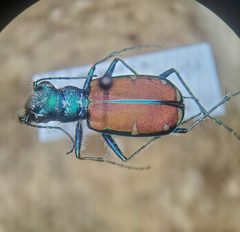
Cicindela splendida is a North American tiger distinguished by its brilliant metallic green coloration and ivory-white . The is a spring-fall active , with northern emerging earlier in spring than southern populations. It inhabits open, sparsely vegetated with exposed soil, particularly dolomite glades and clay exposures. The species is part of a closely related species group that includes C. limbalis and C. denverensis, with which it shares overlapping distributions but maintains reproductive isolation.
Pronunciation
How to pronounce Cicindela splendida: /sɪˈsɪndələ ˈsplɛndɪdə/
These audio files are automatically generated. While they are not always 100% accurate, they are a good starting point.
Identification
Distinguished from sympatric tiger beetles by the combination of bright metallic green and ivory-white . Elytral maculation pattern, percentage of elytral surface covered by spots, and number of non-sensory setae distinguish it from the closely related C. limbalis and C. denverensis. Body measurements and sensory setae counts alone are insufficient for reliable separation from these .
Images
Appearance
display brilliant metallic green to blue-green with variable maculation patterns. The are conspicuously ivory-white, a distinctive feature shared with closely related . The and pronotum typically match the elytral coloration. Larvae have metallic sheen on the head capsule, visible even in third instar burrow-dwelling stages.
Habitat
Open, sparsely vegetated with exposed soil surfaces, particularly dolomite glades and clay exposures in temperate regions. Occupies continental, riparian-influenced environments. Soil type preferences are shared with C. limbalis and C. denverensis, though actual distribution is more restricted than the range of suitable soils would permit.
Distribution
North America: distributed across Canada and the central and northeastern United States. Northern occur at higher latitudes with correspondingly later spring timing compared to southern populations.
Seasonality
Spring-fall : active during spring and autumn periods. Northern emerge earlier in spring than southern populations. Peak abundance timing differs from that of C. limbalis and C. denverensis, though temporal overlap occurs.
Diet
are visual of small arthropods. Larvae are sit-and-wait predators that capture prey drawn into their burrows, including caterpillars and other suitably sized insects.
Life Cycle
Complete with , larval (three instars), pupal, and stages. Larvae construct vertical burrows in soil, with third instar larvae before . Adults emerge in spring, with activity extending into fall. Some individuals may remain in burrows through fall and emerge the following spring rather than becoming active in autumn.
Behavior
are fast-running, visually oriented active during warm, sunny conditions. They seek shelter under rocks or other cover during cold, wet, or overcast conditions. Larvae occupy burrow entrances, striking at passing prey. Adults demonstrate recognition capabilities, maintaining reproductive isolation from syntopic despite close relatedness.
Ecological Role
in open , contributing to regulation of small . Larval burrowing activity may influence soil structure in localized areas.
Human Relevance
Subject of entomological collecting and photography due to striking coloration. Occasionally reared in captivity from larvae for observation and study. No documented economic or agricultural significance.
Similar Taxa
- Cicindela limbalisClosely related sister with overlapping distribution; distinguished by elytral maculation pattern, percentage spot coverage, and non-sensory setae number. Body measurements alone are unreliable for separation.
- Cicindela denverensisMore distantly related member of the same group, representing an earlier lineage; distinguished by similar morphological characters as C. limbalis. All three species maintain reproductive isolation despite syntopy.
More Details
Phylogenetic position
Cicindela splendida and C. limbalis are sister , with C. denverensis representing a more basal lineage within the group. The group ancestor evolved during the late Tertiary as a continental, riparian, cool-temperate North American form. Current species arose through late Pleistocene fragmentation, isolation, and glacial-interglacial .
Rearing observations
Larvae readily accept artificial burrows in containers with native soil and can be maintained on lepidopteran caterpillars or other appropriately sized prey. Partially sunken rocks provide elevated perching surfaces for emerged .