
Cicindela purpurea
Olivier, 1790
Purple Tiger Beetle, Cow Path Tiger Beetle
Species Guides
4- Cicindela purpurea audubonii(Audubon's tiger beetle)
- Cicindela purpurea cimarrona(Cimarron Tiger Beetle)
- Cicindela purpurea hatchi(Hatch's Tiger Beetle)
- Cicindela purpurea purpurea(Cow Path Tiger Beetle)
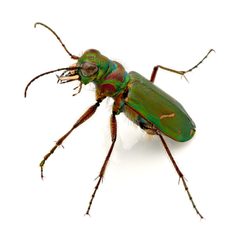
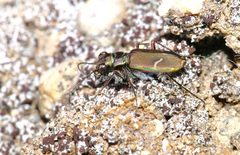
Cicindela purpurea is a North American tiger commonly known as the purple tiger beetle or cow path tiger beetle. measure 12-16 millimeters and display remarkable color , appearing in matte green, metallic green, bluish, black, or bronze-purple forms. The exhibits a spring-fall pattern, with adults active in April-May and September, spending summer as subterranean larvae. It is widespread across northern North America but notably absent from the mid-Atlantic states, Texas, and coastal Pacific regions. Five are recognized, including the distinctive C. p. audubonii with its reduced elytral markings and occasional all-black morphs.

Pronunciation
How to pronounce Cicindela purpurea: //tʃɪˈsɪndələ pɜːrˈpjʊəriə//
These audio files are automatically generated. While they are not always 100% accurate, they are a good starting point.
Identification
Distinguished from similar tiger beetles by its spring-fall activity pattern and characteristic elytral markings: a terminal spot combined with an oblique tilde-shaped mark. The C. p. audubonii shows reduced markings and may display all-black morphs with distinctly hairy , which can be confused with C. nebraskana or C. longilabris but are separated by the hairy frons character. The ' run-stop-run hunting —stopping to refocus due to visual limitations at high speed—aids field identification. When approached, typically fly short distances before resuming ground activity.
Images
Habitat
Degraded prairie with sparse grass cover and abundant bare patches of earth. Also found in open clay habitats, sandy road cuts, and barren paths through grasslands. Occupies a broader range of open substrates than its suggests, including alkaline flats and mixed sand-silt exposures. Not typically found in dense vegetation or forested areas.
Distribution
North America: widespread across the northern three-fourths of the United States and adjacent southern Canada. Specifically recorded from Canada and the United States. Absent from the mid-Atlantic states, southeastern United States, Texas, and coastal areas of the Pacific states. Western in the Great Plains and Rocky Mountains are assigned to audubonii.
Seasonality
Spring-fall with activity peaking in April, May, and September. timing varies with winter severity; mild winters may prompt earlier emergence. Adults overwinter in burrows, having emerged in fall as sexually individuals. Summer months are spent as larvae and pupae in soil burrows.
Diet
are active of small , including ants and other insects. Larvae are also predatory, ambushing prey from burrow entrances. One observation documents an adult female capturing and consuming a blister beetle ( Meloidae) despite the prey's toxic content.
Life Cycle
Complete with spring-fall activity pattern. Adults emerge in fall as sexually , overwinter in burrows, and re-emerge in spring to mate and oviposit. are laid in soil. Larvae construct vertical burrows, passing through developmental stages during summer. occurs in soil chambers. The is or partially depending on latitude and elevation, with higher elevations and northern latitudes typically showing one annually.
Behavior
are fast-running visual that pursue prey at speeds exceeding their visual processing capacity, necessitating characteristic run-stop-run hunting . When disturbed, they fly short distances, land, and resume rapid ground movement. Males recognize females through -specific pronotal dimple- tooth coupling. Larvae are sit-and-wait ambush predators from burrow entrances, retreating rapidly into burrows when disturbed.
Ecological Role
in open grassland and prairie . and larvae contribute to regulation of small . The serves as an indicator of intact or degraded prairie with appropriate bare ground conditions.
Human Relevance
Subject of entomological study and nature observation due to its charismatic appearance and accessible . Photographed extensively by naturalists. No documented economic impact as pest or beneficial .
Similar Taxa
- Cicindela nebraskanaBlack morphs of C. p. audubonii resemble this all-black prairie ; distinguished by hairy in C. purpurea
- Cicindela longilabrisBlack morphs at higher elevations may be confused with this ; C. purpurea has shorter and hairy
- Cicindela formosaSimilar size and sand preference; distinguished by different elytral maculation pattern and summer activity
- Cicindela lengiSimilar green coloration and sand ; distinguished by longer, obliquely straight humeral lunule and more cylindrical body
Misconceptions
The 'Purple Tiger ' is misleading, as the exhibits extreme color and many individuals lack any purple coloration. The name 'Cow Path Tiger Beetle' better describes its association with open, trampled ground in degraded prairies. The species is not restricted to cow paths or purple coloration.
More Details
Subspecies
Five recognized: C. p. purpurea (eastern), C. p. audubonii (central Great Plains and Rocky Mountains), C. p. cimarrona, C. p. hatchi (western intergrade zone), and C. p. lauta. Subspecies audubonii shows reduced ivory markings and notable occurrence of all-black morphs, with black morph frequency increasing at northern latitudes and higher elevations (up to 20-40% in some ), possibly as a thermoregulatory .
Conservation Status
Nominotypical (C. p. purpurea) are feared extirpated in some parts of the eastern United States, though the remains common in western and central portions of its range.
Sources and further reading
- BugGuide
- Wikipedia
- GBIF taxonomy match
- iNaturalist taxon
- NCBI Taxonomy
- Catalogue of Life
- Bug Eric: Cow Path Tiger Beetle
- Tigers in the Nebraska Badlands | Beetles In The Bush
- Bug Eric: April 2014
- Bug Eric: Springtime Tiger Beetles
- Monroe Canyon epilogue – Audubon’s tiger beetle | Beetles In The Bush
- Monroe Canyon – A Tiger Beetle “Hot Spot” | Beetles In The Bush