
Cicindela purpurea hatchi
Leffler, 1980
Hatch's Tiger Beetle
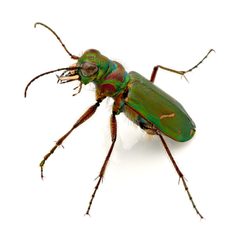
Cicindela purpurea hatchi is a of the purple tiger beetle to western North America, particularly in intergrade zones with the nominate subspecies in the Great Basin and Rocky Mountain regions. exhibit the characteristic spring-fall of the Cicindela purpurea complex, emerging in fall as sexually adults, in burrows, and re-emerging in spring to mate and oviposit. The subspecies shows color including green and black morphs, with black morphs occurring at lower frequency than in the nominate subspecies C. p. audubonii.
Pronunciation
How to pronounce Cicindela purpurea hatchi: //sɪˈsɪndələ pərˈpʊəriə ˈhætʃʌi//
These audio files are automatically generated. While they are not always 100% accurate, they are a good starting point.
Identification
Distinguished from the nominate C. p. purpurea and C. p. audubonii by geographic occurrence in western intergrade zones. share the -level characters: faint purple tinge with metallic purple border along elytral margins, reduced elytral markings consisting of short oblique middle line and white rear tip at elytral edge. Black morph individuals occur but at lower frequency (~1 in 25) than in C. p. audubonii ; black morphs retain reduced white markings and have distinctly hairy distinguishing them from similar black species such as C. nebraskana and C. longilabris. Green morph individuals may be confused with C. denverensis, C. decemnotata, C. limbalis, and C. splendida; C. p. hatchi is distinguished by the purple elytral border and reduced maculation pattern.
Images
Habitat
Inhabits grassland and clay soil environments in the western Great Plains and Rocky Mountain regions. Occurs in sagebrush-pine mixed habitats at moderate elevations.
Distribution
Western North America; intergrade zone between nominate and C. p. audubonii; recorded from northeastern California (Plumas County, near Chilcoot) and presumably throughout the Great Basin and northern Rocky Mountains of the western United States and adjacent Canada.
Seasonality
Spring-fall ; emerge in fall as sexually , overwinter in burrows, and re-emerge in early spring for mating and oviposition. Among the earliest tiger beetles to appear in spring and latest to disappear in fall.
Life Cycle
One annually; laid in spring, larvae develop through summer, emerge in fall and overwinter in burrows before reproducing the following spring.
Behavior
are fast-running, visually hunting typical of tiger beetles. Fall-emerged adults likely augment nutrient reserves before winter dormancy. Thermoregulatory posturing observed in related suggests adults bask to elevate body temperature during cool spring and fall conditions.
Ecological Role
Predatory in grassland ; and ecological interactions presumably similar to other members of the C. purpurea complex.
Similar Taxa
- Cicindela purpurea auduboniiOverlaps in range; distinguished by eastern vs. western distribution and higher frequency of black morphs in audubonii (up to 20-40% in northern vs. ~4% in hatchi)
- Cicindela purpurea purpureaEastern nominate ; distinguished by distribution and presumably lower black morph frequency
- Cicindela nebraskanaBlack morph C. p. hatchi resembles this ; distinguished by hairy in hatchi
- Cicindela longilabrisBlack morph C. p. hatchi resembles this higher-elevation ; distinguished by hairy and reduced elytral markings in hatchi
- Cicindela denverensisGreen claybank tiger co-occurring in Great Plains; distinguished by lack of purple elytral border and different maculation pattern
- Cicindela decemnotataBadlands tiger beetle with similar green coloration; distinguished by more extensive elytral markings
- Cicindela limbalisCommon claybank tiger with similar preference; distinguished by more extensive elytral markings
- Cicindela splendidaSplendid tiger with metallic coloration; distinguished by more extensive elytral markings