
Cicindelini
Latreille, 1802
tiger beetles, flashy tiger beetles
Genus Guides
11- Apterodela
- Brasiella
- Cicindela(common tiger beetles)
- Cicindelidia(Prairie Tiger Beetles)
- Dromochorus(Dromo Tiger Beetles)
- Ellipsoptera(Elliptical-winged Tiger Beetles)
- Eunota(Saline Tiger Beetles)
- Habroscelimorpha(Habro Tiger Beetles)
- Microthylax(Coral Beach Tiger Beetles)
Cicindelini is a tribe of tiger beetles comprising approximately 80% of the 's and . The tribe contains over 90 genera and more than 2,000 described , making it one of the most species-rich groups within the ground beetle . Members are characterized by their activity patterns, rapid running speed, and distinctive predatory . The tribe exhibits broad geographic distribution with highest diversity in tropical and subtropical regions, though species occur across all continents except Antarctica.

Pronunciation
How to pronounce Cicindelini: /sɪˌsɪnˈdɛlɪnaɪ/
These audio files are automatically generated. While they are not always 100% accurate, they are a good starting point.
Identification
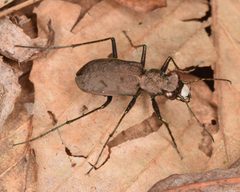
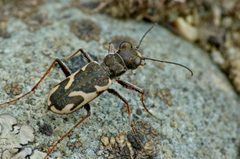
Members of Cicindelini are distinguished from related carabid beetles by their large, prominent adapted for visual hunting, long slender legs built for speed, and elongated body form. The typically display bold contrasting patterns of maculations (light-colored markings) against darker backgrounds. The tribe is further characterized by the presence of white markings on the elytra that vary in configuration among and , often serving as key diagnostic characters. are thread-like and inserted between the and mandibular bases. The is notably wide, covering the base of the from above.
Images
Habitat
Cicindelini occupy diverse open including sandy riverbanks, dry sand deposits, clay banks, coastal salt flats, rocky outcrops, and sparsely vegetated areas. Many species show strong fidelity to specific substrate types—deep dry sand habitats support species such as those in the Cicindela formosa group, while saline or alkaline habitats harbor specialized including members of Eunota. Some species utilize disturbed or ephemeral habitats such as sandbars, blowouts, and anthropogenic sand deposits. Habitat specificity varies considerably, with some species restricted to narrow while others occupy broad habitat ranges.
Distribution
The tribe has worldwide distribution across all continents except Antarctica, with highest in tropical and subtropical regions. Within the New World, significant radiations occur in North America (particularly the southwestern United States and Mexico), Central America, and South America. The Eunota exemplifies this pattern, ranging from the southern United States to Brazil with maximum diversity in northern Mexico. Old World distributions include extensive radiations in Asia, Africa, and the Mediterranean region. Many and exhibit restricted geographic ranges, with some known from single localities or limited patches.
Seasonality
Activity periods vary by and latitude. In temperate regions, are primarily active from spring through early fall, with peak activity during summer months. Some species exhibit extended or bimodal activity patterns, with spring and late summer peaks separated by summer during hot periods. Species in subtropical and tropical regions may be active year-round. activity has been documented in several species, including some Eunota species that are active both diurnally and nocturnally. Late season activity (September-October) characterizes certain rare species such as Eunota albicauda.
Diet
All members are predatory, feeding on small including other insects, spiders, and various arthropods. are visual hunters that actively pursue prey using their speed and agility. Larvae are sit-and-wait that occupy vertical burrows in soil, capturing prey that passes within striking distance of the burrow entrance.
Life Cycle
Development includes , larva, pupa, and stages. Larvae construct vertical burrows in soil substrates, with depth and structure varying by type. The larval stage includes three instars, with duration influenced by environmental conditions. occurs within the burrow. time varies from one to multiple years depending on and climate. Some species in temperate regions may require two or more years to complete development.
Behavior
are renowned for rapid running speed and powerful used for escape from and between patches. When disturbed, adults typically fly short to moderate distances (10-30 meters), landing and freezing against the substrate where their coloration provides camouflage. Many exhibit characteristic 'stilting' —standing on long legs with body elevated—possibly for or improved visual surveillance. Larvae remain in burrows except when expanding or relocating, and may plug the burrow entrance during unfavorable conditions. Some species show strong site fidelity to specific habitat patches, while others are highly dispersive and colonize ephemeral habitats.
Ecological Role
Cicindelini function as mid-level in terrestrial , regulating of small . Their specific requirements make them useful bioindicators of habitat quality and disturbance regimes. Several have been employed as model organisms in conservation and biodiversity assessments due to their ecological specificity and sensitivity to habitat modification. The tribe's dependence on open, often disturbed habitats creates complex conservation dynamics, as many species require active habitat management or natural disturbance processes to maintain suitable conditions.
Human Relevance
Tiger beetles are popular among amateur naturalists and collectors, with extensive representation in museum and private collections. Their striking appearance and active make them favored subjects for macrophotography and natural history observation. Some have been studied for their biomechanics, particularly running speed and visual acuity. loss and modification represent primary threats, with several species of conservation concern due to restricted distributions and specific habitat requirements. Land development near known localities has prompted concern for species such as Eunota mecocheila.
Similar Taxa
- MegacephalinaAnother tribe within ; distinguished by different mandibular structure and generally more robust body form with relatively shorter legs
- Carabini (ground beetles)Related tribe in Carabidae; distinguished by primarily activity, less prominent , and different body proportions with relatively shorter legs and more rounded body form
More Details
Taxonomic history
Cicindelini has been variously treated as a tribe within Carabidae or as the separate . Current molecular supports recognition as a distinct family, though many sources continue to list it as Carabidae: Cicindelinae: Cicindelini. The tribe contains approximately 80% of cicindelid diversity, with the remaining placed in tribe Megacephalina.
Conservation significance
The tribe includes numerous of conservation concern due to restricted ranges and specificity. Discovery of new species continues, with integrative approaches revealing cryptic diversity. Recent descriptions include Eunota mecocheila from saline habitats in northern Mexico and Eunota albicauda from coastal Texas, highlighting ongoing documentation of unrecognized diversity even in relatively well-studied regions.
Sources and further reading
- BugGuide
- Wikipedia
- iNaturalist taxon
- NCBI Taxonomy
- Catalogue of Life
- ID Challenge #12 | Beetles In The Bush
- Big, Bold, and Beautiful | Beetles In The Bush
- ID Challenge #11 | Beetles In The Bush
- The last tiger beetle | Beetles In The Bush
- A new tiger beetle from the Trans-Mexican Volcanic Belt (Coleoptera, Cicindelidae, Cicindelini)
- A new tiger beetle from the Gulf Coast of Texas (Coleoptera, Cicindelidae, Cicindelini)
- Description of a new halophilic tiger beetle in the genus Eunota (Coleoptera, Cicindelidae, Cicindelini) identified using morphology, phylogenetics and biogeography