
Dromochorus
Guérin-Méneville, 1849
Dromo Tiger Beetles
Species Guides
6- Dromochorus belfragei(Loamy-ground Tiger Beetle)
- Dromochorus knisleyi(Juniper Grove Tiger Beetle)
- Dromochorus pilatei(Cajun Tiger Beetle)
- Dromochorus pruininus(Frosted Dromo Tiger Beetle)
- Dromochorus velutinigrens(Velvet Tiger Beetle)
- Dromochorus welderensis(Gulf Prairie Tiger Beetle)
Dromochorus is a of tiger beetles ( ) to North America, containing eight recognized distributed primarily in the south-central United States and northern Mexico. Members of this genus are characterized by their flightlessness, rapid running ability, and secretive habits, making them among the more challenging tiger beetles to observe and study. Several species have highly restricted distributions and are of significant conservation concern, including D. pruinina, which is critically imperiled in Missouri.


Pronunciation
How to pronounce Dromochorus: //drɒˈmɒkərəs//
These audio files are automatically generated. While they are not always 100% accurate, they are a good starting point.
Identification
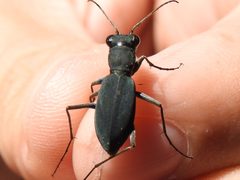
Dromochorus are distinguished from other North American tiger beetles by their flightless condition, reduced or absent hind wings, and typically dark, often velvety or (frosted) . D. pruinina can be separated from the similar D. belfragei by its smooth elytral surface versus the granulated elytra of D. belfragei; these species overlap geographically in central Texas without apparent intergradation. The is further characterized by small body size relative to many other tiger beetles and a tendency toward activity patterns.
Images
Habitat
in this occupy open, sparsely vegetated with exposed soil surfaces, including eroded clay roadsides, red clay slopes, gypsum hills, and talus slopes. The Missouri of D. pruinina is restricted to eroding clay banks along a 2.5-mile stretch of roadside in Knob Noster State Park. Suitable habitat appears to require a patchwork of barren slopes with minimal woody vegetation and specific soil characteristics that may not be present in recently formed anthropogenic habitats.
Distribution
The Dromochorus is distributed in the south-central United States (Kansas, Oklahoma, Texas, Missouri) and northern Mexico. Individual have varying ranges: D. pruinina occurs from Kansas and Oklahoma through Texas, with a highly disjunct in west-central Missouri; D. belfragei is found in Texas; other species have more restricted ranges in Texas and adjacent areas. The Missouri population of D. pruinina is separated from the nearest Kansas population by approximately 75-100 miles.
Seasonality
of D. pruinina have been observed to be most active in the few hours before dusk, showing a distinct activity pattern. In Oklahoma, adults have been found in early June. The timing of adult and peak activity for other in the has not been well documented.
Life Cycle
The larva of D. pruinina was described for the first time in 2008; previously, stages were unknown for this . Larvae construct burrows in the soil, as is typical for tiger beetles. Details of laying, larval development duration, , and strategies remain poorly documented for most species in the .
Behavior
Members of this are flightless and rely on rapid running to escape disturbance. D. pruinina runs swiftly between clumps of vegetation and disappears into cracks in the soil or dense grass tussocks when approached. Individuals are highly secretive, easily overlooked, and difficult to capture despite their flightlessness. When pursued in open areas, they repeatedly attempt to access crevices or vegetation cover and show little tendency to settle even after prolonged disturbance.
Human Relevance
Several Dromochorus are of conservation concern due to restricted distributions and specialization. Dromochorus pruinina is listed as S1 (critically imperiled) in Missouri, the highest state conservation ranking, based on its extreme geographic restriction to a single 2.5-mile roadside segment and small size (38 documented in intensive surveys). The species has been the subject of targeted conservation efforts including habitat maintenance through mowing and potential expansion of suitable open grassland habitats. Other species in the may warrant similar attention given their limited ranges.
Similar Taxa
- Cylindera celeripesAnother flightless, rapidly running tiger with restricted distribution in the Great Plains; shares secretive habits and preference for open clay , but distinguished by different body form and elytral patterning
- Dromochorus belfrageiSimilar dark, appearance and flightless habit; distinguished from D. pruinina by granulated versus smooth elytral surface, with distributions overlapping in central Texas
More Details
Taxonomic History
Dromochorus pruinina has been treated variously as a full or as a synonym or of D. belfragei by different authors. Current consensus based on elytral and lack of intergradation supports species-level status, though this remains a subject of some historical disagreement in the literature.
Conservation Management
The entire Missouri of D. pruinina occurs within Knob Noster State Park, providing some protection through state stewardship. However, true long-term security likely requires significant expansion of suitable area beyond the current 2.5-mile extent, potentially through conversion of forested areas to open grasslands with appropriate soil and structural conditions.
Sources and further reading
- BugGuide
- Wikipedia
- GBIF taxonomy match
- iNaturalist taxon
- NCBI Taxonomy
- Catalogue of Life
- Dromochorus pruinina is not extirpated in Missouri… yet! | Beetles In The Bush
- Dromochorus pruinina in Oklahoma | Beetles In The Bush
- Larval Description of Cicindela (Dromochorus) pruinina (Casey) (Coleoptera: Carabidae: Cicindelinae) with Notes on Habitat and Adult Behavior