
Dromochorus pruininus
Casey, 1897
Frosted Dromo Tiger Beetle
Dromochorus pruininus is a small, flightless tiger with a highly restricted and disjunct distribution across the south-central United States. The inhabits exposed clay and gypsum slopes with sparse vegetation, where it runs swiftly between grass clumps to escape detection. Long considered a synonym of D. belfragei, it was reinstated as a valid species based on smooth contrasting with the granulated surface of its . The species exhibits activity patterns and remains one of North America's most poorly known tiger beetles, with larvae described only in 2008.
Pronunciation
How to pronounce Dromochorus pruininus: //ˌdroʊmoʊˈkɔrəs pruːˈɪnaɪnəs//
These audio files are automatically generated. While they are not always 100% accurate, they are a good starting point.
Identification
Distinguished from D. belfragei by smooth elytral surface versus granulated texture; the two occur sympatrically in central Texas without intergradation. Distinguished from Cylindera celeripes by larger size and different preferences (clay/gypsum slopes versus sandy areas). Flightlessness and rapid running between vegetation clumps are field characteristics, though these traits are shared with other Dromochorus and some Cylindera species.
Images
Appearance
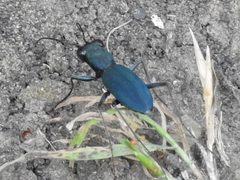
Small tiger with smooth, matte-finished that exhibit a satin to velvety sheen; in low light appears velvety, while flash photography reveals a faint purplish band along the outer elytral margin. Body coloration predominantly black. Distinguished from D. belfragei by smooth rather than granulated elytral surface. Larger than Cylindera celeripes but smaller than many common tiger beetles.
Habitat
Exposed red clay and gypsum slopes with sparse vegetation; lower talus slopes and eroded clay banks. Vegetation cover is rank but patchy, with grass clumps interspersed among bare clay surfaces. Roadside embankments with similar clay substrate in some areas.
Distribution
South-central United States: primary range in Kansas, Oklahoma, and Texas; disjunct eastern in west-central Missouri (Knob Noster State Park area), separated by nearly 100 miles from main range. Western edge of known distribution in northwestern Oklahoma (Gloss Mountains area).
Seasonality
active in early June; most active in hours before dusk (). Likely spring-fall based on larval (third instars present in spring).
Life Cycle
Larval described in 2008; larvae construct burrows in clay substrate. Third instar larvae present in spring, suggesting spring-fall activity pattern. occurs in sealed burrow.
Behavior
Flightless; runs swiftly between clumps of vegetation to escape detection, often disappearing into grass or subterranean cracks. Extremely wary and difficult to approach; repeatedly attempts to crawl into soil cracks or vegetation cover when disturbed. Most active crepuscularly, particularly in hours before dusk. Does not readily settle after initial disturbance, continuing to run for extended periods when pursued.
Ecological Role
Predatory likely functioning as in clay slope ; specific prey relationships undocumented.
Human Relevance
Conservation concern due to extreme localization; ranked S1 (highest conservation priority) in Missouri due to single known occupying 2.5 mile stretch of roadside . Subject of targeted survey efforts. Difficult to photograph in field due to rapid escape ; often requires confinement for documentation.
Similar Taxa
- Dromochorus belfrageiFormerly considered ; distinguished by granulated versus smooth elytral surface. Occurs sympatrically in central Texas without intergradation.
- Cylindera celeripesShares flightlessness and rapid running , but smaller and associated with sandy rather than clay/gypsum .
Misconceptions
Long treated as synonym or of D. belfragei; molecular and morphological evidence now supports specific status. Secretive nature has led to underreporting and assumption of rarity beyond actual distribution limits.
More Details
Taxonomic history
Casey (1897) described as Cicindela pruinina; later transferred to Dromochorus. Freitag (1999) and Pearson et al. (2006) treated as synonym of D. belfragei; reinstated as valid by Spomer et al. (2008) and Erwin & Pearson (2008) based on smooth and lack of intergradation in sympatry.
Conservation status
Missouri S1 ranking represents state's highest conservation priority due to single localized ; no formal federal or IUCN status established.
Collection challenges
Extreme wariness and rapid escape into vegetation or subterranean refugia make field photography exceptionally difficult; hand-capture required due to flightlessness, with success dependent on understanding escape and persistent pursuit.